SUNY Upstate Medical University, Syracuse, New York, USA.
Diabetes Care. 2011 Feb;34(2):274-9. doi: 10.2337/dc10-1346.
The Informatics for Diabetes Education and Telemedicine (IDEATel) project randomized ethnically diverse underserved older adults with diabetes to a telemedicine intervention or usual care. Intervention participants had lower A1C levels over 5 years. New analyses were performed to help better understand this difference.
IDEATel randomized Medicare beneficiaries with diabetes (n = 1,665) to receive home video visits with a diabetes educator and upload glucose levels every 4-6 weeks or usual care (2000-2007). Annual measurements included BMI, A1C (primary outcome), and completion of questionnaires. Mixed-model analyses were performed using random effects to adjust for clustering within primary care physicians.
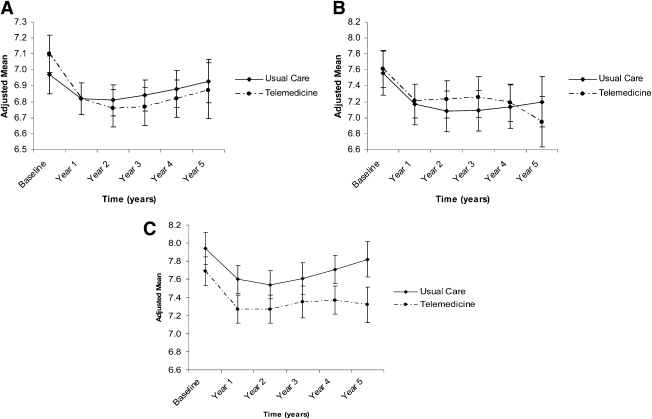
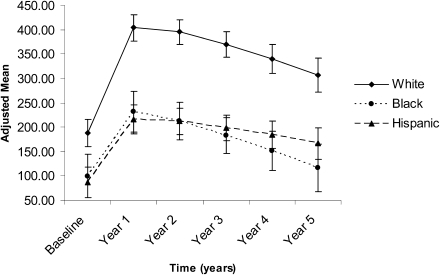
At baseline, A1C levels (mean ± SD) were 7.02 ± 1.25% in non-Hispanic whites (n = 821), 7.58 ± 1.78% in non-Hispanic blacks (n = 248), and 7.79 ± 1.68% in Hispanics (n = 585). Over time, lower A1C levels were associated with more glucose uploads (P = 0.02) and female sex (P = 0.002). Blacks, Hispanics, and insulin-users had higher A1C levels than non-Hispanic whites (P < 0.0001). BMI was not associated with A1C levels. Blacks and Hispanics had significantly fewer uploads than non-Hispanic whites over time. Hispanics had the highest baseline A1C levels and showed the greatest improvement in the intervention, but, unlike non-Hispanic whites, Hispanics did not achieve A1C levels <7.0% at 5 years.
Racial/ethnic disparities were observed in this cohort of underserved older adults with diabetes. The IDEATel telemedicine intervention was associated with improvement in glycemic control, particularly in Hispanics, who had the highest baseline A1C levels, suggesting that telemedicine has the potential to help reduce disparities in diabetes management.
糖尿病教育和远程医疗信息学(IDEATel)项目将具有种族多样性的医疗服务不足的老年糖尿病患者随机分为远程医疗干预组或常规护理组。干预组参与者在 5 年内的 A1C 水平较低。进行了新的分析以帮助更好地理解这一差异。
IDEATel 将医疗保险受益人与糖尿病患者(n=1665)随机分为接受家庭视频访问的糖尿病教育者和每 4-6 周上传一次血糖水平的组或常规护理组(2000-2007 年)。每年的测量指标包括 BMI、A1C(主要结果)和完成问卷。使用随机效应进行混合模型分析,以调整初级保健医生内的聚类。
在基线时,非西班牙裔白种人(n=821)的 A1C 水平(平均值±标准差)为 7.02±1.25%,非西班牙裔黑种人(n=248)为 7.58±1.78%,西班牙裔(n=585)为 7.79±1.68%。随着时间的推移,较低的 A1C 水平与更多的血糖上传次数(P=0.02)和女性性别(P=0.002)相关。黑人、西班牙裔和使用胰岛素的患者的 A1C 水平高于非西班牙裔白人(P<0.0001)。BMI 与 A1C 水平无关。随着时间的推移,黑人患者和西班牙裔患者的上传次数明显少于非西班牙裔白人患者。西班牙裔患者的基线 A1C 水平最高,在干预中改善最大,但与非西班牙裔白人不同,西班牙裔患者在 5 年内未达到 A1C<7.0%的水平。
在这个医疗服务不足的老年糖尿病患者队列中观察到了种族/民族差异。IDEATel 远程医疗干预与血糖控制的改善相关,特别是在西班牙裔患者中,他们的基线 A1C 水平最高,这表明远程医疗有可能有助于减少糖尿病管理中的差异。