Key Laboratory of Combined Multi-Organ Transplantation, Ministry of Public Health, First Affiliated Hospital, School of Medicine, Zhejiang University, Hangzhou, China.
PLoS One. 2011 Jan 25;6(1):e16521. doi: 10.1371/journal.pone.0016521.
ABO-incompatible live transplantation (ILT) is not occasionally performed due to a relative high risk of graft failure. Knowledge of both graft and patient survival rate after ILT is essential for donor selection and therapeutic strategy. We systematically reviewed studies containing outcomes after ILT compared to that after ABO-compatible liver transplantation (CLT).
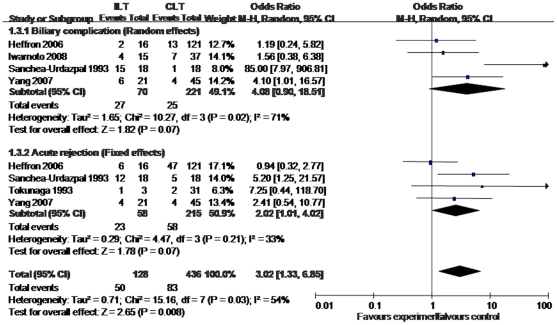
METHODOLOGY/PRINCIPAL FINDINGS: We carried out a comprehensive search strategy on MEDLINE (1966-July 2010), EMBASE (1980-July 2010), Biosis Preview (1969-July 2010), Science Citation Index (1981-July 2010), Cochrane Database of Systematic Reviews (Cochrane Library, issue 7, 2010) and the National Institute of Health (July 2010). Two reviewers independently assessed the quality of each study and abstracted outcome data. Fourteen eligible studies were included which came from various medical centers all over the world. Meta-analysis results showed that no significantly statistical difference was found in pediatric graft survival rate, pediatric and adult patient survival rate between ILT and CLT group. In adult subgroup, the graft survival rate after ILT was significantly lower than that after CLT. The value of totally pooled OR was 0.64 (0.55, 0.74), 0.92 (0.62, 1.38) for graft survival rate and patient survival rate respectively. The whole complication incidence (including acute rejection and biliary complication) after ILT was higher than that after CLT, as the value of totally pooled OR was 3.02 (1.33, 6.85). Similarly, in acute rejection subgroup, the value of OR was 2.02 (1.01, 4.02). However, it was 4.08 (0.90, 18.51) in biliary complication subgroup.
CONCLUSIONS/SIGNIFICANCE: In our view, pediatric ILT has not been a contraindication anymore due to a similar graft and patient survival rate between ILT and CLT group. Though adult graft survival rate is not so satisfactory, ILT is undoubtedly life-saving under exigent condition. Most studies included in our analysis are observational researches. Larger scale of researches and Randomized-Control Studies are still needed.
由于移植物失功的相对高风险,ABO 不相容活体移植(ILT)并非偶尔进行。了解 ILT 后移植物和患者的存活率对于供者选择和治疗策略至关重要。我们系统地回顾了比较 ILT 后与 ABO 相容肝移植(CLT)后结果的研究。
方法/主要发现:我们在 MEDLINE(1966 年-2010 年 7 月)、EMBASE(1980 年-2010 年 7 月)、Biosis Preview(1969 年-2010 年 7 月)、Science Citation Index(1981 年-2010 年 7 月)、Cochrane 系统评价数据库(Cochrane 图书馆,第 7 期,2010 年)和美国国立卫生研究院(2010 年 7 月)上进行了全面的检索策略。两名评审员独立评估了每项研究的质量并提取了结果数据。纳入了来自世界各地不同医疗中心的 14 项合格研究。荟萃分析结果显示,ILT 组与 CLT 组在儿科移植物存活率、儿科和成年患者存活率方面无显著统计学差异。在成年亚组中,ILT 后移植物存活率明显低于 CLT 后。总合并 OR 值分别为 0.64(0.55,0.74)和 0.92(0.62,1.38)。ILT 后总的并发症发生率(包括急性排斥和胆系并发症)高于 CLT 后,总合并 OR 值为 3.02(1.33,6.85)。同样,在急性排斥亚组中,OR 值为 2.02(1.01,4.02)。然而,在胆系并发症亚组中,OR 值为 4.08(0.90,18.51)。
结论/意义:在我们看来,由于 ILT 组与 CLT 组的移植物和患者存活率相似,儿科 ILT 不再是禁忌。尽管成人移植物存活率并不令人满意,但在紧急情况下,ILT 无疑是救命的。我们分析中纳入的大多数研究都是观察性研究。仍然需要更大规模的研究和随机对照研究。