Department of Ecology, University of Granada, Granada, Spain.
PLoS One. 2011 Jan 25;6(1):e16143. doi: 10.1371/journal.pone.0016143.
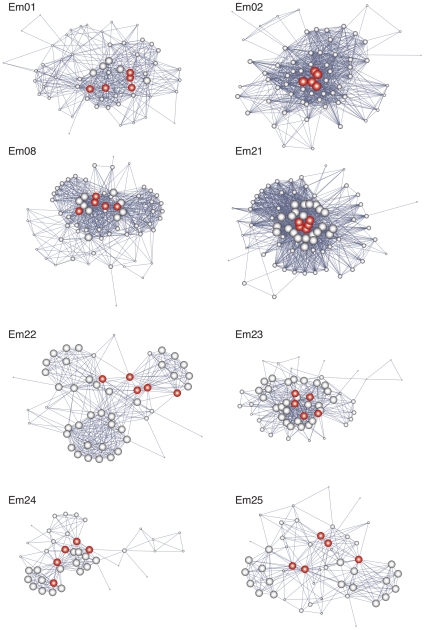
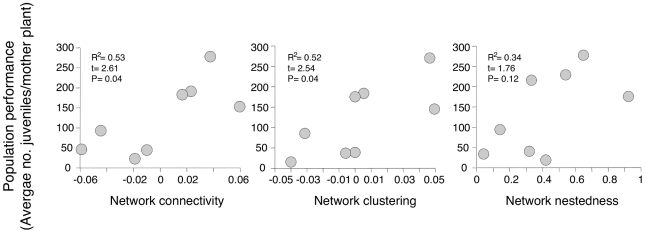
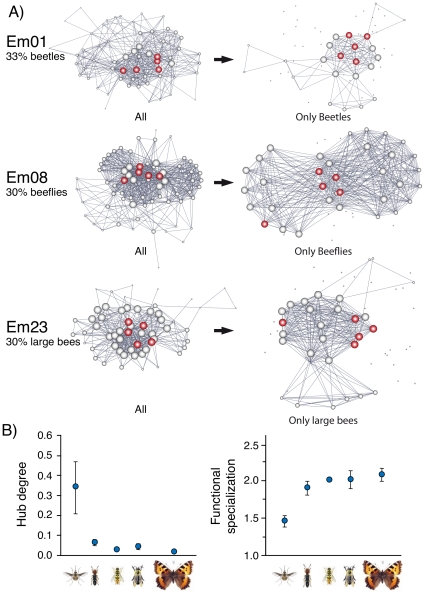
The architecture and properties of many complex networks play a significant role in the functioning of the systems they describe. Recently, complex network theory has been applied to ecological entities, like food webs or mutualistic plant-animal interactions. Unfortunately, we still lack an accurate view of the relationship between the architecture and functioning of ecological networks. In this study we explore this link by building individual-based pollination networks from eight Erysimum mediohispanicum (Brassicaceae) populations. In these individual-based networks, each individual plant in a population was considered a node, and was connected by means of undirected links to conspecifics sharing pollinators. The architecture of these unipartite networks was described by means of nestedness, connectivity and transitivity. Network functioning was estimated by quantifying the performance of the population described by each network as the number of per-capita juvenile plants produced per population. We found a consistent relationship between the topology of the networks and their functioning, since variation across populations in the average per-capita production of juvenile plants was positively and significantly related with network nestedness, connectivity and clustering. Subtle changes in the composition of diverse pollinator assemblages can drive major consequences for plant population performance and local persistence through modifications in the structure of the inter-plant pollination networks.
许多复杂网络的结构和特性在它们所描述的系统的功能中起着重要作用。最近,复杂网络理论已经被应用于生态实体,如食物网或互利的动植物相互作用。不幸的是,我们仍然缺乏对生态网络结构和功能之间关系的准确认识。在这项研究中,我们通过构建八个西班牙旱芹(十字花科)种群的基于个体的传粉网络来探索这种联系。在这些基于个体的网络中,种群中的每个个体植物都被视为一个节点,并通过无向链接与共享传粉者的同种植物相连。这些非二分法网络的结构通过嵌套、连通性和传递性来描述。通过量化每个网络所描述的种群的性能,即每个种群产生的每株植物的个体数量,来估计网络的功能。我们发现网络的拓扑结构与其功能之间存在一致的关系,因为种群之间平均每株植物个体产量的变化与网络嵌套、连通性和聚类呈正相关且显著相关。不同传粉者组合的组成变化可以通过改变植物间传粉网络的结构,对植物种群的表现和局部持久性产生重大影响。