Medical Research Center, Guangdong Provincial Cardiovascular Institute, Guangdong General Hospital, Guangdong Academy of Medical Sciences, Guangzhou, People's Republic of China.
PLoS One. 2011 Jan 25;6(1):e16239. doi: 10.1371/journal.pone.0016239.
Diabetes has been regarded as an inflammatory condition which is associated with left ventricular diastolic dysfunction (LVDD). The purpose of this study was to examine the expression levels of macrophage migration inhibitory factor (MIF) and G protein-coupled receptor kinase 2 (GRK2) in patients with early diabetic cardiomyopathy, and to investigate the mechanisms involved in MIF expression and GRK2 activation.
83 patients in the age range of 30-64 years with type 2 diabetes and 30 matched healthy men were recruited. Left ventricular diastolic function was evaluated by cardiac Doppler echocardiography. Plasma MIF levels were determined by ELISA. To confirm the clinical observation, we also studied MIF expression in prediabetic rats with impaired glucose tolerance (IGT) and relationship between MIF and GRK2 expression in H9C2 cardiomyoblasts exposed to high glucose.
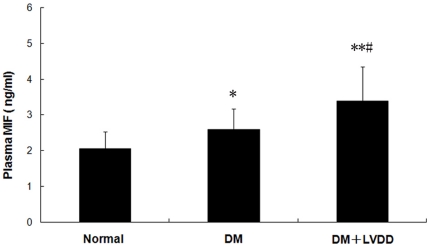
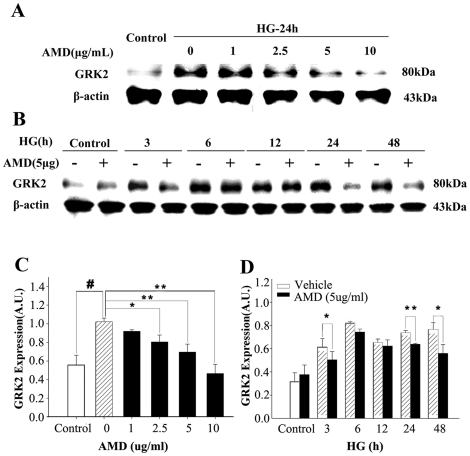
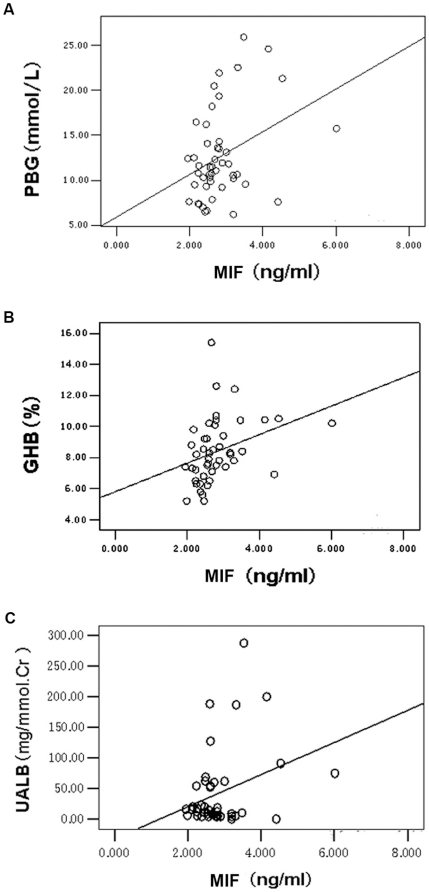
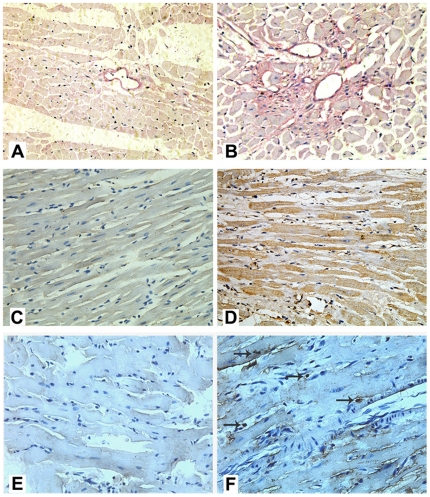
Compared with healthy subjects, patients with diabetes have significantly increased levels of plasma MIF which was further increased in diabetic patients with Left ventricular diastolic dysfunction (LVDD). The increased plasma MIF levels in diabetic patients correlated with plasma glucose, glycosylated hemoglobin and urine albumin levels. We observed a significant number of TUNEL-positive cells in the myocardium of IGT-rats but not in the control rats. Moreover, we found higher MIF expression in the heart of IGT with cardiac dysfunction compared to that of the controls. In H9C2 cardiomyoblast cells, MIF and GRK2 expression was significantly increased in a glucose concentration-dependant manner. Furthermore, GRK2 expression was abolished by siRNA knockdown of MIF and by the inhibition of CXCR4 in H9C2 cells.
Our findings indicate that hyperglycemia is a causal factor for increased levels of pro-inflammatory cytokine MIF which plays a role in the development of cardiomyopathy occurring in patients with type 2 diabetes. The elevated levels of MIF are associated with cardiac dysfunction in diabetic patients, and the MIF effects are mediated by GRK2.
糖尿病被认为是一种炎症状态,与左心室舒张功能障碍(LVDD)有关。本研究旨在探讨早期糖尿病心肌病患者中巨噬细胞移动抑制因子(MIF)和 G 蛋白偶联受体激酶 2(GRK2)的表达水平,并探讨 MIF 表达和 GRK2 激活的机制。
招募了 83 名年龄在 30-64 岁之间的 2 型糖尿病患者和 30 名匹配的健康男性。通过心脏多普勒超声心动图评估左心室舒张功能。通过 ELISA 测定血浆 MIF 水平。为了证实临床观察,我们还研究了糖耐量受损(IGT)的糖尿病前期大鼠中 MIF 的表达以及高糖暴露的 H9C2 心肌细胞中 MIF 与 GRK2 表达之间的关系。
与健康受试者相比,糖尿病患者的血浆 MIF 水平显著升高,而左心室舒张功能障碍(LVDD)的糖尿病患者血浆 MIF 水平进一步升高。糖尿病患者的血浆 MIF 水平升高与血浆葡萄糖、糖化血红蛋白和尿白蛋白水平相关。我们观察到 IGT 大鼠心肌中有大量 TUNEL 阳性细胞,但对照组大鼠中没有。此外,我们发现心脏功能障碍的 IGT 大鼠心脏中的 MIF 表达高于对照组。在 H9C2 心肌细胞中,MIF 和 GRK2 的表达呈葡萄糖浓度依赖性增加。此外,通过 siRNA 敲低 MIF 和抑制 H9C2 细胞中的 CXCR4,GRK2 的表达被抑制。
我们的研究结果表明,高血糖是促炎细胞因子 MIF 水平升高的一个因果因素,MIF 在 2 型糖尿病患者发生心肌病中起作用。糖尿病患者中 MIF 水平升高与心脏功能障碍相关,MIF 作用是通过 GRK2 介导的。