Dept. of Molecular and Cell Biology, 385 LSA, University of California, Berkeley, CA 94720-3200, USA.
Dev Biol. 2011 May 1;353(1):120-33. doi: 10.1016/j.ydbio.2011.01.031. Epub 2011 Feb 3.
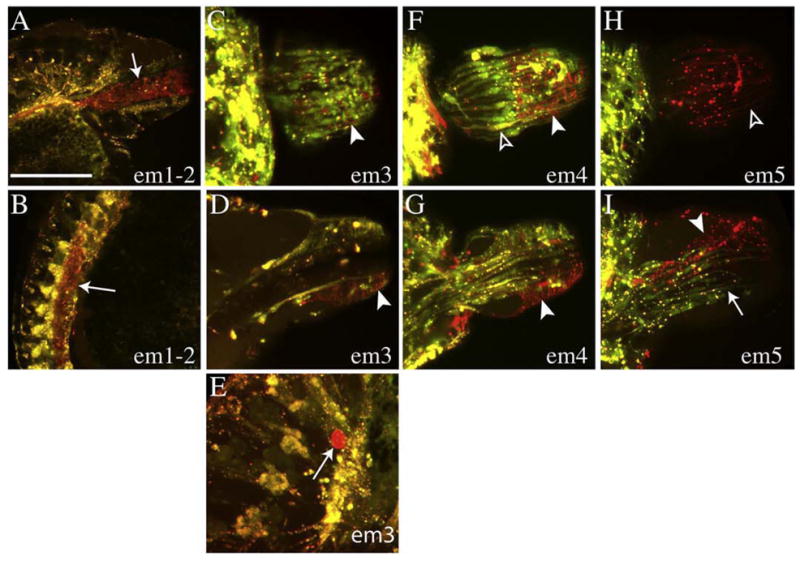
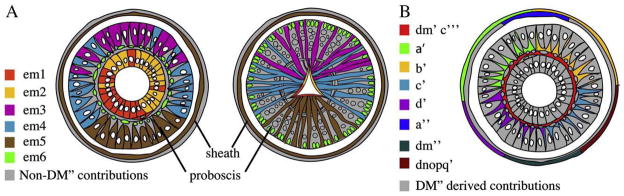
The super-phylum Lophotrochozoa contains the plurality of extant animal phyla and exhibits a corresponding diversity of adult body plans. Moreover, in contrast to Ecdysozoa and Deuterostomia, most lophotrochozoans exhibit a conserved pattern of stereotyped early divisions called spiral cleavage. In particular, bilateral mesoderm in most lophotrochozoan species arises from the progeny of micromere 4d, which is assumed to be homologous with a similar cell in the embryo of the ancestral lophotrochozoan, more than 650 million years ago. Thus, distinguishing the conserved and diversified features of cell fates in the 4d lineage among modern spiralians is required to understand how lophotrochozoan diversity has evolved by changes in developmental processes. Here we analyze cell fates for the early progeny of the bilateral daughters (M teloblasts) of micromere 4d in the leech Helobdella sp. Austin, a clitellate annelid. We show that the first six progeny of the M teloblasts (em1-em6) contribute five different sets of progeny to non-segmental mesoderm, mainly in the head and in the lining of the digestive tract. The latter feature, associated with cells em1 and em2 in Helobdella, is seen with the M teloblast lineage in a second clitellate species, the sludgeworm Tubifex tubifex and, on the basis of previously published work, in the initial progeny of the M teloblast homologs in molluscan species, suggesting that it may be an ancestral feature of lophotrochozoan development.
超门有领动物含有多数现存动物门,并且表现出相应的成年身体模式多样性。此外,与节肢动物和后口动物相反,大多数有领动物表现出保守的定型早期分裂模式,称为螺旋分裂。特别是,大多数有领动物物种的双侧中胚层来自微分裂 4d 的后代,微分裂 4d 被认为与 6500 多万年前的祖先有领动物胚胎中的类似细胞同源。因此,要理解有领动物多样性如何通过发育过程的变化而进化,就需要区分现代螺旋动物中 4d 谱系细胞命运的保守和多样化特征。在这里,我们分析了环节动物蛭形蚓属 Helobdella sp. Austin 的微分裂 4d 双侧后代(M 原生殖细胞)的早期后代的细胞命运。我们表明,M 原生殖细胞的前六个后代(em1-em6)将五个不同的后代组贡献给非节段中胚层,主要在头部和消化道内壁。在蛭形蚓属中与细胞 em1 和 em2 相关的后一个特征,在第二个环节动物种类,淤泥蠕虫 Tubifex tubifex 的 M 原生殖细胞谱系中可见,并且基于以前的研究工作,在软体动物物种的 M 原生殖细胞同源物的初始后代中可见,这表明它可能是有领动物发育的一个祖先特征。