Peng Cong, Chen Yaoyu, Li Dongguang, Li Shaoguang
Division of Hematology/Oncology, Department of Medicine, University of Massachusetts Medical School, 364 Plantation Street, Worcester, MA 01605, USA.
School of Computer and Security Science, Edith Cowan University, 2 Bradford Street, Mount Lawley, WA 6050, Australia.
Oncotarget. 2010 Jun;1(2):156-160. doi: 10.18632/oncotarget.119.
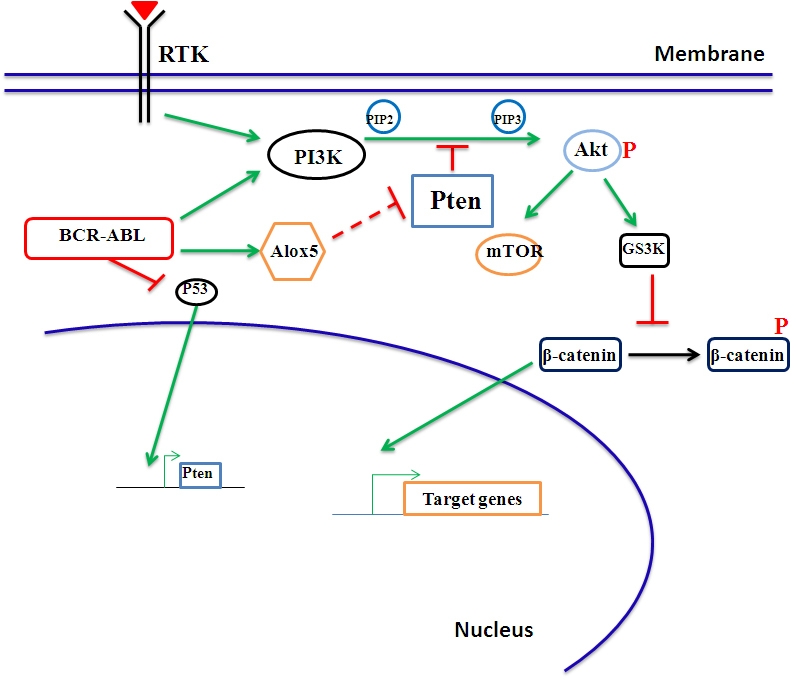
Chronic myeloid leukemia (CML) is initiated from the BCR-ABL-expressing leukemia stem cells (LSCs). These LSCs are highly resistant to BCR-ABL kinase inhibitors, imatinib, dasantinib and nilotinib, and methods for eradication of LSCs are still not available. It is critical to identify genes that play roles in survival and proliferation of LSCs. We recently discovered that the tumor suppressor gene Pten is downregulated in LSCs of CML mice. By genetic deletion or overexpression of Pten, we confirmed that Pten functions as a tumor suppressor in LSCs of CML, consistent with the role of Pten in LSCs of acute myeloid leukemia (AML) and progenitor cells of T-ALL progenitors. Functional enhancement of the Pten pathway provides a therapeutic strategy for targeting LSCs.
慢性髓性白血病(CML)由表达BCR-ABL的白血病干细胞(LSC)引发。这些LSC对BCR-ABL激酶抑制剂伊马替尼、达沙替尼和尼洛替尼具有高度抗性,且仍不存在根除LSC的方法。识别在LSC存活和增殖中起作用的基因至关重要。我们最近发现,肿瘤抑制基因Pten在CML小鼠的LSC中表达下调。通过对Pten进行基因缺失或过表达,我们证实Pten在CML的LSC中发挥肿瘤抑制作用,这与Pten在急性髓性白血病(AML)的LSC和T-ALL祖细胞中的作用一致。Pten通路的功能增强为靶向LSC提供了一种治疗策略。