School of Computing, University of Leeds, Leeds, United Kingdom.
PLoS Comput Biol. 2011 Jan 27;7(1):e1001063. doi: 10.1371/journal.pcbi.1001063.
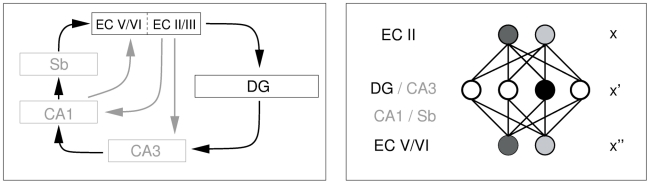
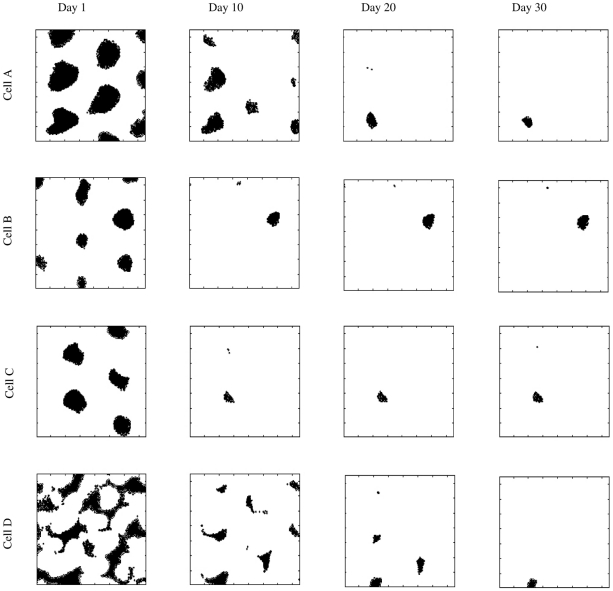
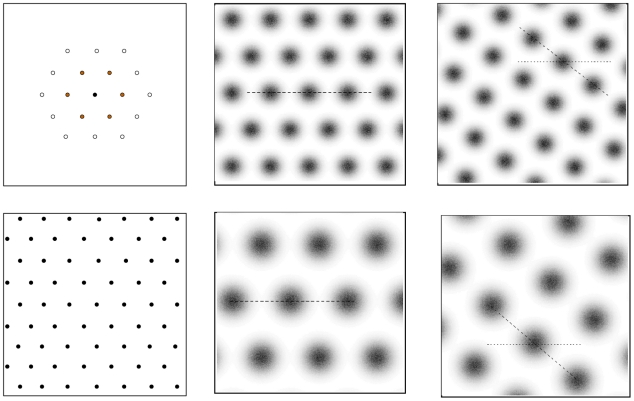
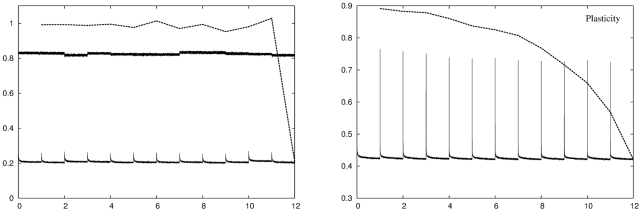
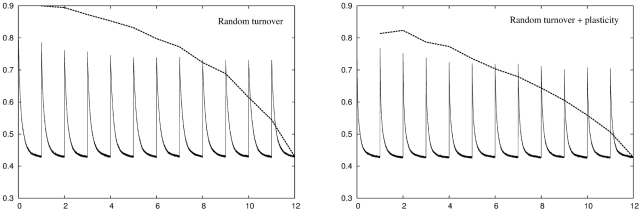
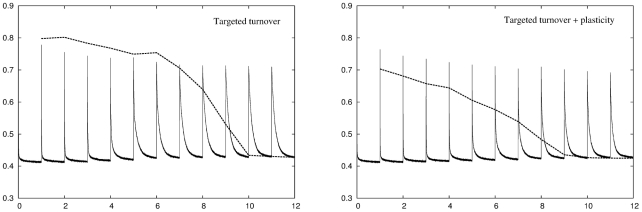
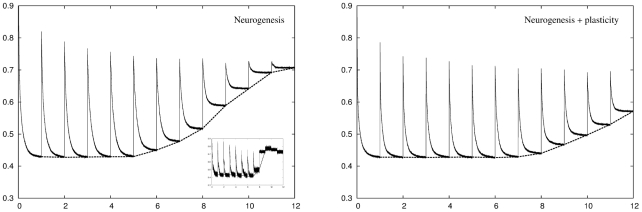
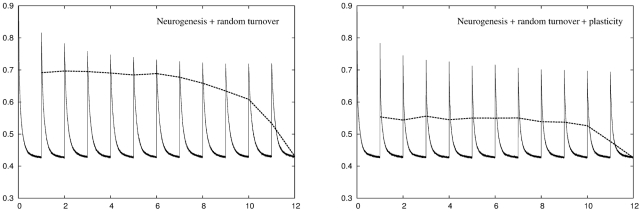
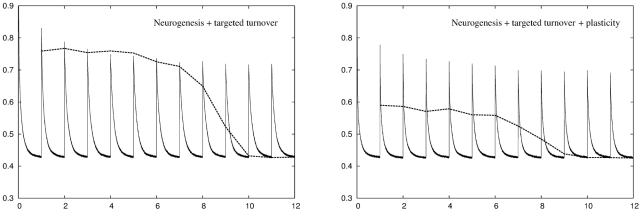
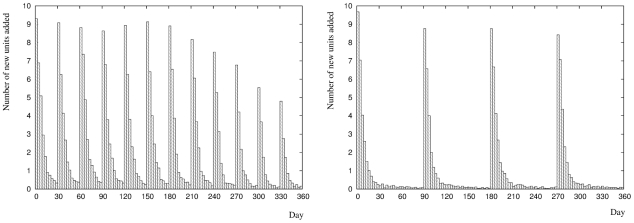
Recently, we presented a study of adult neurogenesis in a simplified hippocampal memory model. The network was required to encode and decode memory patterns despite changing input statistics. We showed that additive neurogenesis was a more effective adaptation strategy compared to neuronal turnover and conventional synaptic plasticity as it allowed the network to respond to changes in the input statistics while preserving representations of earlier environments. Here we extend our model to include realistic, spatially driven input firing patterns in the form of grid cells in the entorhinal cortex. We compare network performance across a sequence of spatial environments using three distinct adaptation strategies: conventional synaptic plasticity, where the network is of fixed size but the connectivity is plastic; neuronal turnover, where the network is of fixed size but units in the network may die and be replaced; and additive neurogenesis, where the network starts out with fewer initial units but grows over time. We confirm that additive neurogenesis is a superior adaptation strategy when using realistic, spatially structured input patterns. We then show that a more biologically plausible neurogenesis rule that incorporates cell death and enhanced plasticity of new granule cells has an overall performance significantly better than any one of the three individual strategies operating alone. This adaptation rule can be tailored to maximise performance of the network when operating as either a short- or long-term memory store. We also examine the time course of adult neurogenesis over the lifetime of an animal raised under different hypothetical rearing conditions. These growth profiles have several distinct features that form a theoretical prediction that could be tested experimentally. Finally, we show that place cells can emerge and refine in a realistic manner in our model as a direct result of the sparsification performed by the dentate gyrus layer.
最近,我们在简化的海马记忆模型中研究了成人神经发生。该网络需要在输入统计数据发生变化的情况下对记忆模式进行编码和解码。我们表明,与神经元更替和传统的突触可塑性相比,加性神经发生是一种更有效的适应策略,因为它允许网络响应输入统计数据的变化,同时保留早期环境的表示。在这里,我们将我们的模型扩展到包括在海马旁回中的网格细胞形式的现实、空间驱动的输入发射模式。我们使用三种不同的适应策略在一系列空间环境中比较网络性能:传统的突触可塑性,其中网络是固定大小的,但连接是可塑的;神经元更替,其中网络是固定大小的,但网络中的单元可能死亡并被替换;以及加性神经发生,其中网络开始时具有较少的初始单元,但随着时间的推移而增长。我们确认,当使用现实的、空间结构化的输入模式时,加性神经发生是一种优越的适应策略。然后,我们表明,一种更具生物学合理性的神经发生规则,即包含细胞死亡和新颗粒细胞的增强可塑性,其整体性能明显优于任何一种单独作用的三种策略。这种适应规则可以根据网络作为短期或长期记忆存储的操作来进行调整,以最大限度地提高性能。我们还研究了在不同假设的饲养条件下饲养的动物一生中的成年神经发生的时间过程。这些生长曲线具有几个不同的特征,形成了一个可以通过实验测试的理论预测。最后,我们表明,由于齿状回层的稀疏化,位置细胞可以以现实的方式在我们的模型中出现并细化。