Department of Biomedical Sciences and Advanced Therapy, University of Ferrara, Ferrara, Italy.
PLoS One. 2011 Jan 26;6(1):e14595. doi: 10.1371/journal.pone.0014595.
In a previous study, we found that when required to imagine another person performing an action, participants reported a higher correspondence between their own handedness and the hand used by the imagined person when the agent was seen from the back compared to when the agent was seen from the front. This result was explained as evidence of a greater involvement of motor areas in the back-view perspective, possibly indicating a greater proneness to put oneself in the agent's shoes in such a condition. In turn, the proneness to put oneself in another's shoes could also be considered as a cue of greater identification with the other, that is a form of empathy. If this is the case, the proportion of lateral matches vs mismatches should be different for subjects with high and low self-reported empathy. In the present study, we aimed at testing this hypothesis.
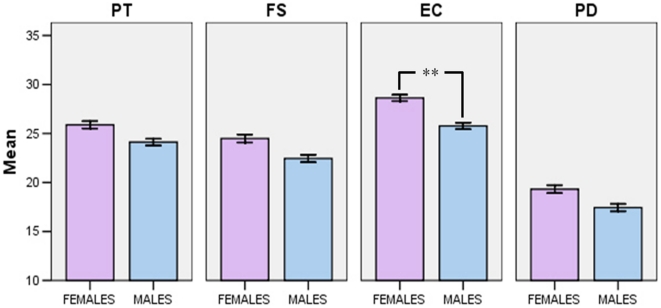
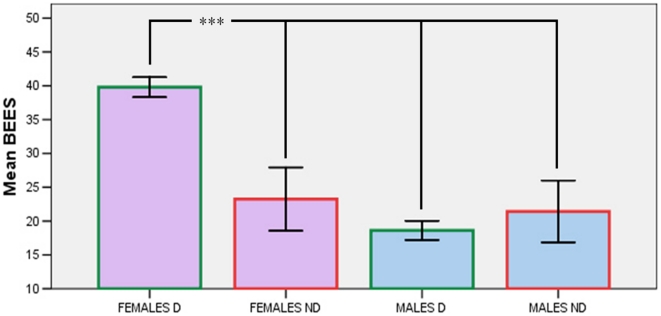
METHODOLOGY/PRINCIPAL FINDINGS: Participants were required to imagine a person performing a single manual action in a back view and to indicate the hand used by the imagined person during movement execution. Consistent with our hypothesis, the proportion of matching between the handedness of participants and the handedness of agents imagined was higher for participants scoring high in a self-report measure of empathy. Importantly, this relationship was specific for females.
CONCLUSIONS/SIGNIFICANCE: At least for females, our data seem to corroborate the idea of a link between self-reported empathy and motor identification with imagined agents. This sex-specific result is consistent with neuroimaging studies indicating a stronger involvement of action representations during emotional and empathic processing in females than in males. In sum, our findings underline the possibility of employing behavioral research as a test-bed for theories deriving from functional studies suggesting a link between empathic processing and the activation of motor-related areas.
在之前的研究中,我们发现当被要求想象另一个人执行一个动作时,与从正面观察被试者相比,参与者报告自己的惯用手与从背面观察到的被试者所使用的手之间的一致性更高。这一结果被解释为后视图中运动区域参与度更高的证据,这可能表明在这种情况下,人们更容易设身处地为他人着想。反过来,设身处地为他人着想也可以被认为是与他人更认同的一种暗示,即一种同理心的形式。如果是这样,那么自我报告的同理心水平较高和较低的被试者,其左右匹配与不匹配的比例应该有所不同。在本研究中,我们旨在检验这一假设。
方法/主要发现:要求参与者想象一个人从背面执行一个单一的手动动作,并在运动执行过程中指示被试者所使用的手。与我们的假设一致,在自我报告的同理心测量中得分较高的被试者中,参与者的惯用手与被试者想象中的惯用手之间的匹配比例更高。重要的是,这种关系是特定于女性的。
结论/意义:至少对于女性来说,我们的数据似乎支持自我报告的同理心和与想象中的代理人的运动认同之间存在联系的观点。这种性别特异性的结果与神经影像学研究一致,这些研究表明,女性在情感和同理心处理过程中,动作表征的参与度强于男性。总之,我们的发现强调了将行为研究作为从功能研究中得出的理论的测试平台的可能性,这些理论表明同理心处理与运动相关区域的激活之间存在联系。