Foundation for Innovative New Diagnostics, Lumumba Avenue, Kampala, Uganda.
Malar J. 2011 Feb 8;10:30. doi: 10.1186/1475-2875-10-30.
Malaria rapid diagnostic tests (RDTs) are increasingly used by remote health personnel with minimal training in laboratory techniques. RDTs must, therefore, be as simple, safe and reliable as possible. Transfer of blood from the patient to the RDT is critical to safety and accuracy, and poses a significant challenge to many users. Blood transfer devices were evaluated for accuracy and precision of volume transferred, safety and ease of use, to identify the most appropriate devices for use with RDTs in routine clinical care.
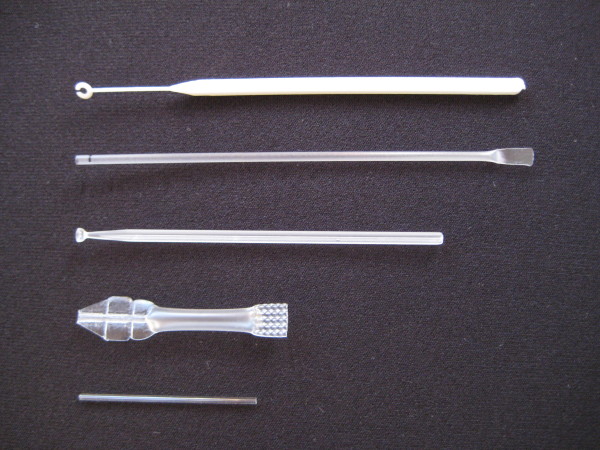
Five devices, a loop, straw-pipette, calibrated pipette, glass capillary tube, and a new inverted cup device, were evaluated in Nigeria, the Philippines and Uganda. The 227 participating health workers used each device to transfer blood from a simulated finger-prick site to filter paper. For each transfer, the number of attempts required to collect and deposit blood and any spilling of blood during transfer were recorded. Perceptions of ease of use and safety of each device were recorded for each participant. Blood volume transferred was calculated from the area of blood spots deposited on filter paper.
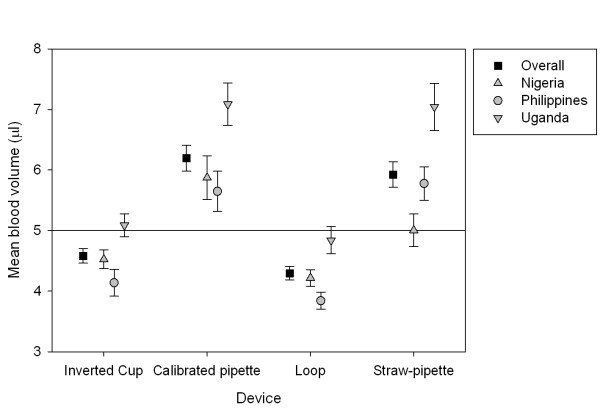
The overall mean volumes transferred by devices differed significantly from the target volume of 5 microliters (p < 0.001). The inverted cup (4.6 microliters) most closely approximated the target volume. The glass capillary was excluded from volume analysis as the estimation method used is not compatible with this device. The calibrated pipette accounted for the largest proportion of blood exposures (23/225, 10%); exposures ranged from 2% to 6% for the other four devices. The inverted cup was considered easiest to use in blood collection (206/226, 91%); the straw-pipette and calibrated pipette were rated lowest (143/225 [64%] and 135/225 [60%] respectively). Overall, the inverted cup was the most preferred device (72%, 163/227), followed by the loop (61%, 138/227).
The performance of blood transfer devices varied in this evaluation of accuracy, blood safety, ease of use, and user preference. The inverted cup design achieved the highest overall performance, while the loop also performed well. These findings have relevance for any point-of-care diagnostics that require blood sampling.
疟疾快速诊断检测(RDT)越来越多地被接受过最低限度实验室技术培训的远程卫生人员使用。因此,RDT 必须尽可能简单、安全和可靠。将血液从患者转移到 RDT 对于安全性和准确性至关重要,但对许多用户来说是一个重大挑战。评估了血液转移装置在转移体积的准确性和精密度、安全性和易用性方面的表现,以确定最适合在常规临床护理中与 RDT 一起使用的装置。
在尼日利亚、菲律宾和乌干达评估了 5 种装置,即环、吸管、校准吸管、玻璃毛细管和新型倒扣杯装置。227 名参与卫生工作者使用每种装置从模拟的指刺部位将血液转移到滤纸上。对于每次转移,记录收集和放置血液所需的尝试次数以及转移过程中血液的任何溢出情况。为每位参与者记录了对每种装置的易用性和安全性的看法。从滤纸沉积的血液斑点的面积计算转移的血液体积。
装置转移的总体平均体积与目标体积 5 微升(p<0.001)差异显著。倒扣杯(4.6 微升)最接近目标体积。由于所用的估计方法与该装置不兼容,因此玻璃毛细管被排除在体积分析之外。校准吸管占血液暴露比例最大(23/225,10%);其他四种装置的暴露范围从 2%到 6%不等。倒扣杯在血液采集方面被认为最容易使用(206/226,91%);吸管和校准吸管的评分最低(143/225[64%]和 135/225[60%])。总体而言,倒扣杯是最受欢迎的装置(72%,163/227),其次是环(61%,138/227)。
在准确性、血液安全性、易用性和用户偏好的评估中,血液转移装置的性能存在差异。倒扣杯设计的总体性能最高,而环的性能也很好。这些发现对于任何需要采血的即时护理诊断都具有相关性。