Department of Oncology, Helsinki University Central Hospital, P.O. Box 180, HUS Helsinki 00029, Finland.
Br J Cancer. 2011 Feb 15;104(4):599-604. doi: 10.1038/bjc.2011.2. Epub 2011 Feb 8.
Hypertension (HTN) is a common toxicity of anti-VEGF (vascular endothelial growth factor) antibody treatment. It may be a marker of VEGF signalling pathway inhibition and therefore represent a cancer biomarker in metastatic colorectal cancer (mCRC) patients treated with chemotherapy and bevacizumab.
A total of 101 consecutive patients with mCRC were treated with standard chemotherapy combined with bevacizumab at dose of 2.5 mg kg(-1) per week in a single centre. The median follow-up time of the patients alive was 64 months. Blood pressure was measured before each bevacizumab infusion, and HTN was graded according to common toxicity criteria for adverse events version 3.0.
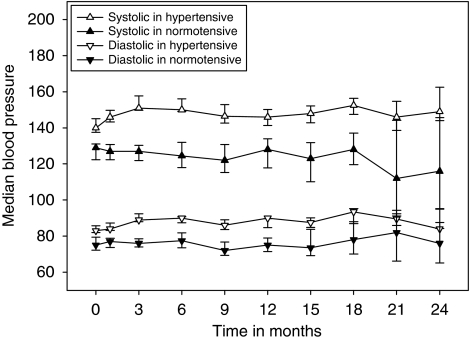
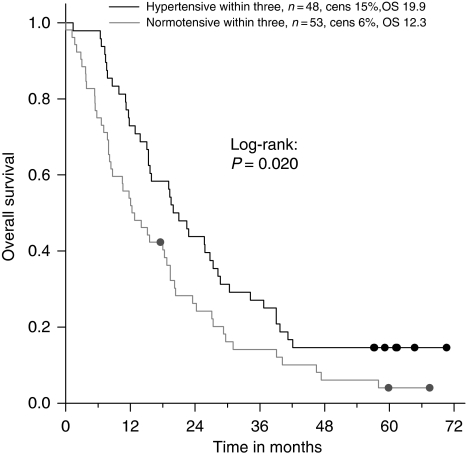
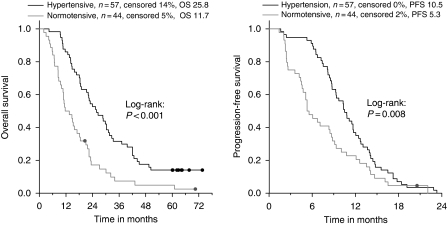
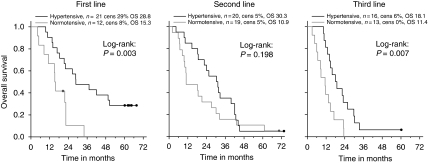
Overall, 57 patients (56%) developed ≥grade 1 HTN (median blood pressure 168/97 mm Hg), whereas 44 (44%) remained normotensive when treated with bevacizumab-containing chemotherapy regimen. Overall response rate was higher among patients with HTN (30 vs 20%; P=0.025). Hypertension was associated with improved progression-free survival (10.5 vs 5.3 months; P=0.008) and overall survival (25.8 vs 11.7 months; P<0.001), and development of HTN within 3 months had an independent, prognostic influence in a multivariate landmark survival analysis together with other known mCRC prognostic factors (P=0.007). There was no association between HTN and development of thromboembolic complications.
Hypertension may predict outcome of bevacizumab-containing chemotherapy in mCRC. These data require confirmation in prospective studies including pharmacodynamic and pharmacokinetic analyses.
高血压(HTN)是抗血管内皮生长因子(VEGF)抗体治疗的常见毒性。它可能是 VEGF 信号通路抑制的标志物,因此代表了接受化疗和贝伐珠单抗治疗的转移性结直肠癌(mCRC)患者的癌症生物标志物。
在一个中心,共有 101 例连续 mCRC 患者接受标准化疗联合贝伐珠单抗治疗,剂量为每周 2.5mg/kg。存活患者的中位随访时间为 64 个月。在每次贝伐珠单抗输注前测量血压,根据不良事件通用毒性标准 3.0 对高血压进行分级。
总体而言,57 例患者(56%)出现≥1 级高血压(中位血压 168/97mmHg),而 44 例患者(44%)在接受贝伐珠单抗联合化疗方案治疗时血压正常。高血压患者的总体反应率更高(30%比 20%;P=0.025)。高血压与无进展生存期(10.5 比 5.3 个月;P=0.008)和总生存期(25.8 比 11.7 个月;P<0.001)的改善相关,并且在多变量里程碑生存分析中,3 个月内发生高血压与其他已知的 mCRC 预后因素一起具有独立的预后影响(P=0.007)。高血压与血栓栓塞并发症的发生无相关性。
高血压可能预测 mCRC 贝伐珠单抗联合化疗的疗效。这些数据需要在包括药效学和药代动力学分析的前瞻性研究中得到证实。