Department of Clinical Genetics, Institute of Biomedicine, University of Gothenburg, Sahlgrenska University Hospital, SE-41345 Gothenburg, Sweden.
BMC Cancer. 2011 Feb 11;11:66. doi: 10.1186/1471-2407-11-66.
Epigenetic mechanisms such as DNA methylation and histone modifications are important regulators of gene expression and are frequently involved in silencing tumor suppressor genes.
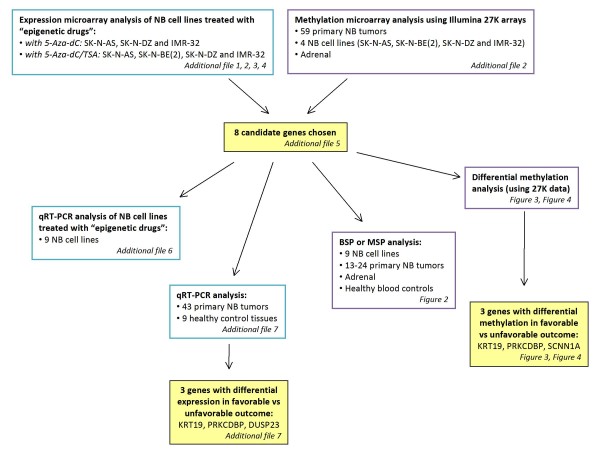
In order to identify genes that are epigenetically regulated in neuroblastoma tumors, we treated four neuroblastoma cell lines with the demethylating agent 5-Aza-2'-deoxycytidine (5-Aza-dC) either separately or in conjunction with the histone deacetylase inhibitor trichostatin A (TSA). Expression was analyzed using whole-genome expression arrays to identify genes activated by the treatment. These data were then combined with data from genome-wide DNA methylation arrays to identify candidate genes silenced in neuroblastoma due to DNA methylation.
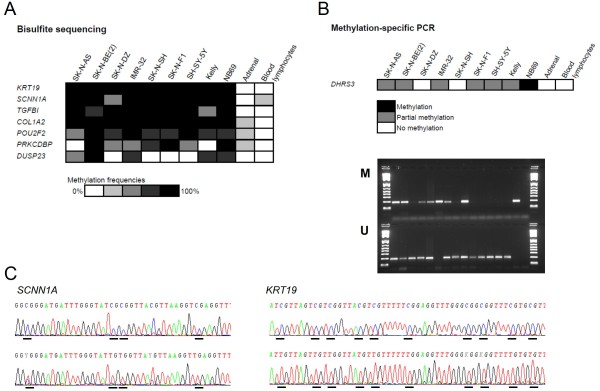
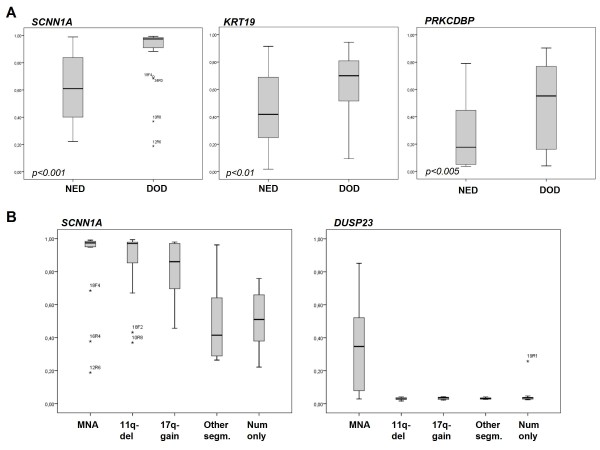
We present eight genes (KRT19, PRKCDBP, SCNN1A, POU2F2, TGFBI, COL1A2, DHRS3 and DUSP23) that are methylated in neuroblastoma, most of them not previously reported as such, some of which also distinguish between biological subsets of neuroblastoma tumors. Differential methylation was observed for the genes SCNN1A (p < 0.001), PRKCDBP (p < 0.001) and KRT19 (p < 0.01). Among these, the mRNA expression of KRT19 and PRKCDBP was significantly lower in patients that have died from the disease compared with patients with no evidence of disease (fold change -8.3, p = 0.01 for KRT19 and fold change -2.4, p = 0.04 for PRKCDBP).
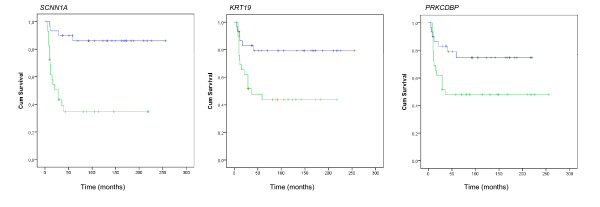
In our study, a low methylation frequency of SCNN1A, PRKCDBP and KRT19 is significantly associated with favorable outcome in neuroblastoma. It is likely that analysis of specific DNA methylation will be one of several methods in future patient therapy stratification protocols for treatment of childhood neuroblastomas.
表观遗传机制,如 DNA 甲基化和组蛋白修饰,是基因表达的重要调控因子,经常参与肿瘤抑制基因的沉默。
为了鉴定神经母细胞瘤肿瘤中受表观遗传调控的基因,我们分别用去甲基化剂 5-氮杂-2'-脱氧胞苷(5-Aza-dC)和组蛋白去乙酰化酶抑制剂曲古抑菌素 A(TSA)处理 4 种神经母细胞瘤细胞系,或者联合处理。使用全基因组表达谱芯片分析处理后基因的表达,以鉴定受处理激活的基因。然后将这些数据与全基因组 DNA 甲基化谱数据相结合,以鉴定由于 DNA 甲基化而在神经母细胞瘤中沉默的候选基因。
我们提出了 8 个基因(KRT19、PRKCDBP、SCNN1A、POU2F2、TGFBI、COL1A2、DHRS3 和 DUSP23)在神经母细胞瘤中发生甲基化,其中大多数以前没有报道过,其中一些基因也可以区分神经母细胞瘤肿瘤的生物学亚型。SCNN1A(p < 0.001)、PRKCDBP(p < 0.001)和 KRT19(p < 0.01)基因的甲基化存在差异。在这些基因中,与无疾病证据的患者相比,死于该疾病的患者的 KRT19 和 PRKCDBP 的 mRNA 表达显著降低(KRT19 的 fold change 为-8.3,p = 0.01;PRKCDBP 的 fold change 为-2.4,p = 0.04)。
在我们的研究中,SCNN1A、PRKCDBP 和 KRT19 的低甲基化频率与神经母细胞瘤的良好预后显著相关。分析特定的 DNA 甲基化很可能成为未来儿童神经母细胞瘤患者治疗分层方案中的几种方法之一。