Mkaddem Sanae Ben, Bens Marcelle, Vandewalle Alain
Oncotarget. 2010 Dec;1(8):741-750. doi: 10.18632/oncotarget.209.
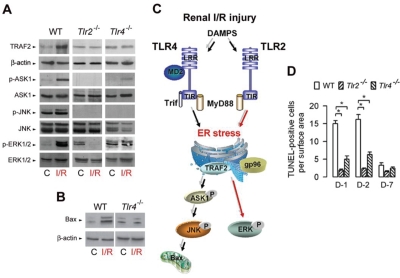
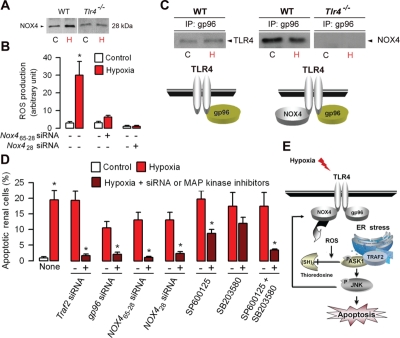
Ischemia-reperfusion injury induces intense inflammatory response and tissue damages resulting from the capacity of endogenous constituents called damageassociated molecular patterns (DAMPs) released by damaged or necrotic cells, to activate signaling pathways mediated by receptors of the innate immune systems. Among them, two members of the Toll-like receptors (TLR) family, TLR2 and TLR4 have been shown to play key roles in the induction of inflammatory response and cell apoptosis in a variety of ischemic tissues. The oxidative stress injury caused by I/R injury has been attributed to the activation of MAP kinase pathways, including those of ERK, JNK and p38. Here, we summarise recent findings concerning the role of the protein phosphatase 5 involved in the selective regulation of TLR2-mediated ERK1/2 signaling and the identification of the key role of the non-phagocytic NADPH oxidase 4 producing reactive oxygen species in the control of TLR4-mediated apoptosis in murine models of renal I/R injury and in post-hypoxic kidney tubule cells. The identification of molecules signaling involved in the ER stress-induced apoptotic signaling cascade may therefore represent potential targets to prevent the induction of apoptosis in hypoxic tissues.
缺血再灌注损伤会引发强烈的炎症反应和组织损伤,这是由于受损或坏死细胞释放的内源性成分(称为损伤相关分子模式,即DAMPs)能够激活由先天免疫系统受体介导的信号通路。其中,Toll样受体(TLR)家族的两个成员TLR2和TLR4已被证明在多种缺血组织中炎症反应的诱导和细胞凋亡中起关键作用。缺血再灌注损伤引起的氧化应激损伤归因于丝裂原活化蛋白激酶(MAP)途径的激活,包括细胞外信号调节激酶(ERK)、应激活化蛋白激酶(JNK)和p38途径。在此,我们总结了近期的研究发现,这些发现涉及蛋白磷酸酶5在选择性调节TLR2介导的ERK1/2信号传导中的作用,以及非吞噬性烟酰胺腺嘌呤二核苷酸磷酸(NADPH)氧化酶4在肾缺血再灌注损伤小鼠模型和缺氧后肾小管细胞中产生活性氧以控制TLR4介导的细胞凋亡中的关键作用。因此,识别内质网应激诱导的凋亡信号级联中涉及的信号分子可能代表预防缺氧组织中细胞凋亡诱导的潜在靶点。