Graduate School of Frontier Biosciences, Osaka University, 1-3 Yamadaoka, Suita, Osaka 565-0871, Japan.
Nature. 2011 Feb 17;470(7334):394-8. doi: 10.1038/nature09729.
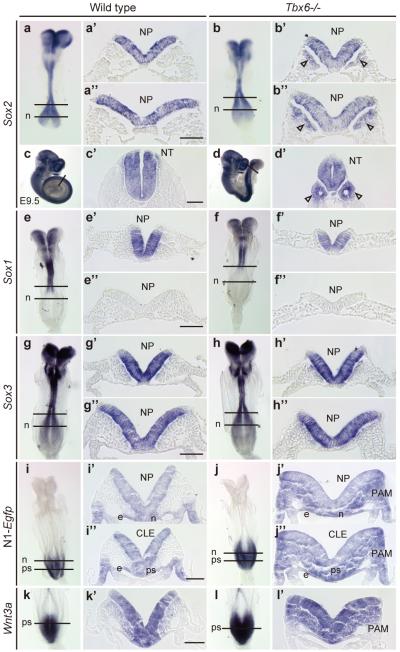
The classical view of neural plate development held that it arises from the ectoderm, after its separation from the mesodermal and endodermal lineages. However, recent cell-lineage-tracing experiments indicate that the caudal neural plate and paraxial mesoderm are generated from common bipotential axial stem cells originating from the caudal lateral epiblast. Tbx6 null mutant mouse embryos which produce ectopic neural tubes at the expense of paraxial mesoderm must provide a clue to the regulatory mechanism underlying this neural versus mesodermal fate choice. Here we demonstrate that Tbx6-dependent regulation of Sox2 determines the fate of axial stem cells. In wild-type embryos, enhancer N1 of the neural primordial gene Sox2 is activated in the caudal lateral epiblast, and the cells staying in the superficial layer sustain N1 activity and activate Sox2 expression in the neural plate. In contrast, the cells destined to become mesoderm activate Tbx6 and turn off enhancer N1 before migrating into the paraxial mesoderm compartment. In Tbx6 mutant embryos, however, enhancer N1 activity persists in the paraxial mesoderm compartment, eliciting ectopic Sox2 activation and transforming the paraxial mesoderm into neural tubes. An enhancer-N1-specific deletion mutation introduced into Tbx6 mutant embryos prevented this Sox2 activation in the mesodermal compartment and subsequent development of ectopic neural tubes, indicating that Tbx6 regulates Sox2 via enhancer N1. Tbx6-dependent repression of Wnt3a in the paraxial mesodermal compartment is implicated in this regulatory process. Paraxial mesoderm-specific misexpression of a Sox2 transgene in wild-type embryos resulted in ectopic neural tube development. Thus, Tbx6 represses Sox2 by inactivating enhancer N1 to inhibit neural development, and this is an essential step for the specification of paraxial mesoderm from the axial stem cells.
经典的神经管发育观点认为,神经管起源于外胚层,由中胚层和内胚层分离而来。然而,最近的细胞谱系追踪实验表明,尾侧神经板和轴旁中胚层是由起源于尾侧侧外胚层的共同双潜能轴向干细胞产生的。Tbx6 缺失突变体小鼠胚胎以牺牲轴旁中胚层为代价产生异位神经管,这必然为调控这种神经与中胚层命运选择的机制提供了线索。在这里,我们证明 Tbx6 依赖性 Sox2 调节决定了轴向干细胞的命运。在野生型胚胎中,神经原基基因 Sox2 的增强子 N1 在尾侧侧外胚层中被激活,停留在浅层的细胞维持 N1 活性,并在神经板中激活 Sox2 表达。相反,注定要成为中胚层的细胞在迁移到轴旁中胚层区室之前激活 Tbx6 并关闭增强子 N1。然而,在 Tbx6 突变体胚胎中,增强子 N1 的活性持续存在于轴旁中胚层区室中,引发异位 Sox2 激活并将轴旁中胚层转化为神经管。在 Tbx6 突变体胚胎中引入的增强子 N1 特异性缺失突变阻止了中胚层区室中的 Sox2 激活和随后异位神经管的发育,表明 Tbx6 通过增强子 N1 调节 Sox2。Tbx6 依赖性抑制轴旁中胚层区室中的 Wnt3a 可能参与了这一调控过程。在野生型胚胎中,将 Sox2 转基因在轴旁中胚层中特异性过表达导致异位神经管发育。因此,Tbx6 通过失活增强子 N1 抑制 Sox2 的表达来抑制神经发育,这是从轴向干细胞特化出轴旁中胚层的一个关键步骤。