Cui Wei, Bueso-Ramos Carlos E, Yin C Cameron, Sun Jianlan, Chen Su, Muddasani Ramya, Lu Gary
Department of Hematopathology, The University of Texas M.D. Anderson Cancer Center, 1515 Holcombe Bouleuard, Houston, TX 77030, USA.
J Biomed Biotechnol. 2010;2010:365318. doi: 10.1155/2010/365318. Epub 2011 Jan 20.
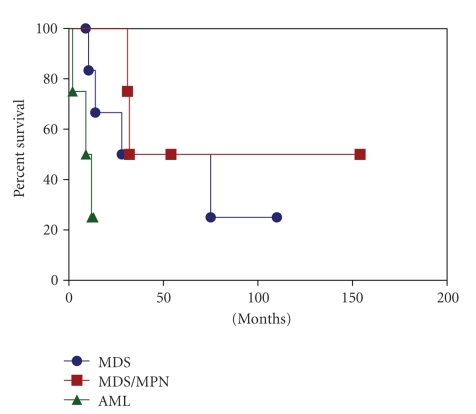
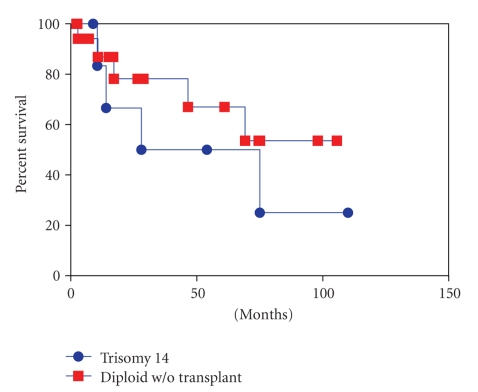
Trisomy 14 is a rare recurrent cytogenetic abnormality in myeloid neoplasms; however, its clinicopathologic features have not been well described. We report the clinicopathologic, immunophenotypic, and molecular genetic features of 16 cases of myeloid neoplasms with isolated trisomy 14. Our results show that cases with isolated trisomy 14 encompass a heterogeneous group of myeloid neoplasms including myelodysplastic syndrome (MDS, 44%), myelodysplastic/myeloproliferative neoplasms (31%), and acute myeloid leukemia (25%). The patients are usually elder (median age 71 years), and there is a male predominance (82%). Multilineage dysplasia is noted in all cases. Oncogenic mutations of genes involved in cell proliferation and/or survival rarely occur. Compared with cases of MDS with diploid karyotype, patients of MDS with isolated trisomy 14 demonstrate a similar overall survival and rate of leukemia transformation.
14号染色体三体是髓系肿瘤中一种罕见的复发性细胞遗传学异常;然而,其临床病理特征尚未得到充分描述。我们报告了16例孤立性14号染色体三体髓系肿瘤的临床病理、免疫表型和分子遗传学特征。我们的结果表明,孤立性14号染色体三体的病例包括一组异质性的髓系肿瘤,包括骨髓增生异常综合征(MDS,44%)、骨髓增生异常/骨髓增殖性肿瘤(31%)和急性髓系白血病(25%)。患者通常年龄较大(中位年龄71岁),且以男性为主(82%)。所有病例均有多系发育异常。很少发生涉及细胞增殖和/或存活的致癌基因突变。与二倍体核型的MDS病例相比,孤立性14号染色体三体的MDS患者的总生存率和白血病转化率相似。