
[重症监护病房中的医院内鼻窦炎:一项微生物学研究]
[Nosocomial sinusitis in an intensive care unit: a microbiological study].
作者信息
Balsalobre Filho Leonardo Lopes, Vieira Fernando Mirage Jardim, Stefanini Renato, Cavalcante Ricardo, Santos Rodrigo de Paula, Gregório Luis Carlos
机构信息
Departamento de Otorrinolaringologia e Cirurgia de Cabeça e Pescoço, Universidade Federal de São Paulo, São Paulo.
出版信息
Braz J Otorhinolaryngol. 2011 Jan-Feb;77(1):102-6. doi: 10.1590/S1808-86942011000100017.
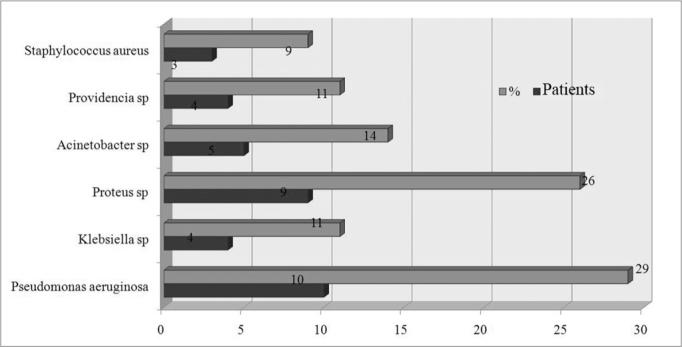
Nosocomial sinusitis is a common complication of patients in ICUs. Its diagnosis is important, and early treatment is required to avoid serious complications such as pneumonia, sepsis, meningitis, and intracranial abscesses. To identify the germs causing sinusitis in ICUs by nasal swabs and maxillary sinus puncture, and to correlate these results. ICU patients with a diagnosis (CT confirmed) of maxillary sinusitis underwent nasal swab and puncture of the sinus to collect material for culture and antibiogram. This study evaluated 22 patients. The microbial agent isolated in the swab correlated with the agent in the puncture in 14 of 22 cases (63%). Gram-negative bacteria were the most frequent, as follows: Pseudomonas aeruginosa (29% of punctures), following by Proteus mirabillis (26%) and Acinetobacter baumanni (14%). The resistance index in the antibiogram was high to antibiotics. Maxillary sinus puncture of ICU patients with sinusitis appears to be the best method for identifying bacteria; antibiograms demonstrate resistance to therapy. The swab has little diagnostic value; the correlation was 63%. It may be used when sinus puncture is contraindicated.
医院获得性鼻窦炎是重症监护病房(ICU)患者常见的并发症。其诊断很重要,需要早期治疗以避免严重并发症,如肺炎、败血症、脑膜炎和颅内脓肿。通过鼻拭子和上颌窦穿刺来识别ICU中引起鼻窦炎的病菌,并关联这些结果。诊断为(CT确诊)上颌窦炎的ICU患者接受鼻拭子检查和鼻窦穿刺,以收集材料进行培养和药敏试验。本研究评估了22例患者。在22例病例中的14例(63%)中,拭子中分离出的微生物病原体与穿刺中分离出的病原体相关。革兰氏阴性菌最为常见,如下:铜绿假单胞菌(穿刺病例的29%),其次是奇异变形杆菌(26%)和鲍曼不动杆菌(14%)。药敏试验中的耐药指数对抗生素较高。对患有鼻窦炎的ICU患者进行上颌窦穿刺似乎是识别细菌的最佳方法;药敏试验显示对治疗有耐药性。鼻拭子的诊断价值不大;相关性为63%。当鼻窦穿刺禁忌时可使用鼻拭子。

 Zotero 插件