Department of Pathology, Genetic Epidemiology Laboratory, Victoria, Carlton, Australia.
Br J Cancer. 2011 Mar 15;104(6):903-9. doi: 10.1038/bjc.2011.41. Epub 2011 Feb 22.
Knowing a young woman with newly diagnosed breast cancer has a germline BRCA1 mutation informs her clinical management and that of her relatives. We sought an optimal strategy for identifying carriers using family history, breast cancer morphology and hormone receptor status data.
We studied a population-based sample of 452 Australian women with invasive breast cancer diagnosed before age 40 years for whom we conducted extensive germline mutation testing (29 carried a BRCA1 mutation) and a systematic pathology review, and collected three-generational family history and tumour ER and PR status. Predictors of mutation status were identified using multiple logistic regression. Areas under receiver operator characteristic (ROC) curves were estimated using five-fold stratified cross-validation.
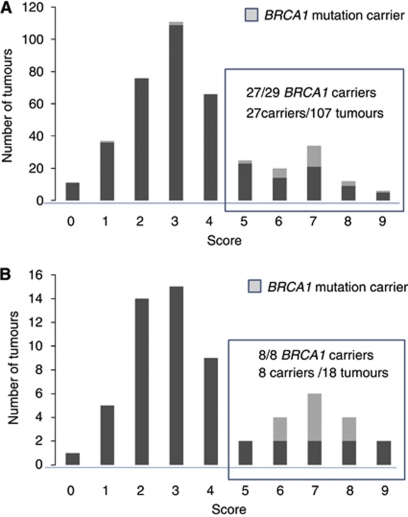
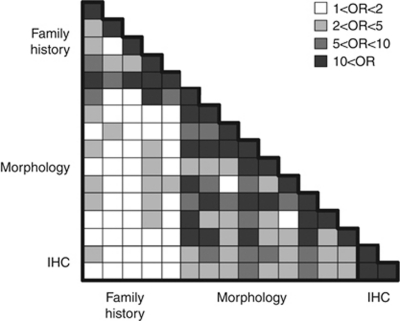
The probability of being a BRCA1 mutation carrier increased with number of selected histology features even after adjusting for family history and ER and PR status (P<0.0001). From the most parsimonious multivariate model, the odds ratio for being a carrier were: 9.7 (95% confidence interval: 2.6-47.0) for trabecular growth pattern (P=0.001); 7.8 (2.7-25.7) for mitotic index over 50 mitoses per 10 high-powered field (P=0.0003); and 2.7 (1.3-5.9) for each first-degree relative with breast cancer diagnosed before age 60 years (P=0.01).The area under the ROC curve was 0.87 (0.83-0.90).
Pathology review, with attention to a few specific morphological features of invasive breast cancers, can identify almost all BRCA1 germline mutation carriers among women with early-onset breast cancer without taking into account family history.
了解患有新诊断乳腺癌的年轻女性是否存在胚系 BRCA1 突变,这会影响她的临床管理及其亲属的管理。我们旨在寻求一种最佳策略,利用家族史、乳腺癌形态学和激素受体状态数据来识别突变携带者。
我们对 452 名年龄在 40 岁以下患有浸润性乳腺癌的澳大利亚女性进行了基于人群的研究,对这些女性进行了广泛的胚系突变检测(其中 29 名携带 BRCA1 突变)和系统病理学检查,并收集了三代家族史和肿瘤雌激素受体(ER)和孕激素受体(PR)状态。使用多变量逻辑回归识别突变状态的预测因素。使用五重分层交叉验证估计接收者操作特征(ROC)曲线下的面积。
即使在调整了家族史和 ER 和 PR 状态后,具有选定组织学特征的数量也会增加成为 BRCA1 突变携带者的概率(P<0.0001)。从最简约的多变量模型来看,携带者的比值比为:具有小梁生长模式的为 9.7(95%置信区间:2.6-47.0)(P=0.001);有丝分裂指数超过 50 个/10 高倍视野的为 7.8(2.7-25.7)(P=0.0003);每个一级亲属在 60 岁之前被诊断患有乳腺癌的为 2.7(1.3-5.9)(P=0.01)。ROC 曲线下的面积为 0.87(0.83-0.90)。
病理检查,特别注意浸润性乳腺癌的一些特定形态学特征,可以在不考虑家族史的情况下,识别出几乎所有患有早发性乳腺癌的 BRCA1 胚系突变携带者。