Massachusetts General Hospital Cancer Center, Boston, MA 02114, USA.
Oncologist. 2011;16(3):310-8. doi: 10.1634/theoncologist.2010-0223. Epub 2011 Feb 24.
There is a paucity of information on the clinical presentation and outcome of elderly hepatocellular carcinoma (HCC) patients. We performed a multicenter retrospective comparative study to assess the impact of age on potential differences in clinical characteristics, treatment patterns, and outcome in HCC patients.
We retrospectively analyzed HCC patients treated at two U.S. tertiary institutions from 1998 to 2008. Demographics, tumor parameters, etiology and severity of cirrhosis, treatment, and survival from diagnosis were collected and analyzed. After exclusion of transplanted patients, survival analyses were performed using the Kaplan-Meier method with log-rank tests and Cox proportional hazards models.
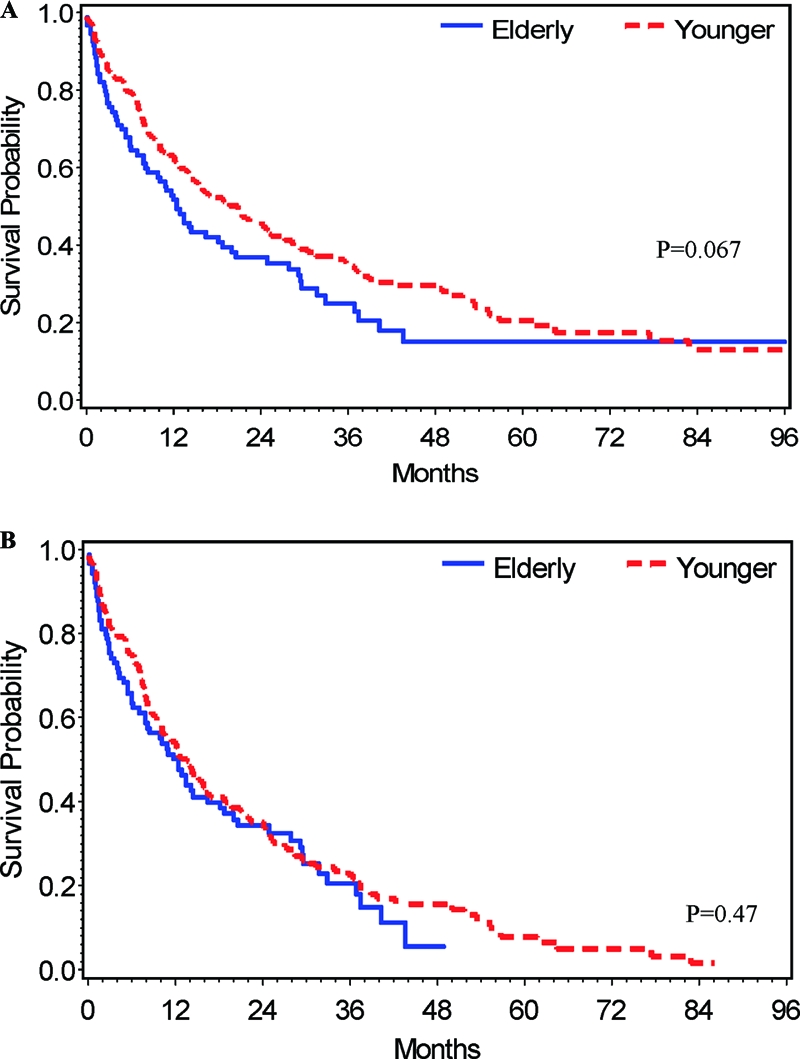
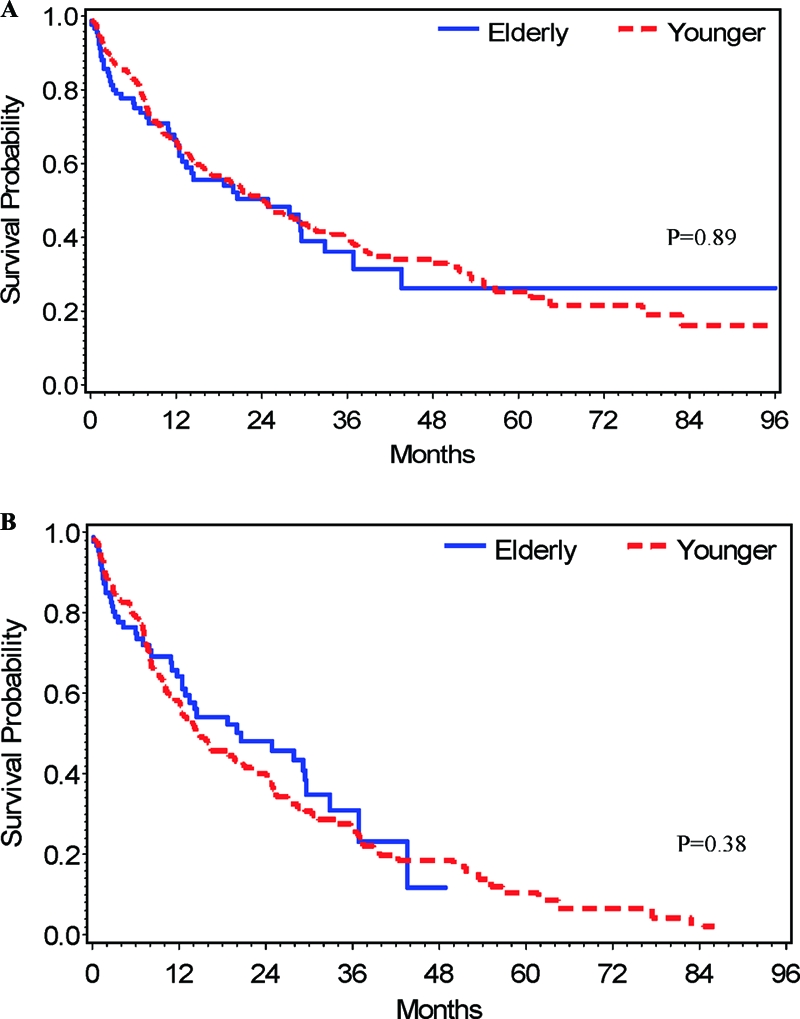
Three hundred thirty-five HCC patients were divided into two groups: "elderly" (95 patients, age ≥ 70 years) and "younger" (240 patients, aged <70 years). The male/female (M/F) ratio was 5.8:1 and 1.7:1 in the younger and elderly groups, respectively (p < .0001). Hepatitis C virus (HCV) infection rate was 48.3% in younger and 21.1% in elderly patients (p < .0001); Child class B and C cirrhosis accounted for 35.8% in younger and 25.3% in elderly patients (p = .063). Compared with younger patients, the elderly received transplant less frequently (19.6% versus 5.3%, p = .0002) and were more likely to receive supportive care only (22.9% versus 36.8%, p = .01). No significant differences between the two age groups were seen in tumor parameters or other treatments received. Overall (p = .47) and HCC-specific survival rates (p = .38) were similar in both age groups.
Characteristics that distinguish elderly from younger HCC patients include lower M/F ratio, worse performance status, lower rate of HCV infection, and less advanced underlying cirrhosis. Elderly patients were less likely to have a liver transplant and more likely to receive supportive care only. However, overall and HCC-specific survival were similar between the two groups.
有关老年肝细胞癌(HCC)患者的临床表现和结局的信息很少。我们进行了一项多中心回顾性对比研究,以评估年龄对 HCC 患者的临床特征、治疗模式和结局的潜在差异的影响。
我们回顾性分析了 1998 年至 2008 年在美国两家三级医疗机构接受治疗的 HCC 患者。收集并分析了人口统计学、肿瘤参数、病因和肝硬化严重程度、治疗以及从诊断开始的生存情况。排除移植患者后,使用 Kaplan-Meier 方法进行生存分析,采用对数秩检验和 Cox 比例风险模型。
335 例 HCC 患者分为两组:“老年”(95 例,年龄≥70 岁)和“年轻”(240 例,年龄<70 岁)。年轻组和老年组的男女比分别为 5.8:1 和 1.7:1(p<0.0001)。年轻组 HCV 感染率为 48.3%,老年组为 21.1%(p<0.0001);年轻组 Child 分级 B 和 C 肝硬化占 35.8%,老年组占 25.3%(p=0.063)。与年轻患者相比,老年患者接受移植的频率较低(19.6%对 5.3%,p=0.0002),更有可能仅接受支持性治疗(22.9%对 36.8%,p=0.01)。两组在肿瘤参数或其他治疗方面无显著差异。两组的总体生存率(p=0.47)和 HCC 特异性生存率(p=0.38)相似。
将老年 HCC 患者与年轻患者区分开来的特征包括男女比例较低、体能状态较差、HCV 感染率较低以及潜在肝硬化程度较轻。老年患者进行肝移植的可能性较低,更有可能仅接受支持性治疗。然而,两组的总体生存率和 HCC 特异性生存率相似。