Bak Rasmus O, Stenderup Karin, Rosada Cecilia, Petersen Line B, Moldt Brian, Dagnæs-Hansen Frederik, Jakobsen Maria, Kamp Søren, Jensen Thomas G, Dam Tomas N, Mikkelsen Jacob Giehm
Department of Human Genetics, University of Aarhus, Aarhus, Denmark.
BMC Dermatol. 2011 Feb 27;11:5. doi: 10.1186/1471-5945-11-5.
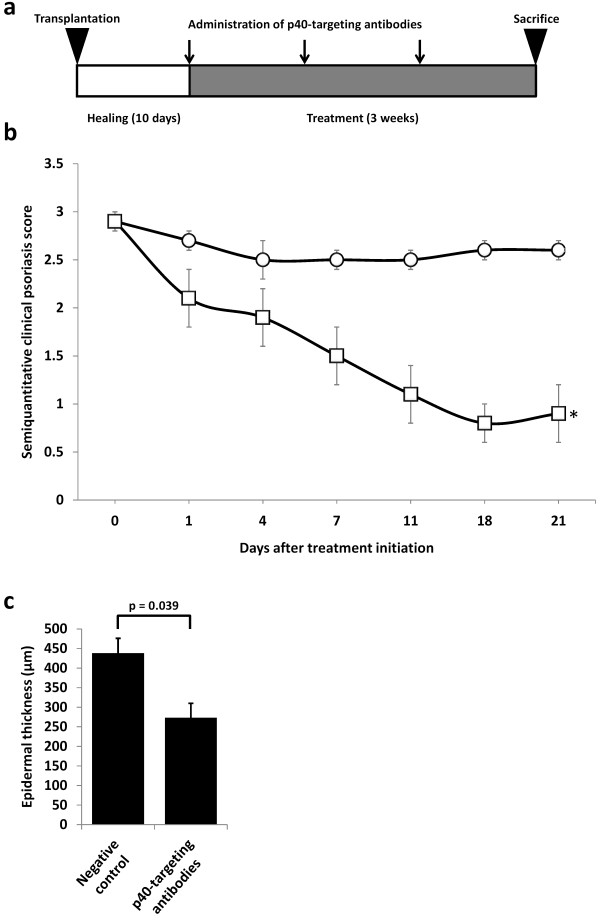
Psoriasis is a chronic inflammatory skin disorder that shows as erythematous and scaly lesions. The pathogenesis of psoriasis is driven by a dysregulation of the immune system which leads to an altered cytokine production. Proinflammatory cytokines that are up-regulated in psoriasis include tumor necrosis factor alpha (TNFα), interleukin-12 (IL-12), and IL-23 for which monoclonal antibodies have already been approved for clinical use. We have previously documented the therapeutic applicability of targeting TNFα mRNA for RNA interference-mediated down-regulation by anti-TNFα small hairpin RNAs (shRNAs) delivered by lentiviral vectors to xenografted psoriatic skin. The present report aims at targeting mRNA encoding the shared p40 subunit (IL-12B) of IL-12 and IL-23 by cellular transduction with lentiviral vectors encoding anti-IL12B shRNAs.
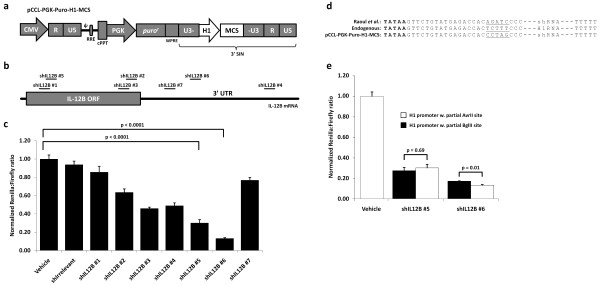
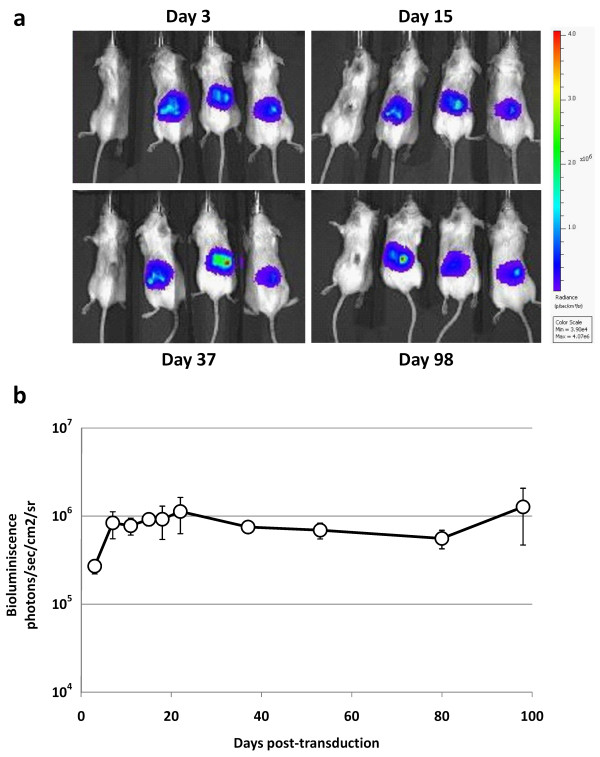
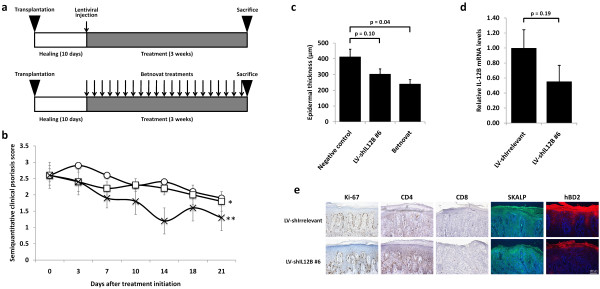
Effective anti-IL12B shRNAs are identified among a panel of shRNAs by potency measurements in cultured cells. The efficiency and persistency of lentiviral gene delivery to xenografted human skin are investigated by bioluminescence analysis of skin treated with lentiviral vectors encoding the luciferase gene. shRNA-expressing lentiviral vectors are intradermally injected in xenografted psoriatic skin and the effects of the treatment evaluated by clinical psoriasis scoring, by measurements of epidermal thickness, and IL-12B mRNA levels.
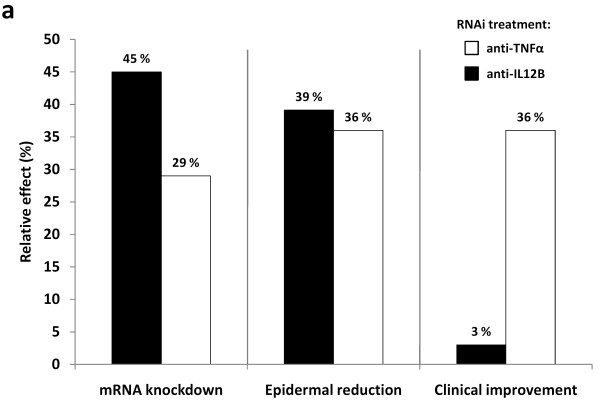
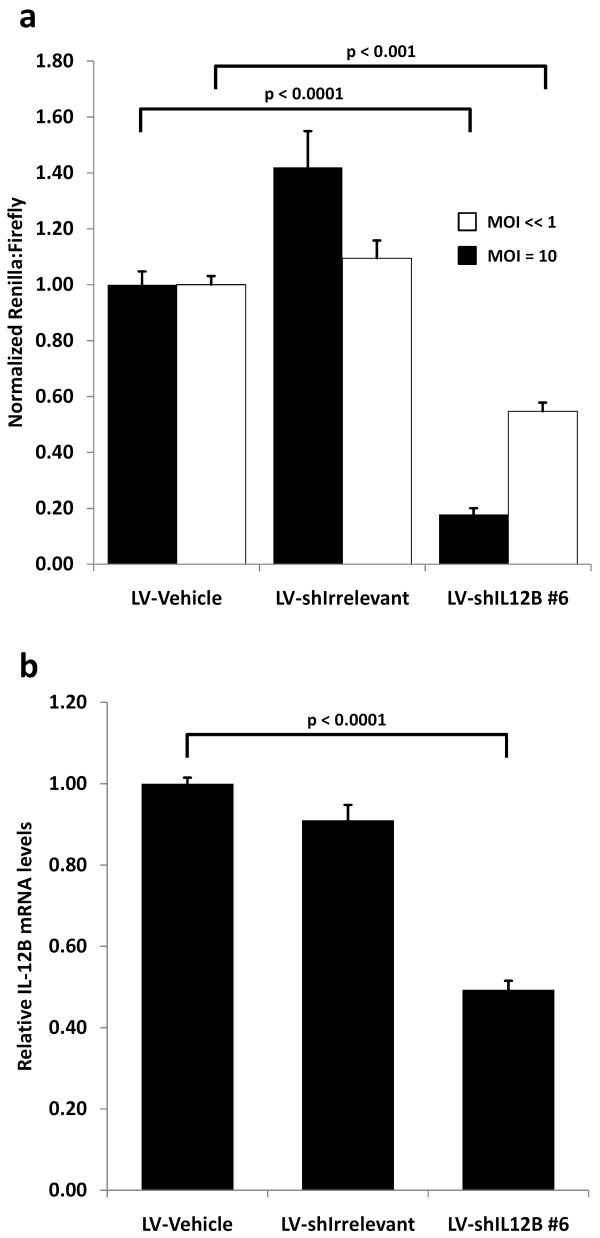
Potent and persistent transgene expression following a single intradermal injection of lentiviral vectors in xenografted human skin is reported. Stable IL-12B mRNA knockdown and reduced epidermal thickness are achieved three weeks after treatment of xenografted psoriatic skin with lentivirus-encoded anti-IL12B shRNAs. These findings mimic the results obtained with anti-TNFα shRNAs but, in contrast to anti-TNFα treatment, anti-IL12B shRNAs do not ameliorate the psoriatic phenotype as evaluated by semi-quantitative clinical scoring and by immunohistological examination.
Our studies consolidate the properties of lentiviral vectors as a tool for potent gene delivery and for evaluation of mRNA targets for anti-inflammatory therapy. However, in contrast to local anti-TNFα treatment, the therapeutic potential of targeting IL-12B at the RNA level in psoriasis is questioned.
银屑病是一种慢性炎症性皮肤病,表现为红斑和鳞屑性皮损。银屑病的发病机制是由免疫系统失调导致细胞因子产生改变所驱动。在银屑病中上调的促炎细胞因子包括肿瘤坏死因子α(TNFα)、白细胞介素12(IL-12)和IL-23,针对这些细胞因子的单克隆抗体已被批准用于临床。我们之前已经记录了通过慢病毒载体递送抗TNFα小发夹RNA(shRNAs)靶向TNFα mRNA进行RNA干扰介导的下调在异种移植银屑病皮肤中的治疗适用性。本报告旨在通过用编码抗IL12B shRNAs的慢病毒载体进行细胞转导来靶向编码IL-12和IL-23共享p40亚基(IL-12B)的mRNA。
通过在培养细胞中的效力测量,从一组shRNAs中鉴定出有效的抗IL12B shRNAs。通过对用编码荧光素酶基因的慢病毒载体处理的皮肤进行生物发光分析,研究慢病毒基因递送至异种移植人皮肤的效率和持久性。将表达shRNA的慢病毒载体皮内注射到异种移植的银屑病皮肤中,并通过临床银屑病评分、表皮厚度测量和IL-12B mRNA水平评估治疗效果。
报告了在异种移植人皮肤中单次皮内注射慢病毒载体后强大且持久的转基因表达。在用慢病毒编码的抗IL12B shRNAs处理异种移植的银屑病皮肤三周后,实现了稳定的IL-12B mRNA敲低和表皮厚度降低。这些发现与用抗TNFα shRNAs获得的结果相似,但与抗TNFα治疗相反,通过半定量临床评分和免疫组织学检查评估,抗IL12B shRNAs并未改善银屑病表型。
我们的研究巩固了慢病毒载体作为有效基因递送工具和抗炎治疗mRNA靶点评估工具的特性。然而,与局部抗TNFα治疗相反,在银屑病中RNA水平靶向IL-12B的治疗潜力受到质疑。