Department of Preventive Medicine, Keck School of Medicine, University of Southern California, Los Angeles, California, USA.
Diabetes Care. 2011 Apr;34(4):994-9. doi: 10.2337/dc10-1593. Epub 2011 Feb 28.
To examine the relationship of fasting indicators of insulin sensitivity with a more invasive measure of insulin sensitivity (frequently sampled intravenous glucose tolerance test [FSIVGTT]) and the effect of Tanner stage and ethnicity on that relationship.
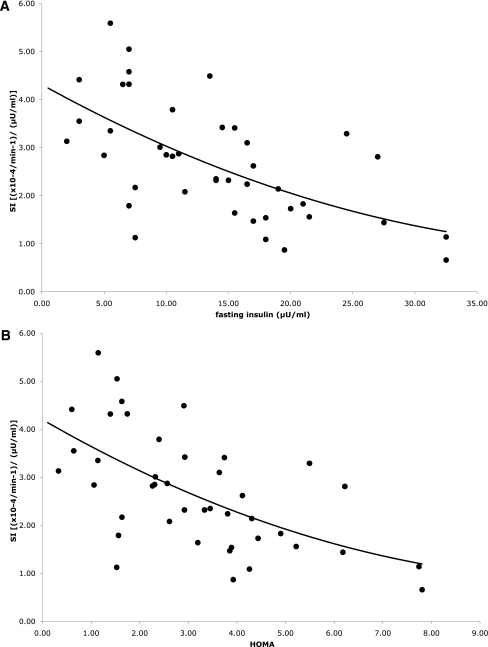
Data were analyzed from 149 overweight girls (97 Hispanic and 52 African American) who were either in the early stages of maturation defined by Tanner stages 1 or 2 (52 Hispanic and 18 African American) or in the later stages of maturation defined by Tanner stages 4 and 5 (45 Hispanic and 34 African American). Fasting indicators of insulin sensitivity (IS) included fasting insulin and glucose and the homeostasis model assessment of insulin resistance (HOMA-IR). IS was derived from an FSIVGTT with minimal modeling.
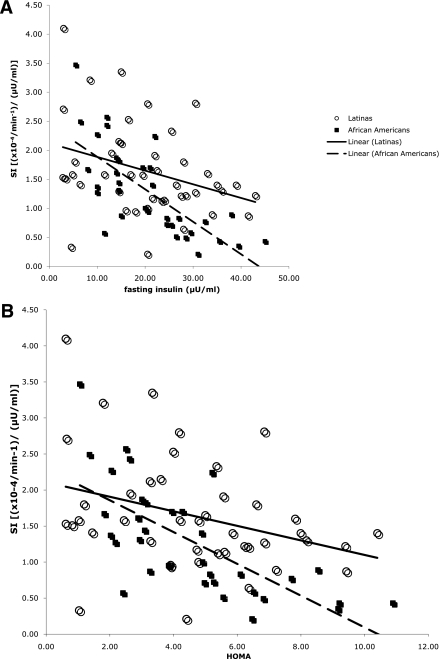
In Tanner stages 1 and 2, all fasting indicators were significantly associated with IS: (fasting insulin: r = -0.67, P < 0.01; HOMA: r = -0.66, P < 0.01) with no significant influence of ethnicity on these relationships. In Tanner stages 4 and 5, however, all fasting indicators were associated with IS in African American girls (fasting insulin: r = -0.55, P < 0.01; HOMA: r = -0.47, P < 0.01), but none of the indicators were significantly associated with IS in Hispanic girls.
Fasting indicators were reflective of IS for girls in Tanner stages 1 and 2, regardless of ethnicity and may provide a clinical measure of future risk for type 2 diabetes. In the latter stages of maturation, however, more invasive measures are warranted to adequately determine IS in clinical practice.
研究胰岛素敏感性的空腹指标与更具侵袭性的胰岛素敏感性测量方法(频繁采样静脉葡萄糖耐量试验[FSIVGTT])之间的关系,并探讨Tanner 分期和种族对这种关系的影响。
对 149 名超重女孩(97 名西班牙裔和 52 名非裔美国人)的数据进行了分析,这些女孩要么处于青春期早期(Tanner 分期 1 或 2,52 名西班牙裔和 18 名非裔美国人),要么处于青春期后期(Tanner 分期 4 和 5,45 名西班牙裔和 34 名非裔美国人)。胰岛素敏感性的空腹指标包括空腹胰岛素和血糖以及稳态模型评估的胰岛素抵抗(HOMA-IR)。胰岛素敏感性通过最小模型的 FSIVGTT 得出。
在 Tanner 分期 1 和 2 中,所有空腹指标均与胰岛素敏感性显著相关:(空腹胰岛素:r = -0.67,P < 0.01;HOMA:r = -0.66,P < 0.01),而种族对这些关系没有显著影响。然而,在 Tanner 分期 4 和 5 中,所有空腹指标均与非裔美国女孩的胰岛素敏感性相关(空腹胰岛素:r = -0.55,P < 0.01;HOMA:r = -0.47,P < 0.01),但在西班牙裔女孩中,没有任何指标与胰岛素敏感性显著相关。
在 Tanner 分期 1 和 2 中,无论种族如何,空腹指标都能反映胰岛素敏感性,可能为未来 2 型糖尿病的风险提供临床衡量标准。然而,在青春期后期,更具侵袭性的测量方法在临床实践中是必要的,以充分确定胰岛素敏感性。