Department of Pediatrics, Faculty of Medicine, University of Kelaniya, Ragama, Sri Lanka.
J Neurogastroenterol Motil. 2011 Jan;17(1):35-47. doi: 10.5056/jnm.2011.17.1.35. Epub 2011 Jan 26.
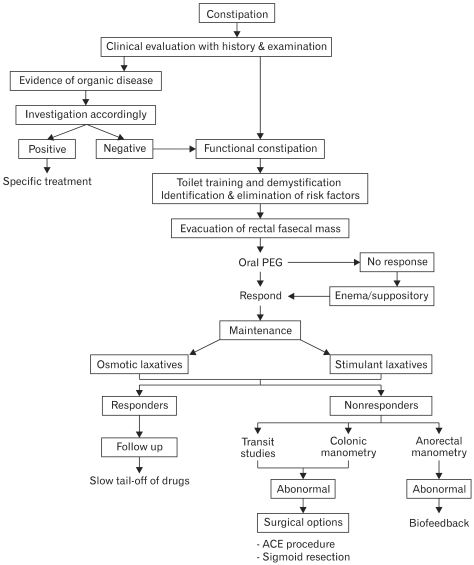
Constipation in children is a common health problem affecting 0.7% to 29.6% children across the world. Exact etiology for developing symptoms is not clear in children and the majority is considered to have functional constipation. Alteration of rectal and pelvic floor function through the brain-gut axis seems to play a crucial role in the etiology. The diagnosis is often a symptom-based clinical process. Recently developed Rome III diagnostic criteria looks promising, both in clinical and research fields. Laboratory investigations such as barium enema, colonoscopy, anorectal manometry and colonic transit studies are rarely indicated except in those who do not respond to standard management. Treatment of childhood constipation involves several facets including education and demystification, toilet training, rational use of laxatives for disimpaction and maintenance and regular follow-up. Surgical options should be considered only when medical therapy fails in long standing constipation. Since most of the management strategies of childhood constipation are not evidence-based, high-quality randomized controlled trials are required to assess the efficacy of currently available or newly emerging therapeutic options. Contrary to the common belief that children outgrow constipation as they grow up, a sizable percentage continue to have symptoms beyond puberty.
儿童便秘是一种常见的健康问题,影响全球 0.7%至 29.6%的儿童。儿童出现症状的确切病因尚不清楚,大多数被认为是功能性便秘。直肠和盆底功能通过脑-肠轴的改变似乎在病因中起着关键作用。诊断通常是基于症状的临床过程。最近开发的罗马 III 诊断标准在临床和研究领域都有很好的前景。除了那些对标准治疗没有反应的患者外,很少需要进行钡灌肠、结肠镜检查、直肠测压和结肠传输研究等实验室检查。儿童便秘的治疗包括几个方面,包括教育和消除神秘感、如厕训练、合理使用泻药以解除便秘和维持治疗以及定期随访。只有在长期便秘的药物治疗失败时,才应考虑手术治疗。由于大多数儿童便秘的管理策略都不是基于证据的,因此需要高质量的随机对照试验来评估目前可用或新出现的治疗选择的疗效。与普遍认为儿童随着成长便秘会自行缓解的观点相反,相当一部分儿童在青春期后仍持续有症状。