Division of Laboratory, Yamaguchi University Hospital, 1-1-1 Minami-kogushi, Ube, Yamaguchi 755-8505, Japan.
J Clin Biochem Nutr. 2011 Mar;48(2):103-6. doi: 10.3164/jcbn.10-76. Epub 2011 Feb 26.
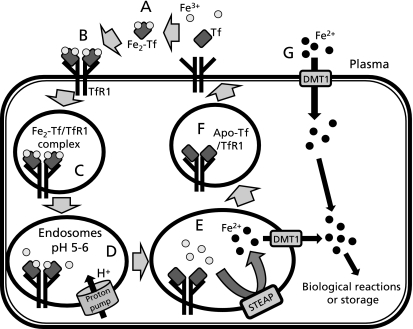
Iron is an essential metallic microelement for life. However, iron overload is toxic. The liver serves an important role as a storehouse for iron in the body. About 20-25 mg of iron is required each day for hemoglobin synthesis. To maintain iron homeostasis, transferrin and transferrin receptors are primarily involved in the uptake of iron into hepatocytes, ferritin in its storage, and ferroportin in its export. Moreover, hepcidin controls ferroportin and plays a central role in the iron metabolism. Excess "free" reactive iron produces damaging free radicals via Fenton or Harber-Weiss reactions. Produced free radicals attack cellular proteins, lipids and nucleic acid. Several detoxification system and anti-oxidant defense mechanisms exist to prevent cellular damage by free radicals. Excessive free radicals can lead to hepatocellular damage, liver fibrosis, and hepatocarcinogenesis.
铁是生命必需的微量元素。然而,铁过载是有毒的。肝脏作为体内铁的储存库起着重要作用。每天大约需要 20-25 毫克的铁用于血红蛋白合成。为了维持铁平衡,转铁蛋白和转铁蛋白受体主要参与铁进入肝细胞的摄取、铁蛋白的储存以及铁蛋白的输出。此外,hepcidin 控制铁蛋白并在铁代谢中发挥核心作用。过量的“游离”反应性铁通过 Fenton 或 Harber-Weiss 反应产生有害的自由基。产生的自由基攻击细胞蛋白质、脂质和核酸。存在几种解毒系统和抗氧化防御机制来防止自由基对细胞的损伤。过多的自由基可导致肝细胞损伤、肝纤维化和肝癌发生。