Kane Maureen A, Bright Frank V, Napoli Joseph L
Department of Nutritional Science and Toxicology, University of California, Berkeley, CA 94720-3104, USA.
Biochim Biophys Acta. 2011 May;1810(5):514-8. doi: 10.1016/j.bbagen.2011.02.009. Epub 2011 Mar 5.
Cellular retinol binding-protein I (CRBPI) and cellular retinol binding-protein II (CRBPII) serve as intracellular retinoid chaperones that bind retinol and retinal with high affinity and facilitate substrate delivery to select enzymes that catalyze retinoic acid (RA) and retinyl ester biosynthesis. Recently, 9-cis-RA has been identified in vivo in the pancreas, where it contributes to regulating glucose-stimulated insulin secretion. In vitro, 9-cis-RA activates RXR (retinoid × receptors), which serve as therapeutic targets for treating cancer and metabolic diseases. Binding affinities and structure-function relationships have been well characterized for CRBPI and CRBPII with all-trans-retinoids, but not for 9-cis-retinoids. This study extended current knowledge by establishing binding affinities for CRBPI and CRBPII with 9-cis-retinoids.
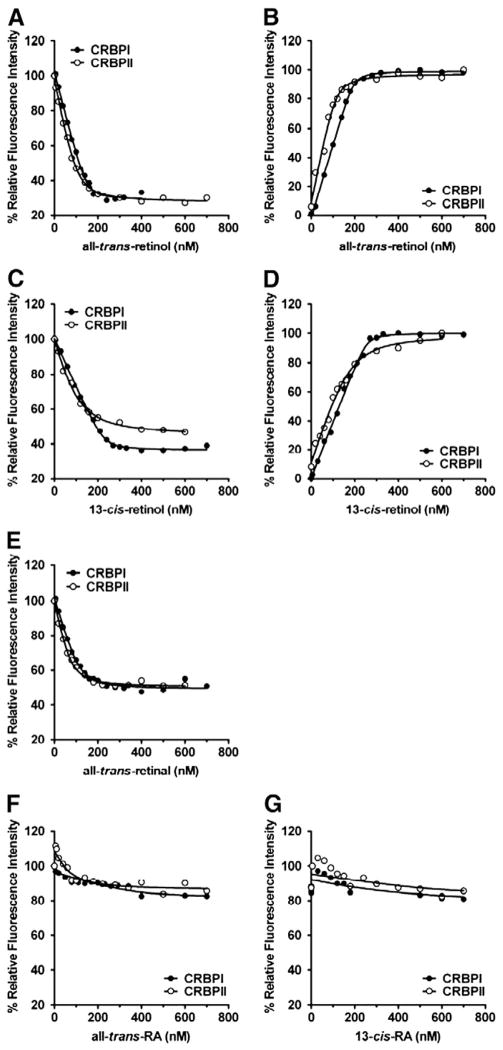
We have determined apparent dissociation constants, K'(d), through monitoring binding of 9-cis-retinol, 9-cis-retinal, and 9-cis-RA with CRBPI and CRBPII by fluorescence spectroscopy, and analyzing the data with non-linear regression. We compared these data to the data we obtained for all-trans- and 13-cis-retinoids under identical conditions.
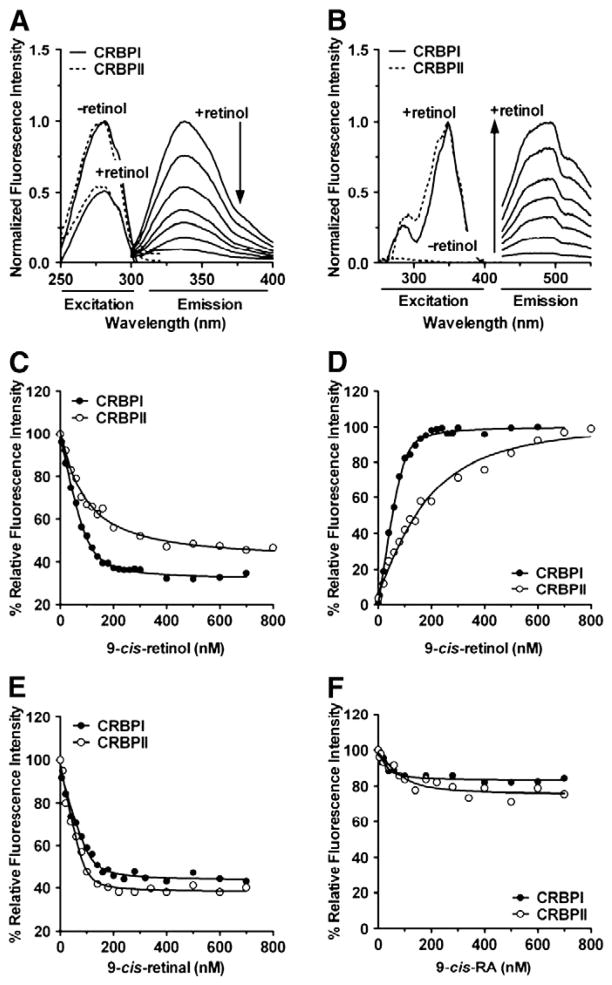
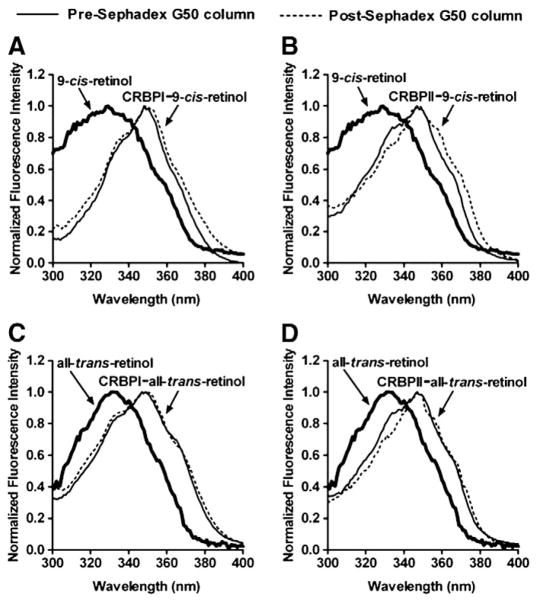
CRBPI and CRBPII, respectively, bind 9-cis-retinol (K'(d), 11nM and 68nM) and 9-cis-retinal (K'(d), 8nM and 5nM) with high affinity. No significant 9-cis-RA binding was observed with CRBPI or CRBPII.
CRBPI and CRBPII bind 9-cis-retinol and 9-cis-retinal with high affinities, albeit with affinities somewhat lower than for all-trans-retinol and all-trans-retinal.
These data provide further insight into structure-binding relationships of cellular retinol binding-proteins and are consistent with a model of 9-cis-RA biosynthesis that involves chaperoned delivery of 9-cis-retinoids to enzymes that recognize retinoid binding-proteins.
细胞视黄醇结合蛋白I(CRBPI)和细胞视黄醇结合蛋白II(CRBPII)作为细胞内类视黄醇伴侣蛋白,它们以高亲和力结合视黄醇和视黄醛,并促进底物传递给特定的酶,这些酶催化视黄酸(RA)和视黄酯的生物合成。最近,在胰腺中体内鉴定出9-顺式视黄酸,它有助于调节葡萄糖刺激的胰岛素分泌。在体外,9-顺式视黄酸激活视黄醇X受体(RXR),该受体是治疗癌症和代谢疾病的治疗靶点。CRBPI和CRBPII与全反式类视黄醇的结合亲和力和结构-功能关系已得到充分表征,但与9-顺式类视黄醇的关系尚未明确。本研究通过确定CRBPI和CRBPII与9-顺式类视黄醇的结合亲和力,扩展了当前的知识。
我们通过荧光光谱监测9-顺式视黄醇、9-顺式视黄醛和9-顺式视黄酸与CRBPI和CRBPII的结合,并使用非线性回归分析数据,从而确定了表观解离常数K'(d)。我们将这些数据与在相同条件下获得的全反式和13-顺式类视黄醇的数据进行了比较。
CRBPI和CRBPII分别以高亲和力结合9-顺式视黄醇(K'(d)分别为11nM和68nM)和9-顺式视黄醛(K'(d)分别为8nM和5nM)。未观察到CRBPI或CRBPII与9-顺式视黄酸有明显结合。
CRBPI和CRBPII以高亲和力结合9-顺式视黄醇和9-顺式视黄醛,尽管其亲和力略低于全反式视黄醇和全反式视黄醛。
这些数据为细胞视黄醇结合蛋白的结构-结合关系提供了进一步的见解,并且与9-顺式视黄酸生物合成模型一致,该模型涉及将9-顺式类视黄醇伴侣运输到识别类视黄醇结合蛋白的酶。