Tomita Minoru, Watabe Miyuki, Ito Mitsutoshi, Tsuru Tadahiko
Shinagawa LASIK Center, Chiyoda-ku, Tokyo, Japan.
Clin Ophthalmol. 2011;5:231-7. doi: 10.2147/OPTH.S16791. Epub 2011 Feb 16.
To evaluate the efficacy and safety of conductive keratoplasty (CK) for the treatment of presbyopia and analyze the differences in the effects between post- and non-laser in situ keratomileusis (LASIK) eyes. Clinical preoperative factors that could affect the predictability of CK were also analyzed.
The visual and refractive outcomes of CK for the treatment of presbyopia in 14 eyes of 13 post-LASIK patients (post-LASIK group mean age 50.9 ± 3.4 years) and those of 25 eyes of 25 non-LASIK patients (non-LASIK group mean age 52.4 ± 4.0 years) were studied. The clinical efficacy, safety, stability, and predictability of CK were statistically evaluated.
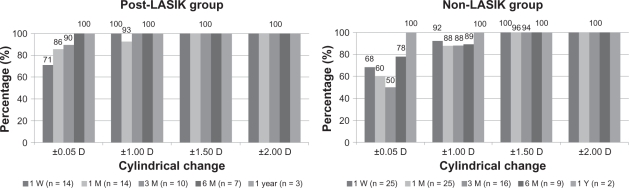
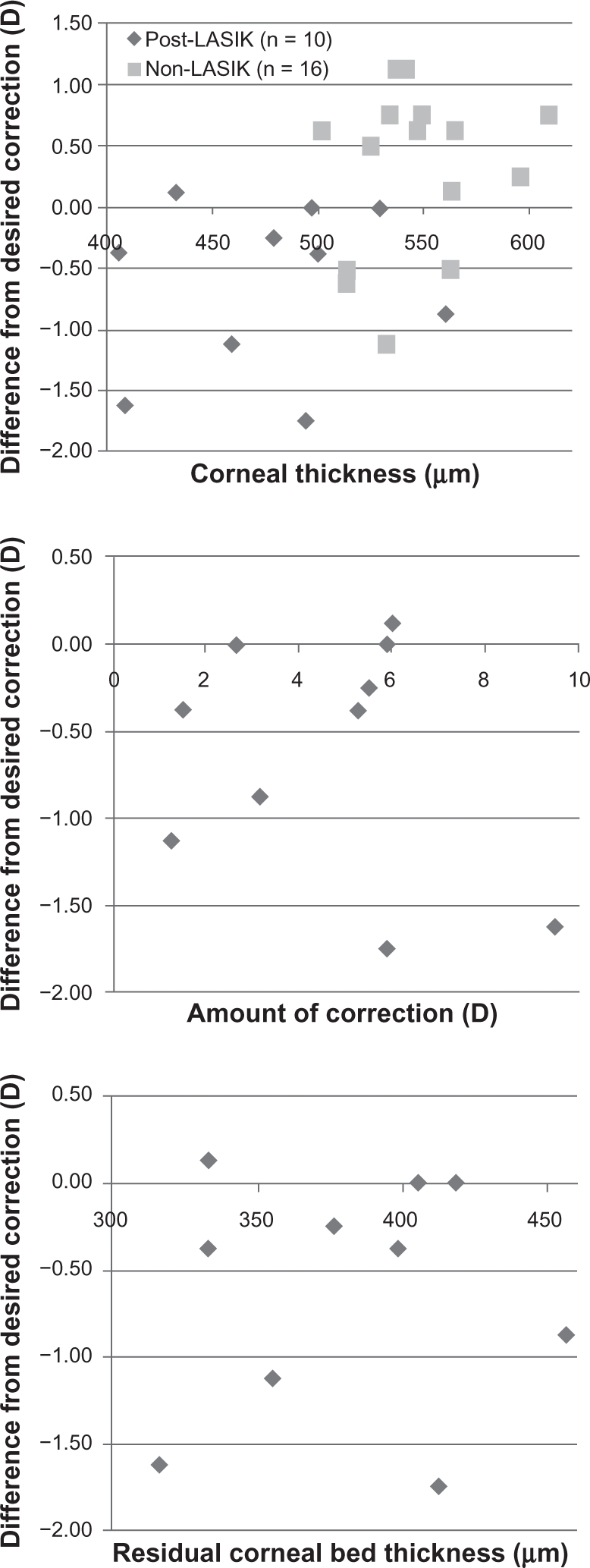
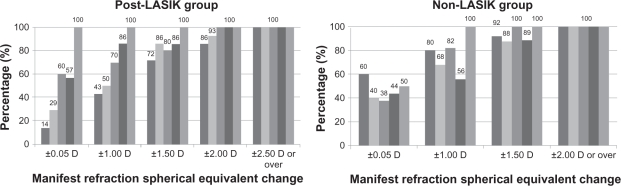
The mean (logarithm of the minimum angle of resolution [logMAR] ± standard deviation [SD]) of preoperative uncorrected near visual acuity (UNVA) and manifest refraction spherical equivalent (MRSE) were 0.64 ± 0.25 diopter (D) and 0.35 ± 0.48 D, respectively, in the post-LASIK group, and 0.71 ± 0.20 D and 0.64 ± 0.61 D, respectively, in the non-LASIK group. At 6 months after CK, the mean UNVA and MRSE were 0.07 ± 0.13 D and -1.59 ± 0.86 D, respectively, in the post-LASIK group, and 0.07 ± 0.12 D and -1.06 ± 0.56 D, respectively, in the non-LASIK group. At 1 year after CK, the mean UNVA and MRSE were 0.30 ± 0.17 D and -0.58 ± 0.52 D, respectively, in the post-LASIK group, and 0.28 ± 0.34 D and -1.56 ± 0.62 D, respectively, in the non-LASIK group. There was no significant difference between the two groups in either factor at 6 months postoperative (Student's t-test, P > 0.05). At 1 year after CK, all the treated eyes maintained corrected distance visual acuity better than -0.08 (logMAR). The mean cylindrical errors were within ±1.00 D in 100% of the post-LASIK and non-LASIK patients. As for the preoperative clinical factors evaluated for their potential relationship to the predictability of CK, none showed significant effect on the clinical outcomes.
CK is demonstrated to be safe for the treatment of presbyopia in post-LASIK patients as well as in non-LASIK patients, though needed longer observation in terms of factors affecting predictability.
评估传导性角膜成形术(CK)治疗老花眼的疗效和安全性,并分析激光原位角膜磨镶术(LASIK)术后眼和非LASIK术后眼之间效果的差异。还分析了可能影响CK可预测性的临床术前因素。
研究了13例LASIK术后患者(LASIK术后组平均年龄50.9±3.4岁)的14只眼以及25例非LASIK患者(非LASIK组平均年龄52.4±4.0岁)的25只眼CK治疗老花眼的视力和屈光结果。对CK的临床疗效、安全性、稳定性和可预测性进行了统计学评估。
LASIK术后组术前未矫正近视力(UNVA)的平均值(最小分辨角对数[logMAR]±标准差[SD])和明显屈光球镜等效值(MRSE)分别为0.64±0.25屈光度(D)和0.35±0.48 D,非LASIK组分别为0.71±0.20 D和0.64±0.61 D。CK术后6个月,LASIK术后组的平均UNVA和MRSE分别为0.07±0.13 D和-1.59±0.86 D,非LASIK组分别为0.07±0.12 D和-1.06±0.56 D。CK术后1年,LASIK术后组的平均UNVA和MRSE分别为0.30±0.17 D和-0.58±0.52 D,非LASIK组分别为0.28±0.34 D和-1.56±0.62 D。术后6个月时两组在任何一个因素上均无显著差异(Student t检验,P>0.05)。CK术后1年,所有治疗眼的矫正远视力均保持在优于-0.08(logMAR)。100%的LASIK术后和非LASIK患者的平均柱镜误差在±1.00 D以内。至于评估的术前临床因素与CK可预测性的潜在关系,均未显示对临床结果有显著影响。
已证明CK治疗LASIK术后患者和非LASIK患者的老花眼是安全的,不过在影响可预测性的因素方面需要更长时间的观察。