Iacopino A M, Christakos S
Department of Biochemistry and Molecular Biology, Graduate School of Biomedical Sciences, University of Medicine and Dentistry of New Jersey, Newark 07103.
Proc Natl Acad Sci U S A. 1990 Jun;87(11):4078-82. doi: 10.1073/pnas.87.11.4078.
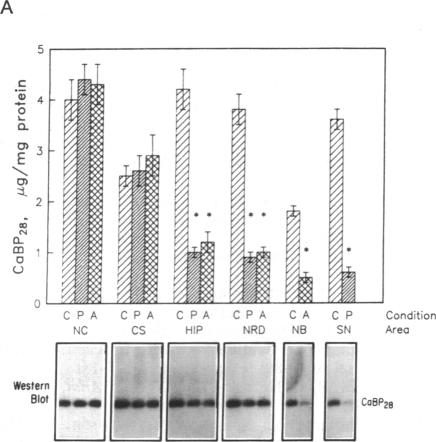
The present studies establish that there are specific, significant decreases in the neuronal calcium-binding protein (28-kDa calbindin-D) gene expression in aging and in neurodegenerative diseases. The specificity of the changes observed in calbindin mRNA levels was tested by reprobing blots with calmodulin, cyclophilin, and B-actin cDNAs. Gross brain regions of the aging rat exhibited specific, significant decreases (60-80%) in calbindin mRNA and protein levels in the cerebellum, corpus striatum, and brain-stem region but not in the cerebral cortex or hippocampus. Discrete areas of the aging human brain exhibited significant decreases (50-88%) in calbindin protein and mRNA in the cerebellum, corpus striatum, and nucleus basalis but not in the neocortex, hippocampus, amygdala, locus ceruleus, or nucleus raphe dorsalis. Comparison of diseased human brain tissue with age- and sex-matched controls yielded significant decreases (60-88%) in calbindin protein and mRNA in the substantia nigra (Parkinson disease), in the corpus striatum (Huntington disease), in the nucleus basalis (Alzheimer disease), and in the hippocampus and nucleus raphe dorsalis (Parkinson, Huntington, and Alzheimer diseases) but not in the cerebellum, neocortex, amygdala, or locus ceruleus. Since calbindin gene expression decreased specifically in brain areas known to be particularly affected in aging and in each of the neurodegenerative diseases, these findings suggest that decreased calbindin gene expression may lead to a failure of calcium buffering or intraneuronal calcium homeostasis, which contributes to calcium-mediated cytotoxic events during aging and in the pathogenesis of neurodegenerative diseases.
目前的研究表明,在衰老过程和神经退行性疾病中,神经元钙结合蛋白(28 kDa钙结合蛋白-D)基因表达存在特定的、显著的下降。通过用钙调蛋白、亲环蛋白和β-肌动蛋白cDNA对印迹进行再杂交,测试了在钙结合蛋白mRNA水平上观察到的变化的特异性。衰老大鼠的大脑总体区域中,小脑、纹状体和脑干区域的钙结合蛋白mRNA和蛋白质水平出现了特定的、显著的下降(60 - 80%),但在大脑皮层或海马体中未出现这种情况。衰老人类大脑的离散区域中,小脑、纹状体和基底核中的钙结合蛋白和mRNA显著下降(50 - 88%),但在新皮层、海马体、杏仁核、蓝斑或中缝背核中未出现这种情况。将患病人类脑组织与年龄和性别匹配的对照组进行比较,发现黑质(帕金森病)、纹状体(亨廷顿病)、基底核(阿尔茨海默病)以及海马体和中缝背核(帕金森病、亨廷顿病和阿尔茨海默病)中的钙结合蛋白和mRNA显著下降(60 - 88%),但在小脑、新皮层、杏仁核或蓝斑中未出现这种情况。由于钙结合蛋白基因表达在已知在衰老和每种神经退行性疾病中特别受影响的脑区中特异性下降,这些发现表明钙结合蛋白基因表达下降可能导致钙缓冲或神经元内钙稳态的失败,这在衰老过程和神经退行性疾病的发病机制中促成了钙介导的细胞毒性事件。