MR-Research in Neurology and Psychiatry, University Medical Centre, Göttingen, Germany.
Magn Reson Med. 2011 Sep;66(3):669-77. doi: 10.1002/mrm.22849. Epub 2011 Mar 22.
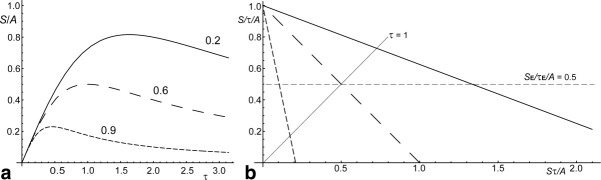
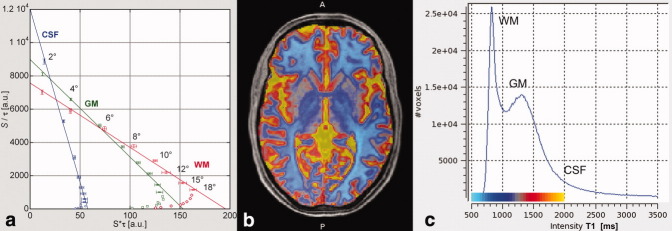
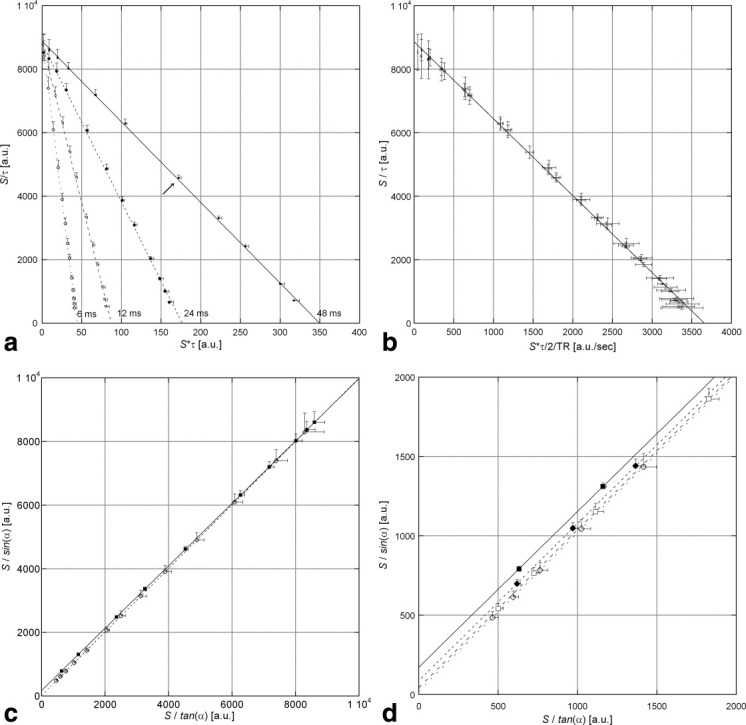
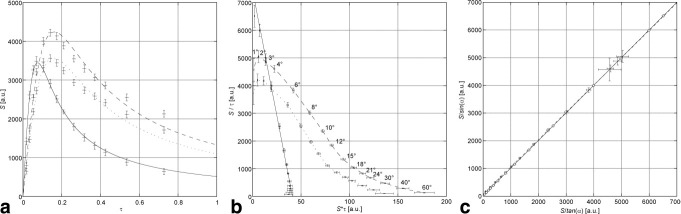
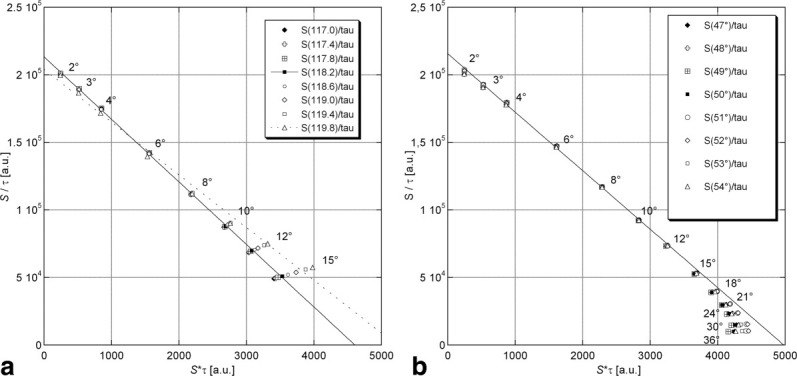
A novel linear parameterization for the variable flip angle method for longitudinal relaxation time T(1) quantification from spoiled steady state MRI is derived from the half angle tangent transform, τ, of the flip angle. Plotting the signal S at coordinates x=Sτ and y=S/τ, respectively, establishes a line that renders signal amplitude and relaxation term separately as y-intercept and slope. This representation allows for estimation of the respective parameter from the experimental data. A comprehensive analysis of noise propagation is performed. Numerical results for efficient optimization of longitudinal relaxation time and proton density mapping experiments are derived. Appropriate scaling allows for a linear presentation of data that are acquired at different short pulse repetition times, TR << T1 thus increasing flexibility in the data acquisition by removing the limitation of a single pulse repetition time. Signal bias, like due to slice-selective excitation or imperfect spoiling, can be readily identified by systematic deviations from the linear plot. The method is illustrated and validated by 3T experiments on phantoms and human brain.
一种新的线性参数化方法,用于从扰稳态 MRI 中定量纵向弛豫时间 T(1),是从翻转角的半角正切变换 τ 导出的。在坐标 x=Sτ 和 y=S/τ 上绘制信号 S,分别建立一条线,将信号幅度和弛豫项分别表示为 y 截距和斜率。这种表示形式允许从实验数据中估计各自的参数。对噪声传播进行了全面分析。推导出用于高效优化纵向弛豫时间和质子密度映射实验的数值结果。适当的缩放允许线性呈现在不同短脉冲重复时间 TR << T1 下采集的数据,从而通过消除单个脉冲重复时间的限制来提高数据采集的灵活性。信号偏差,如由于片选激发或不完全去相位引起的偏差,可以通过与线性图的系统偏差来轻松识别。该方法通过对 3T 幻影和人脑的实验进行了说明和验证。