Bel Yolanda, Ferré Juan, Escriche Baltasar
Department of Genetics, University of Valencia, 46100-Burjassot, Valencia, Spain.
BMC Res Notes. 2011 Mar 28;4:84. doi: 10.1186/1756-0500-4-84.
The accurate determination of the number of copies of a gene in the genome (gene dosage) is essential for a number of genetic analyses. Quantitative real time PCR (qPCR) with TaqMan detection has shown advantages over traditional Southern-blot and FISH techniques, however the high costs of the required labeled probes is an important limitation of this method. qPCR with SYBR Green I detection is a simple and inexpensive alternative, but it has never been applied to the determination of the copy number of low copy number genes in organisms with high allelic variability (as some insects), where a very small margin of error is essential.
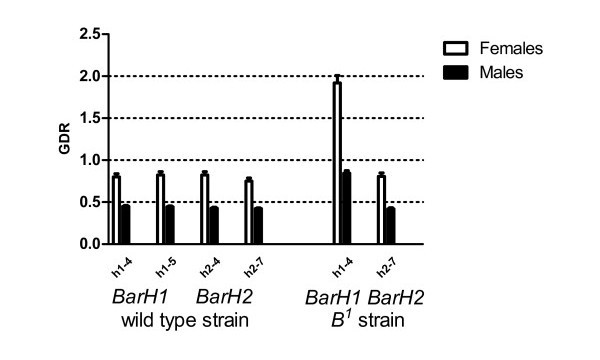
We have tested the suitability of the qPCR with SYBR Green I detection methodology for the detection of low copy number genes in two insects: the genetically well characterized Drosophila melanogaster (Diptera) and the poor genetically characterized Ostrinia nubilalis (Lepidoptera). The system was applied to determine the copy number of: (1) the O. nubilalis cadherin gene, involved in the mode of action of Bacillus thuringiensis toxins, which showed indirect evidence of duplication, and (2) the D. melanogaster BarH1 and BarH2 genes, located within the Bar region of the X chromosome, to clearly determine whether they both are covered by the tandem duplication in the classical Bar (B1) mutant. Our results showed that the O. nubilalis cadherin gene is an autosomal single copy gene and that BarH1, but not BarH2, is duplicated in the Drosophila B1 mutant.
This work shows that qPCR with SYBR Green I detection can be specific and accurate enough to distinguish between one and two gene copies per haploid genome of genes with high allelic variability. The technique is sensitive enough to give reliable results with a minimum amount of sample (DNA from individual thoraxes) and to detect gene duplications in tandem.
准确测定基因组中基因的拷贝数(基因剂量)对于许多遗传分析至关重要。采用TaqMan检测的定量实时PCR(qPCR)已显示出优于传统Southern印迹法和荧光原位杂交(FISH)技术的优势,然而所需标记探针的高成本是该方法的一个重要限制。采用SYBR Green I检测的qPCR是一种简单且成本低廉的替代方法,但它从未应用于具有高等位基因变异性的生物体(如某些昆虫)中低拷贝数基因拷贝数的测定,在这些生物体中,极小的误差范围至关重要。
我们测试了采用SYBR Green I检测方法的qPCR在两种昆虫中检测低拷贝数基因的适用性:遗传特征明确的黑腹果蝇(双翅目)和遗传特征不明的欧洲玉米螟(鳞翅目)。该系统用于测定:(1)参与苏云金芽孢杆菌毒素作用模式的欧洲玉米螟钙黏蛋白基因的拷贝数,该基因显示出重复的间接证据;(2)位于X染色体Bar区域内的黑腹果蝇BarH1和BarH2基因,以明确确定它们是否都被经典Bar(B1)突变体中的串联重复所覆盖。我们的结果表明,欧洲玉米螟钙黏蛋白基因是一个常染色体单拷贝基因,并且在果蝇B1突变体中BarH1基因发生了重复,而BarH2基因未重复。
这项工作表明,采用SYBR Green I检测的qPCR能够足够特异和准确地区分每个单倍体基因组中具有高等位基因变异性的基因的一个和两个基因拷贝。该技术足够灵敏,能够以最少的样本量(来自单个胸部的DNA)给出可靠结果,并检测串联基因重复。