Department of Psychology, California State University, San Bernardino, 5500 University Parkway, CA 92407, USA.
Neuroscience. 2011 Jun 2;183:121-33. doi: 10.1016/j.neuroscience.2011.03.037. Epub 2011 Apr 2.
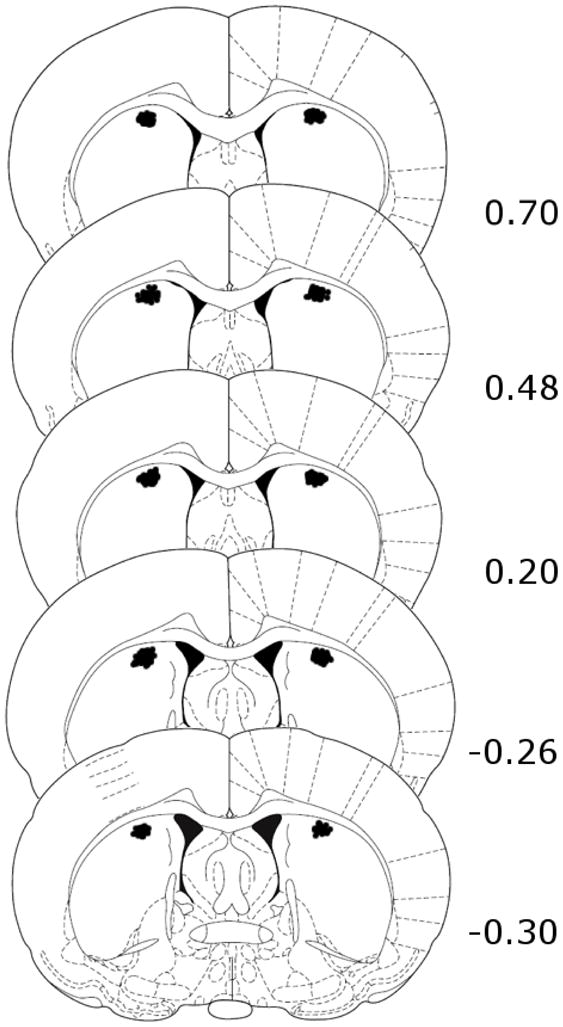
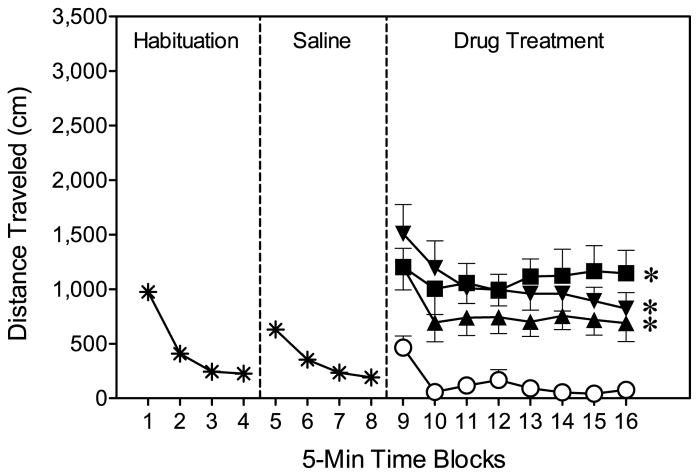
Dopaminergic compounds often affect the unlearned behaviors of preweanling and adult rats differently, although the brain regions underlying these age-dependent behavioral effects have not been specified. A candidate brain region is the dorsal caudate-putamen (CPu); thus, a goal of the present study was to determine whether D1 and D2 receptors in the dorsal CPu are capable of modulating the unlearned behaviors of preweanling rats. In Experiments 1 and 2, selective and nonselective dopamine agonists were bilaterally microinjected into the dorsal CPu on postnatal day (PD) 18 and both locomotor activity and stereotypy were measured. In Experiment 3, the functional coupling of D1 and D2 receptors was assessed by microinjecting the D1 agonist SKF-82958 and the D₂/D₃ agonist quinpirole either alone or in combination. In Experiments 4 and 5, quinpirole and the D1 receptor antagonist SCH-23390, or SKF-82958 and the D2 receptor antagonist raclopride, were co-administered into the dorsal CPu to further assess whether a functional D1 or D2 receptor system is necessary for the expression of quinpirole- or SKF-82958-induced behaviors. Results showed that selective stimulation of D1 or D2 receptors in the dorsal CPu increased both the locomotor activity and stereotypy of preweanling rats. Receptor coupling was evident on PD 18 because co-administration of a subthreshold dose of SKF-82958 and quinpirole produced more locomotor activity than either agonist alone. Lastly, the dopamine antagonist experiments showed that both D1 and D2 receptor systems must be functional for SKF-82958- or quinpirole-induced locomotor activity to be fully manifested. When the present data are compared to results from non-ontogenetic studies, it appears that pharmacological manipulation of D1 and D2 receptors in the dorsal CPu affects the behavior of preweanling and adult rats in a generally similar manner, although some important age-dependent differences are apparent. For example, D1 and/or D2 agonists preferentially induce locomotor activity, and not intense stereotypy, in younger animals.
多巴胺能化合物通常会对未成年和成年大鼠的未习得行为产生不同的影响,尽管尚未确定这些与年龄相关的行为效应的大脑区域。候选大脑区域是背侧尾壳核(CPu);因此,本研究的一个目标是确定背侧 CPu 中的 D1 和 D2 受体是否能够调节未成年大鼠的未习得行为。在实验 1 和 2 中,选择性和非选择性多巴胺激动剂分别在生后第 18 天(PD)双侧微注射到背侧 CPu,测量运动活动和刻板行为。在实验 3 中,通过单独或联合微注射 D1 激动剂 SKF-82958 和 D2/D3 激动剂喹吡罗来评估 D1 和 D2 受体的功能偶联。在实验 4 和 5 中,将喹吡罗和 D1 受体拮抗剂 SCH-23390 或 SKF-82958 和 D2 受体拮抗剂 raclopride 共同注入背侧 CPu,以进一步评估功能性 D1 或 D2 受体系统是否对喹吡罗或 SKF-82958 诱导的行为的表达是必需的。结果表明,选择性刺激背侧 CPu 中的 D1 或 D2 受体均可增加未成年大鼠的运动活动和刻板行为。受体偶联在 PD 18 时是明显的,因为共同给予亚阈值剂量的 SKF-82958 和喹吡罗产生的运动活动比单独给予任何一种激动剂都多。最后,多巴胺拮抗剂实验表明,D1 和 D2 受体系统都必须是功能性的,以使 SKF-82958 或喹吡罗诱导的运动活动完全表现出来。当将本研究数据与非发育研究的结果进行比较时,似乎背侧 CPu 中 D1 和 D2 受体的药理学操纵以一般相似的方式影响未成年和成年大鼠的行为,尽管存在一些重要的与年龄相关的差异。例如,D1 和/或 D2 激动剂优先诱导年幼动物的运动活动,而不是强烈的刻板行为。