Department of Ophthalmology and Visual Sciences, Washington University School of Medicine, St. Louis, Missouri, United States of America.
PLoS One. 2011 Mar 18;6(3):e17671. doi: 10.1371/journal.pone.0017671.
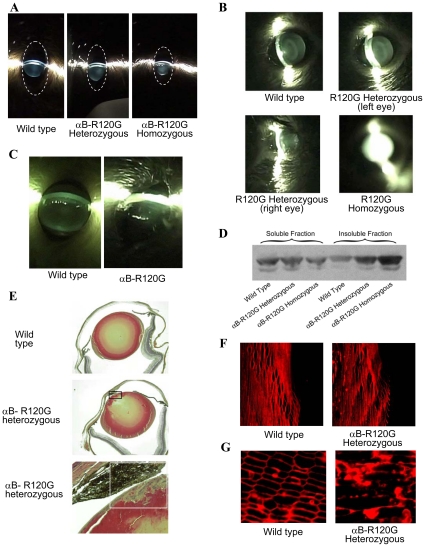
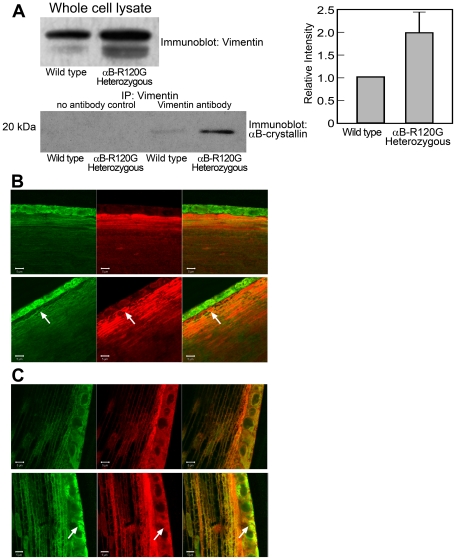
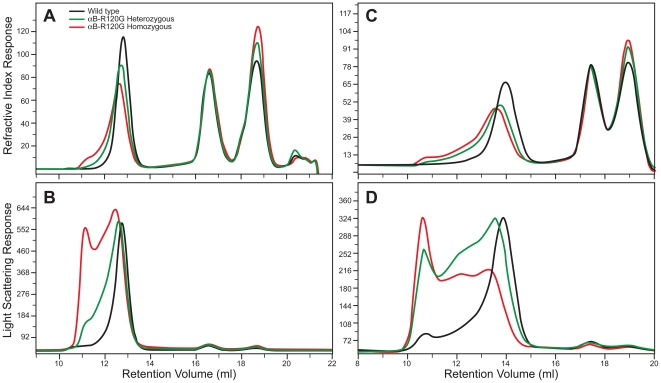
An autosomal dominant missense mutation in αB-crystallin (αB-R120G) causes cataracts and desmin-related myopathy, but the underlying mechanisms are unknown. Here, we report the development of an αB-R120G crystallin knock-in mouse model of these disorders. Knock-in αB-R120G mice were generated and analyzed with slit lamp imaging, gel permeation chromatography, immunofluorescence, immunoprecipitation, histology, and muscle strength assays. Wild-type, age-matched mice were used as controls for all studies. Both heterozygous and homozygous mutant mice developed myopathy. Moreover, homozygous mutant mice were significantly weaker than wild-type control littermates at 6 months of age. Cataract severity increased with age and mutant gene dosage. The total mass, precipitation, and interaction with the intermediate filament protein vimentin, as well as light scattering of αB-crystallin, also increased in mutant lenses. In skeletal muscle, αB-R120G co-aggregated with desmin, became detergent insoluble, and was ubiquitinated in heterozygous and homozygous mutant mice. These data suggest that the cataract and myopathy pathologies in αB-R120G knock-in mice share common mechanisms, including increased insolubility of αB-crystallin and co-aggregation of αB-crystallin with intermediate filament proteins. These knock-in αB-R120G mice are a valuable model of the developmental and molecular biological mechanisms that underlie the pathophysiology of human hereditary cataracts and myopathy.
一种常染色体显性错义突变的 αB-晶状体蛋白(αB-R120G)可引起白内障和肌原纤维相关的肌病,但潜在的机制尚不清楚。在这里,我们报告了这些疾病的 αB-R120G 晶状体蛋白敲入小鼠模型的开发。生成了敲入 αB-R120G 小鼠,并通过裂隙灯成像、凝胶渗透色谱、免疫荧光、免疫沉淀、组织学和肌肉力量测定进行了分析。所有研究均使用野生型、年龄匹配的小鼠作为对照。杂合和纯合突变小鼠均发生肌病。此外,在 6 个月大时,纯合突变小鼠的肌肉力量明显弱于野生型对照同窝仔鼠。白内障严重程度随年龄和突变基因剂量的增加而增加。αB-晶状体蛋白的总质量、沉淀、与中间丝蛋白波形蛋白的相互作用以及光散射也在突变晶状体中增加。在骨骼肌中,αB-R120G 与结蛋白共聚集,变得去污剂不溶,并在杂合和纯合突变小鼠中发生泛素化。这些数据表明,αB-R120G 敲入小鼠的白内障和肌病病理具有共同的机制,包括 αB-晶状体蛋白的不溶性增加和 αB-晶状体蛋白与中间丝蛋白的共聚集。这些敲入 αB-R120G 小鼠是研究人类遗传性白内障和肌病病理生理学的发育和分子生物学机制的有价值的模型。