Mak Isabella W Y, Turcotte Robert E, Popovic Snezana, Singh Gurmit, Ghert Michelle
Department of Surgery, McMaster University, Hamilton, ON, Canada L8S 4L8.
Biochem Res Int. 2011;2011:164197. doi: 10.1155/2011/164197. Epub 2011 Feb 27.
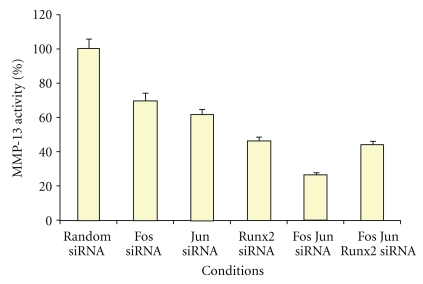
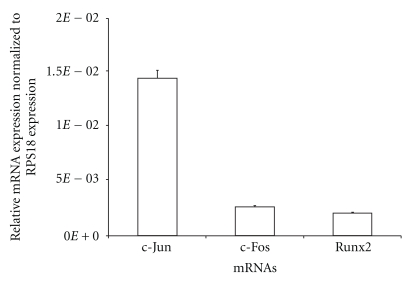
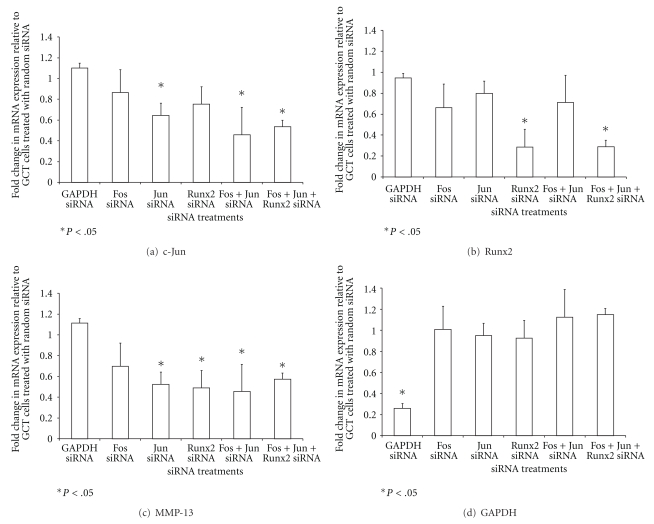
Matrix-metalloproteinase-13 (MMP-13) has been shown to be an important protease in inflammatory and neoplastic conditions of the skeletal system. In particular, the stromal cells of giant cell tumor of bone (GCT) express very high levels of MMP-13 in response to the cytokine-rich environment of the tumor. We have previously shown that MMP-13 expression in these cells is regulated, at least in part, by the RUNX2 transcription factor. In the current study, we identify the expression of the c-Fos and c-Jun elements of the AP-1 transcription factor in these cells by protein screening assays and real-time PCR. We then used siRNA gene knockdown to determine that these elements, in particular c-Jun, are upstream regulators of MMP-13 expression and activity in GCT stromal cells. We conclude that there was no synergy found between RUNX2 and AP-1 in the regulation of the MMP13 expression and that these transcription factors may be independently regulated in these cells.
基质金属蛋白酶-13(MMP-13)已被证明是骨骼系统炎症和肿瘤性疾病中的一种重要蛋白酶。特别是,骨巨细胞瘤(GCT)的基质细胞在肿瘤富含细胞因子的环境中会表达非常高水平的MMP-13。我们之前已经表明,这些细胞中MMP-13的表达至少部分受RUNX2转录因子调控。在当前研究中,我们通过蛋白质筛选分析和实时PCR确定了这些细胞中AP-1转录因子的c-Fos和c-Jun元件的表达。然后我们使用小干扰RNA(siRNA)基因敲低来确定这些元件,特别是c-Jun,是GCT基质细胞中MMP-13表达和活性的上游调节因子。我们得出结论,在MMP13表达的调控中未发现RUNX2和AP-1之间存在协同作用,并且这些转录因子在这些细胞中可能是独立调控的。