Department of Periodontics and Oral Medicine, School of Dentistry, University of Michigan, Ann Arbor, Michigan 48109-1078, USA.
Cancer. 2011 Apr 15;117(8):1670-8. doi: 10.1002/cncr.25676. Epub 2010 Nov 29.
Several sirtuin family members (SIRT1-7), which are evolutionarily conserved NAD-dependent deacetylases, play an important role in carcinogenesis. However, their role in oral cancer has not yet been investigated. Therefore, the objective of this study was to investigate whether sirtuins play a role in oral cancer carcinogenesis.
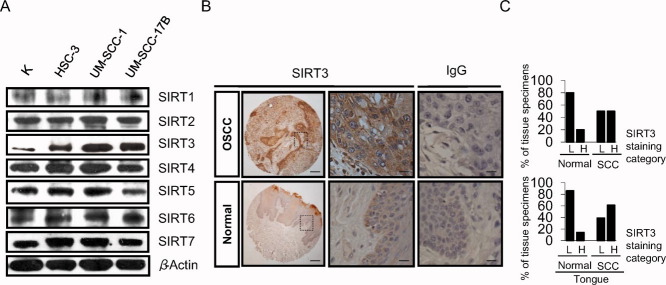
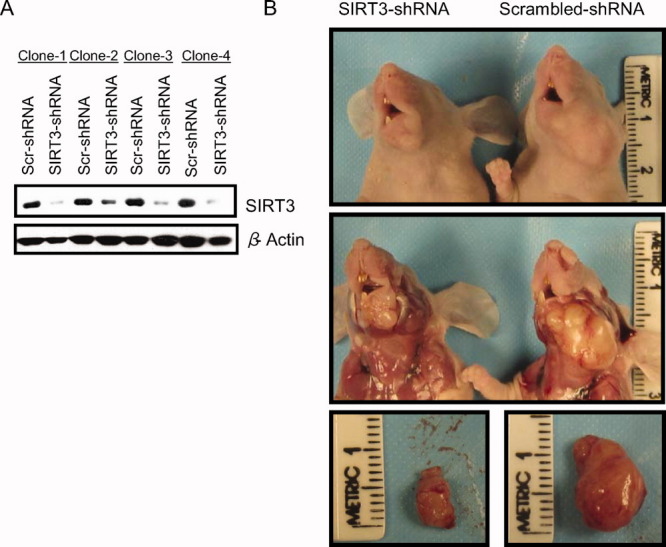
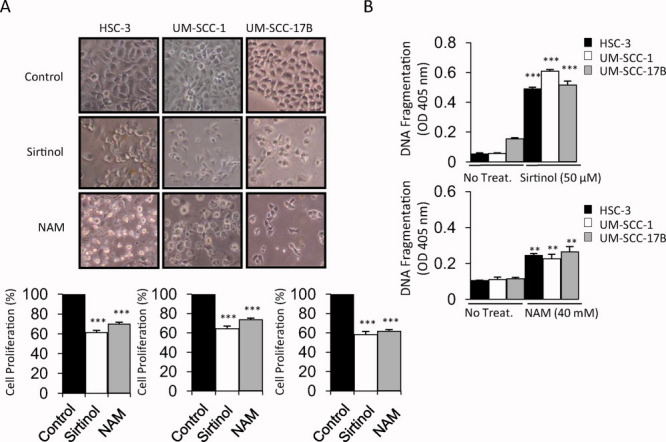
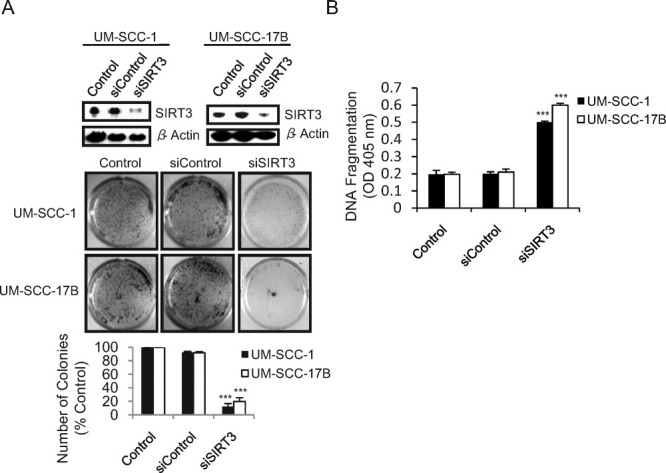
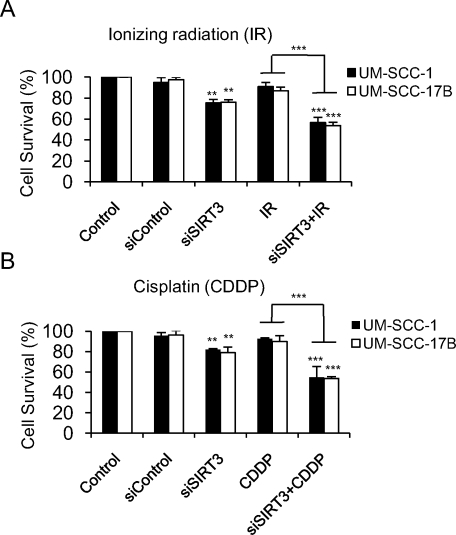
The expression levels of all sirtuins in several oral squamous cell carcinoma (OSCC) cell lines were compared with normal human oral keratinocytes and observed that SIRT3 was highly expressed. Therefore, tissue microarrays were used to evaluate the clinical relevance of this overexpression. SIRT3 down-regulation in OSCC cell proliferation and survival was investigated and analyzed by using cell-proliferation and cell-viability assays. Ionizing radiation and cisplatin were used to investigate whether SIRT3 down-regulation could increase the sensitivity of OSCC to both treatments. To further assess the in vivo role of SIRT3 in OSCC carcinogenesis, a floor-of-mouth oral cancer murine model was used to study the effect of SIRT3 down-regulation on OSCC tumor growth in immunodeficient mice.
The current results demonstrated for the first time that SIRT3 is overexpressed in OSCC in vitro and in vivo compared with other sirtuins. Down-regulation of SIRT3 inhibited OSCC cell growth and proliferation and increased OSCC cell sensitivity to radiation and cisplatin treatments in vitro. SIRT3 down-regulation also reduced tumor burden in vivo.
The current investigation revealed a novel role for SIRT3 in oral cancer carcinogenesis as a promoter of cell proliferation and survival, thus implicating SIRT3 as a new potential therapeutic target to treat oral cancer.
几种组蛋白去乙酰化酶家族成员(SIRT1-7)是进化上保守的 NAD 依赖性去乙酰化酶,在致癌作用中发挥重要作用。然而,它们在口腔癌中的作用尚未被研究。因此,本研究旨在探讨 Sirtuins 是否在口腔癌的致癌作用中发挥作用。
比较几种口腔鳞状细胞癌(OSCC)细胞系中所有 Sirtuins 的表达水平与正常的人口腔角质形成细胞,并观察到 SIRT3 高表达。因此,使用组织微阵列评估这种过表达的临床相关性。通过细胞增殖和细胞活力测定来研究和分析 SIRT3 在 OSCC 细胞增殖和存活中的下调作用。使用电离辐射和顺铂来研究 SIRT3 下调是否能增加 OSCC 对这两种治疗的敏感性。为了进一步评估 SIRT3 在口腔癌发生中的体内作用,使用口腔底部口腔癌小鼠模型来研究 SIRT3 下调对免疫缺陷小鼠中 OSCC 肿瘤生长的影响。
目前的结果首次证明,与其他 Sirtuins 相比,SIRT3 在 OSCC 的体外和体内均过度表达。SIRT3 的下调抑制了 OSCC 细胞的生长和增殖,并增加了 OSCC 细胞对辐射和顺铂治疗的敏感性。SIRT3 的下调也减少了体内的肿瘤负担。
本研究揭示了 SIRT3 在口腔癌致癌作用中的新作用,作为促进细胞增殖和存活的促进剂,从而暗示 SIRT3 是治疗口腔癌的一个新的潜在治疗靶点。