Ferguson T S, Younger N, Tulloch-Reid M K, Lawrence-Wright M B, Forrester T E, Cooper R S, Van den Broeck J, Wilks R J
Tropical Medicine Research Institute, The University of the West Indies, Kingston 7, Jamaica.
West Indian Med J. 2010 Oct;59(5):486-93.
To estimate the incidence of hypertension in people with and without prehypertension and determine the factors that predict progression to hypertension.
Data from a cohort of 25-74-year-old residents of Spanish Town, Jamaica, were analysed. All participants completed a structured questionnaire and had blood pressure (BP), anthropometric measurements and venous blood sampling performed by trained personnel. Blood Pressure was classified using the Seventh Report of the Joint National Committee on the Prevention, Detection, Evaluation and Treatment of High Blood Pressure (JNC-7) criteria.
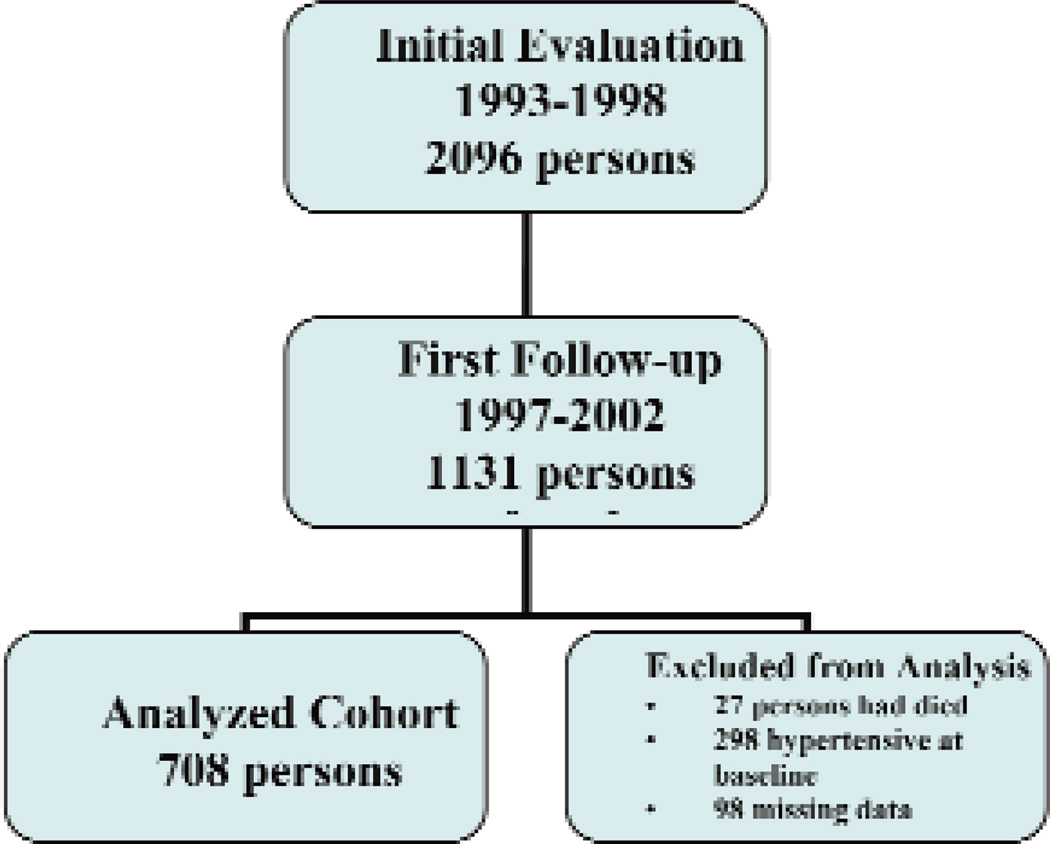
708 persons who had the required data and were not hypertensive at baseline were included in this analysis. Mean follow-up time was 4.1 years; 28.7% of prehypertensive participants developed hypertension compared to 6.2% of normotensive participants. The unadjusted incidence rate ratio (IRR [95% CI]) for progression among prehypertensive compared to normotensive participants was 4.62 [2.96, 7.43]. Among males, the rate of progression to hypertension was significantly higher for those 45-64 years old and those who were current smokers. Among females, progression was higher for age groups 25-44 years, 45-64 years, those who were overweight (BMI > or =25), obese (BMI > or =30) and current smokers. In multivariate models, prehypertension, female gender overweight status and older age remained significantly associated with progression to hypertension among the combined prehypertensive and normotensive groups. IRR [95% CI] were: prehypertension, 3.45 [2.18-5.45]; female gender 1.81 [1.12, 2.94]; overweight, 1.87 [1.15, 2.94]; age 45-64 years, 1.73 [1.08, 2.76]; age > 65 years 2.39 [1.31, 4.34].
Prehypertension is associated with a three-fold increase in the incidence of hypertension. Higher BMI, age and female gender also independently predict the development of hypertension.
评估有和没有高血压前期人群的高血压发病率,并确定预测进展为高血压的因素。
对牙买加西班牙镇25 - 74岁居民队列的数据进行分析。所有参与者均完成一份结构化问卷,并由经过培训的人员进行血压(BP)测量、人体测量和静脉血采样。血压根据美国预防、检测、评估与治疗高血压联合委员会第七次报告(JNC - 7)标准进行分类。
本分析纳入了708名有所需数据且基线时无高血压的人员。平均随访时间为4.1年;28.7%的高血压前期参与者发展为高血压,而血压正常参与者的这一比例为6.2%。高血压前期参与者与血压正常参与者相比,进展的未调整发病率比(IRR [95% CI])为4.62 [2.96, 7.43]。在男性中,45 - 64岁人群和当前吸烟者进展为高血压的比例显著更高。在女性中,25 - 44岁、45 - 64岁、超重(BMI≥25)、肥胖(BMI≥30)和当前吸烟者进展的比例更高。在多变量模型中,高血压前期、女性性别、超重状态和年龄较大在高血压前期和血压正常的合并组中仍与进展为高血压显著相关。IRR [95% CI]为:高血压前期,3.45 [2.18 - 5.45];女性性别,1.81 [1.12, 2.94];超重,1.87 [1.15, 2.94];年龄45 - 64岁,1.73 [1.08, 2.76];年龄>65岁,2.39 [1.31, 4.34]。
高血压前期与高血压发病率增加三倍相关。较高的BMI、年龄和女性性别也独立预测高血压的发生。