Donders Institute for Brain, Cognition and Behaviour, Radboud University, P.O. Box 9104, 6500 HE Nijmegen, The Netherlands.
Exp Brain Res. 2011 Jun;211(3-4):581-92. doi: 10.1007/s00221-011-2658-3. Epub 2011 Apr 11.
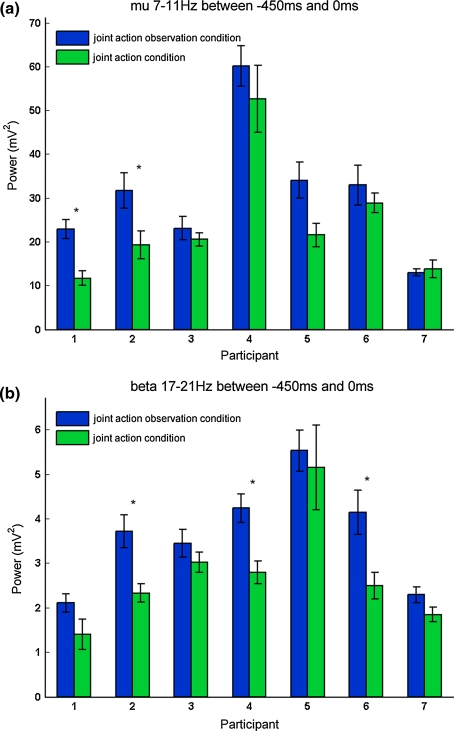
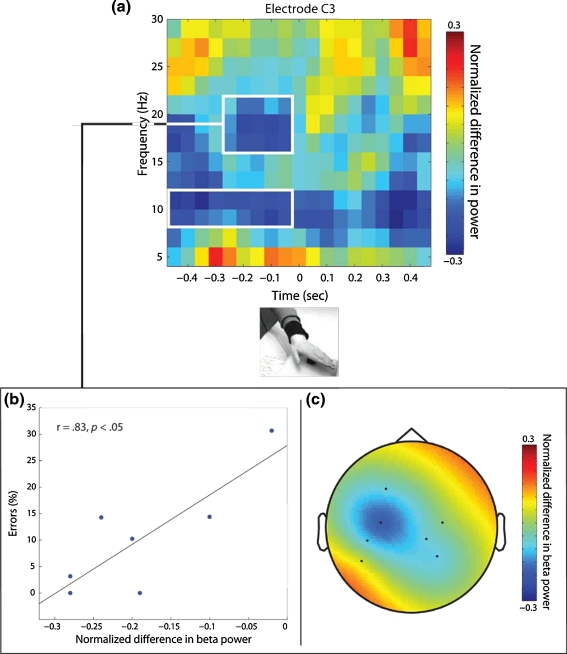
When we are engaged in a joint action, we need to integrate our partner's actions with our own actions. Previous research has shown that in adults the involvement of one's own motor system is enhanced during observation of an action partner as compared to during observation of an individual actor. The aim of this study was to investigate whether similar motor system involvement is present at early stages of joint action development and whether it is related to joint action performance. In an EEG experiment with 3-year-old children, we assessed the children's brain activity and performance during a joint game with an adult experimenter. We used a simple button-pressing game in which the two players acted in turns. Power in the mu- and beta-frequency bands was compared when children were not actively moving but observing the experimenter's actions when (1) they were engaged in the joint action game and (2) when they were not engaged. Enhanced motor involvement during action observation as indicated by attenuated sensorimotor mu- and beta-power was found when the 3-year-olds were engaged in the joint action. This enhanced motor activation during action observation was associated with better joint action performance. The findings suggest that already in early childhood the motor system is differentially activated during action observation depending on the involvement in a joint action. This motor system involvement might play an important role for children's joint action performance.
当我们参与联合行动时,我们需要将自己的动作与伙伴的动作整合在一起。先前的研究表明,与观察个体演员相比,成年人在观察动作伙伴时会增强自身运动系统的参与度。本研究旨在探讨在联合动作发展的早期阶段是否存在类似的运动系统参与,以及这种参与是否与联合动作表现相关。在一项针对 3 岁儿童的 EEG 实验中,我们评估了儿童在与成人实验者进行联合游戏时的大脑活动和表现。我们使用了一种简单的按钮按压游戏,其中两名玩家轮流行动。当儿童没有主动移动但观察实验者的动作时,比较了他们在(1)参与联合动作游戏和(2)不参与时的 mu 频带和 beta 频带的功率。当 3 岁儿童参与联合动作时,观察动作时的运动系统参与度增强,表现为感觉运动 mu 频带和 beta 频带的功率减弱。观察动作时的这种增强的运动激活与更好的联合动作表现相关。研究结果表明,在儿童早期,运动系统在观察动作时会根据参与联合动作的情况而产生差异激活。这种运动系统的参与可能对儿童的联合动作表现起着重要作用。