Center for Infection and Immunity of Lille, CNRS UMR 8204, INSERM U 1019, Institut Pasteur de Lille, Université Lille Nord de France, Lille, France.
PLoS Pathog. 2011 Mar;7(3):e1001328. doi: 10.1371/journal.ppat.1001328. Epub 2011 Mar 31.
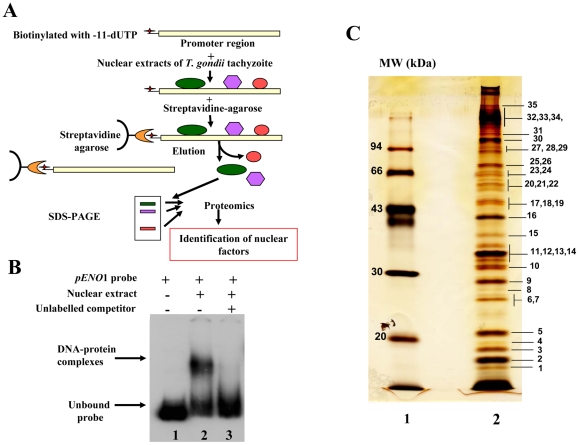
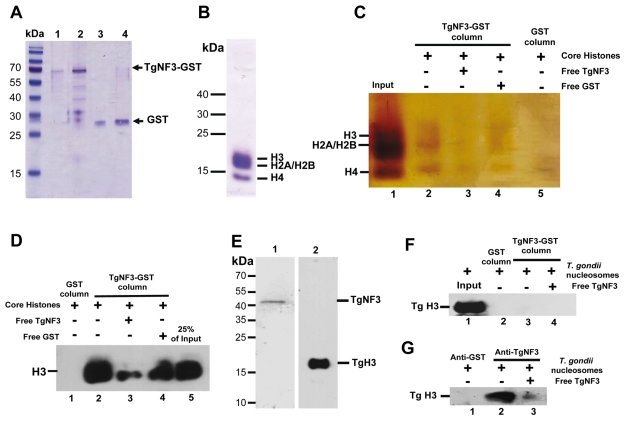
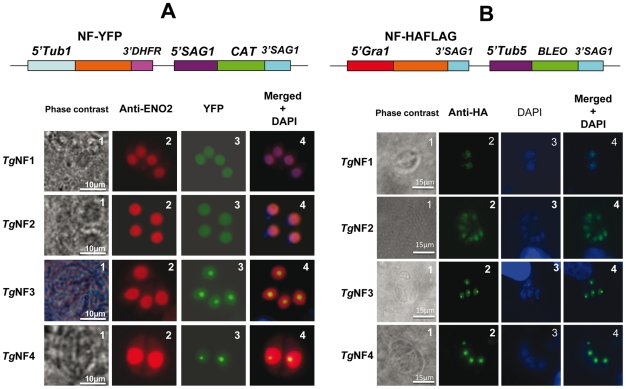
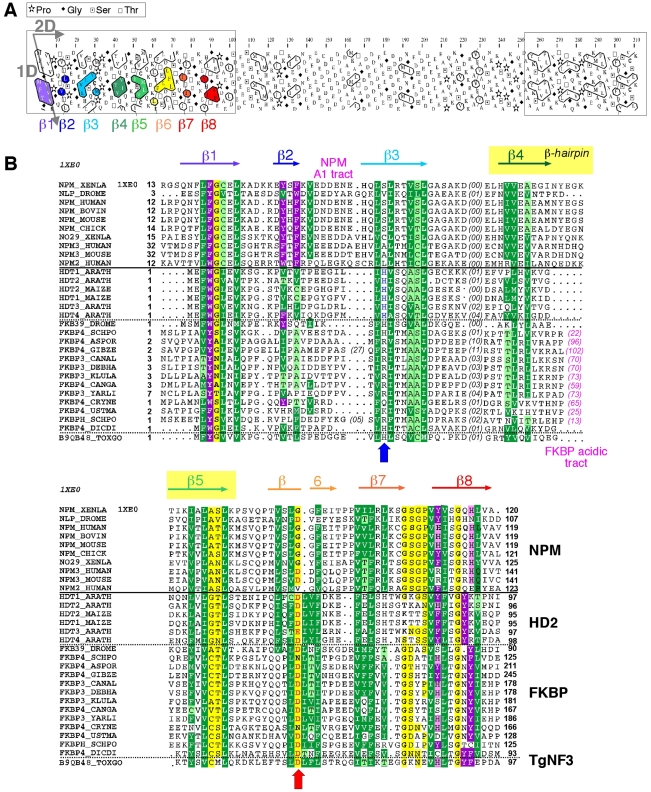
In Toxoplasma gondii, cis-acting elements present in promoter sequences of genes that are stage-specifically regulated have been described. However, the nuclear factors that bind to these cis-acting elements and regulate promoter activities have not been identified. In the present study, we performed affinity purification, followed by proteomic analysis, to identify nuclear factors that bind to a stage-specific promoter in T. gondii. This led to the identification of several nuclear factors in T. gondii including a novel factor, designated herein as TgNF3. The N-terminal domain of TgNF3 shares similarities with the N-terminus of yeast nuclear FK506-binding protein (FKBP), known as a histone chaperone regulating gene silencing. Using anti-TgNF3 antibodies, HA-FLAG and YFP-tagged TgNF3, we show that TgNF3 is predominantly a parasite nucleolar, chromatin-associated protein that binds specifically to T. gondii gene promoters in vivo. Genome-wide analysis using chromatin immunoprecipitation followed by high-throughput sequencing (ChIP-seq) identified promoter occupancies by TgNF3. In addition, TgNF3 has a direct role in transcriptional control of genes involved in parasite metabolism, transcription and translation. The ectopic expression of TgNF3 in the tachyzoites revealed dynamic changes in the size of the nucleolus, leading to a severe attenuation of virulence in vivo. We demonstrate that TgNF3 physically interacts with H3, H4 and H2A/H2B assembled into bona fide core and nucleosome-associated histones. Furthermore, TgNF3 interacts specifically to histones in the context of stage-specific gene silencing of a promoter that lacks active epigenetic acetylated histone marks. In contrast to virulent tachyzoites, which express the majority of TgNF3 in the nucleolus, the protein is exclusively located in the cytoplasm of the avirulent bradyzoites. We propose a model where TgNF3 acts essentially to coordinate nucleolus and nuclear functions by modulating nucleosome activities during the intracellular proliferation of the virulent tachyzoites of T. gondii.
在刚地弓形虫中,已经描述了在阶段特异性调节的基因启动子序列中存在的顺式作用元件。然而,与这些顺式作用元件结合并调节启动子活性的核因子尚未被鉴定。在本研究中,我们进行了亲和纯化,随后进行了蛋白质组学分析,以鉴定与刚地弓形虫阶段特异性启动子结合的核因子。这导致鉴定了刚地弓形虫中的几种核因子,包括一种新型因子,在此命名为 TgNF3。TgNF3 的 N 端结构域与酵母核 FK506 结合蛋白(FKBP)的 N 端相似,后者是一种调节基因沉默的组蛋白伴侣。使用抗 TgNF3 抗体、HA-FLAG 和 YFP 标记的 TgNF3,我们表明 TgNF3 主要是寄生虫核仁、染色质相关蛋白,它在体内特异性结合刚地弓形虫基因启动子。使用染色质免疫沉淀 followed by high-throughput sequencing (ChIP-seq) 的全基因组分析鉴定了 TgNF3 的启动子占据。此外,TgNF3 在寄生虫代谢、转录和翻译相关基因的转录控制中具有直接作用。TgNF3 在速殖子中的异位表达导致核仁大小发生动态变化,从而导致体内毒力严重减弱。我们证明 TgNF3 与组装成真正核心和核小体相关组蛋白的 H3、H4 和 H2A/H2B 直接相互作用。此外,TgNF3 在缺乏活性表观遗传乙酰化组蛋白标记的阶段特异性基因沉默的启动子中特异性地与组蛋白相互作用。与表达大多数 TgNF3 的毒力速殖子不同,该蛋白仅位于无毒性缓殖子的细胞质中。我们提出了一个模型,其中 TgNF3 通过在刚地弓形虫的毒力速殖子的细胞内增殖过程中调节核小体活性,主要协调核仁与核功能。