Wellcome Trust Centre for Molecular Parasitology, Institute of Infection, Immunity and Inflammation, College of Medical, Veterinary and Life Sciences, University of Glasgow, Glasgow, United Kingdom.
PLoS Negl Trop Dis. 2011 Apr 5;5(4):e1033. doi: 10.1371/journal.pntd.0001033.
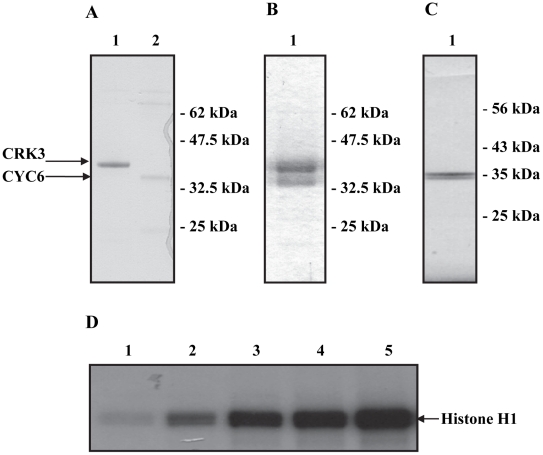
Leishmania species are parasitic protozoa that have a tightly controlled cell cycle, regulated by cyclin-dependent kinases (CDKs). Cdc2-related kinase 3 (CRK3), an essential CDK in Leishmania and functional orthologue of human CDK1, can form an active protein kinase complex with Leishmania cyclins CYCA and CYC6. Here we describe the identification and synthesis of specific small molecule inhibitors of bacterially expressed Leishmania CRK3:CYC6 using a high throughput screening assay and iterative chemistry. We also describe the biological activity of the molecules against Leishmania parasites.
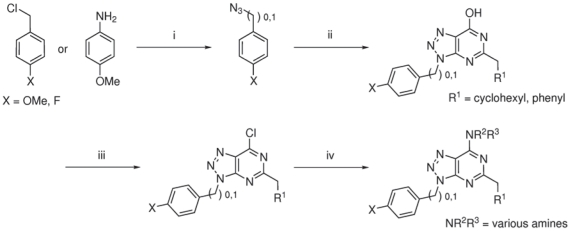
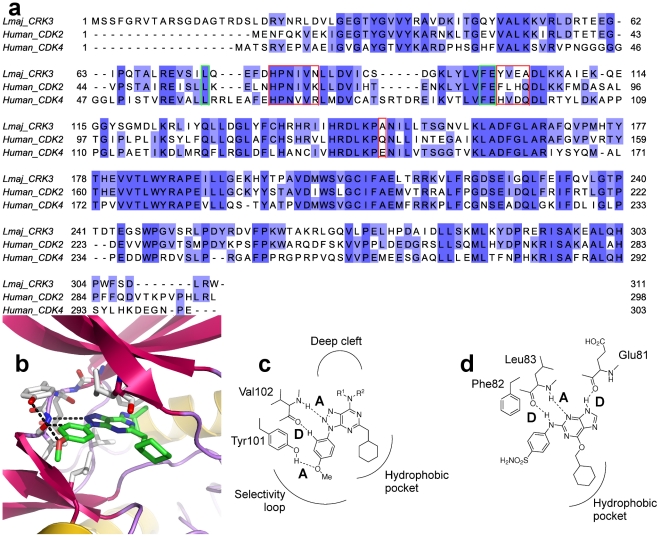
METHODOLOGY/PRINCIPAL FINDINGS: In order to obtain an active Leishmania CRK3:CYC6 protein kinase complex, we developed a co-expression and co-purification system for Leishmania CRK3 and CYC6 proteins. This active enzyme was used in a high throughput screening (HTS) platform, utilising an IMAP fluorescence polarisation assay. We carried out two chemical library screens and identified specific inhibitors of CRK3:CYC6 that were inactive against the human cyclin-dependent kinase CDK2:CycA. Subsequently, the best inhibitors were tested against 11 other mammalian protein kinases. Twelve of the most potent hits had an azapurine core with structure activity relationship (SAR) analysis identifying the functional groups on the 2 and 9 positions as essential for CRK3:CYC6 inhibition and specificity against CDK2:CycA. Iterative chemistry allowed synthesis of a number of azapurine derivatives with one, compound 17, demonstrating anti-parasitic activity against both promastigote and amastigote forms of L. major. Following the second HTS, 11 compounds with a thiazole core (active towards CRK3:CYC6 and inactive against CDK2:CycA) were tested. Ten of these hits demonstrated anti-parasitic activity against promastigote L. major.
CONCLUSIONS/SIGNIFICANCE: The pharmacophores identified from the high throughput screens, and the derivatives synthesised, selectively target the parasite enzyme and represent compounds for future hit-to-lead synthesis programs to develop therapeutics against Leishmania species. Challenges remain in identifying specific CDK inhibitors with both target selectivity and potency against the parasite.
利什曼原虫是一种寄生的原生动物,其细胞周期受到严格控制,由细胞周期蛋白依赖性激酶(CDKs)调节。CDC2 相关激酶 3(CRK3)是利什曼原虫中必不可少的 CDK,是人类 CDK1 的功能同源物,可与利什曼原虫细胞周期蛋白 CYCA 和 CYC6 形成活性蛋白激酶复合物。在这里,我们描述了使用高通量筛选测定法和迭代化学合成来鉴定和合成特定的细菌表达的利什曼原虫 CRK3:CYC6 的小分子抑制剂。我们还描述了这些分子对利什曼原虫寄生虫的生物学活性。
方法/主要发现:为了获得活性的利什曼原虫 CRK3:CYC6 蛋白激酶复合物,我们开发了一种用于利什曼原虫 CRK3 和 CYC6 蛋白的共表达和共纯化系统。该活性酶用于高通量筛选(HTS)平台,利用 IMAP 荧光偏振测定法。我们进行了两次化学文库筛选,并鉴定了 CRK3:CYC6 的特异性抑制剂,这些抑制剂对人类细胞周期蛋白依赖性激酶 CDK2:CycA 无活性。随后,对其他 11 种哺乳动物蛋白激酶进行了最佳抑制剂的测试。12 个最有效的候选物具有一个氮杂嘌呤核心,结构活性关系(SAR)分析确定了 2 位和 9 位的功能基团对 CRK3:CYC6 抑制和对 CDK2:CycA 的特异性是必不可少的。迭代化学允许合成许多氮杂嘌呤衍生物,其中一种化合物 17,对 L. major 的前鞭毛体和无鞭毛体形式均具有抗寄生虫活性。在第二次 HTS 之后,测试了具有噻唑核心的 11 种化合物(对 CRK3:CYC6 有效且对 CDK2:CycA 无效)。其中 10 个对前鞭毛体 L. major 具有抗寄生虫活性。
结论/意义:高通量筛选中确定的药效团,以及合成的衍生物,选择性地针对寄生虫酶,代表了针对利什曼原虫物种开发治疗药物的未来从命中到先导的合成计划中的化合物。在鉴定对寄生虫具有靶选择性和效力的特定 CDK 抑制剂方面仍然存在挑战。