Gastro-Immuno Research Laboratory (GIRL), Department of Medicine V, Aarhus University Hospital, and Institute of Molecular Biology, Aarhus University, Aarhus, Denmark.
PLoS One. 2011 Mar 31;6(3):e17890. doi: 10.1371/journal.pone.0017890.
Concominant with the widespread use of combined immunotherapy in the management of Crohn's disease (CD), the incidence of hepato-splenic gamma-delta (γδ)-T cell lymphoma has increased sharply in CD patients. Malignant transformation of lymphocytes is believed to be a multistep process resulting in the selection of malignant γδ-T cell clones. We hypothesised that repeated infusion of anti-TNF-α agents may induce clonal selection and that concurrent treatment with immunomodulators further predisposes patients to γδ-T cell expansion.
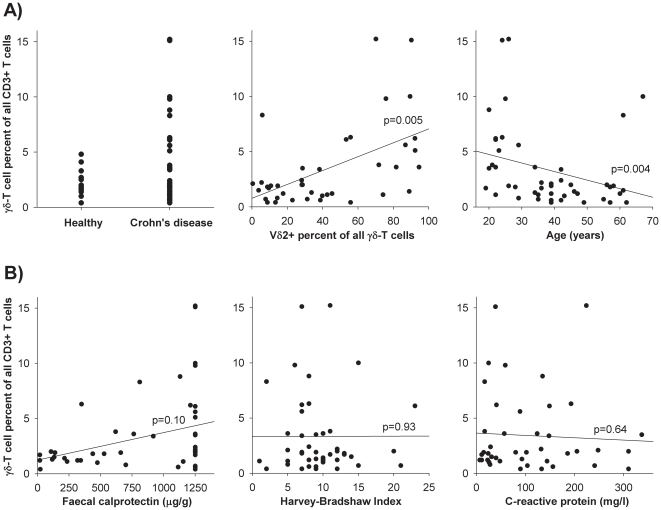
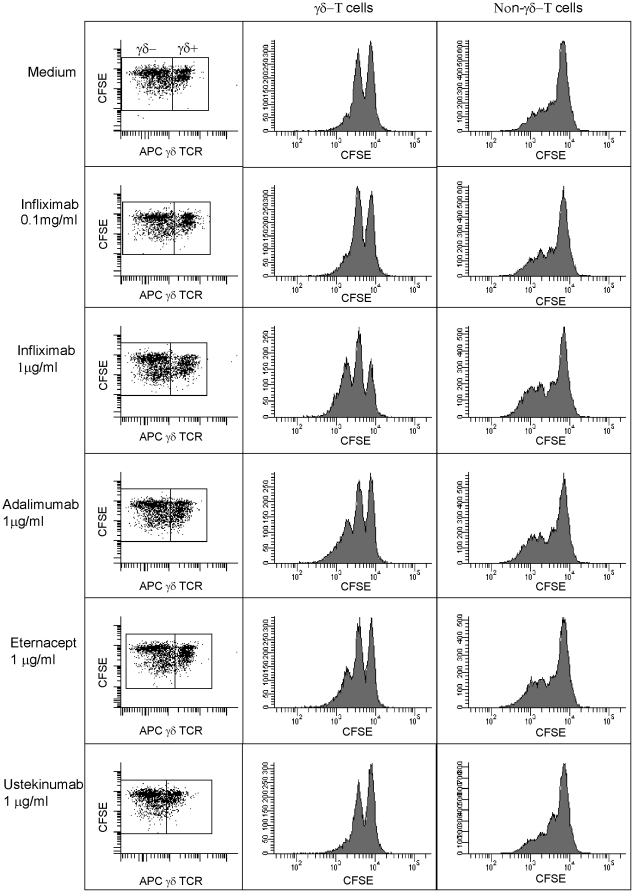
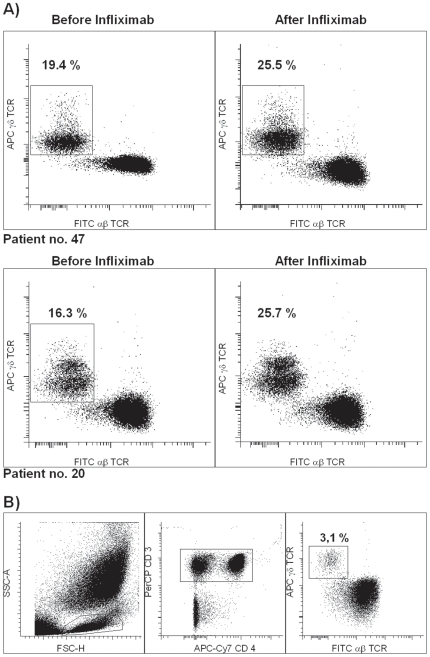
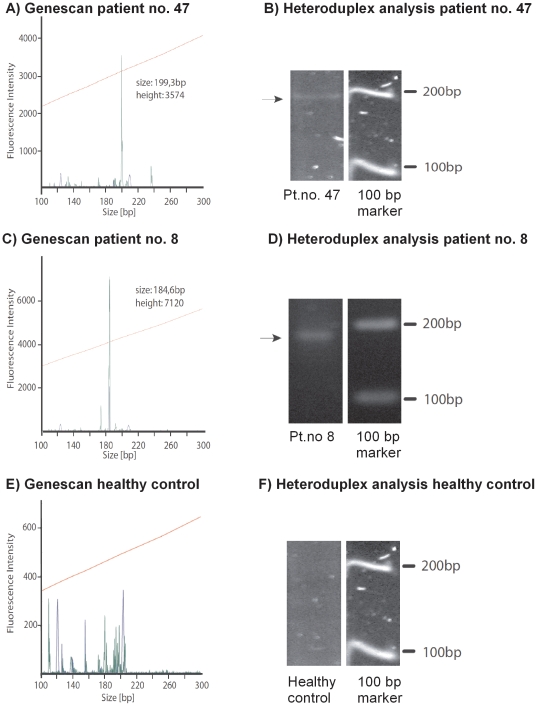
METHODOLOGY/PRINCIPAL FINDINGS: We investigated dynamic changes in the γδ-T cells of patient with CD following treatment with infliximab (Remicade®; n=20) or adalimumab (Humira®; n=26) using flow cytometry. In patients with a high γδ-T cell level, the γδ-T cells were assessed for clonality. Of these 46 CD patients, 35 had a γδ-T cells level (mean 1.6%) comparable to healthy individuals (mean 2.2%), and 11 CD patients (24%) exhibited an increased level of γδ-T cells (5-15%). In the 18 patients also receiving thiopurines or methotrexate, the average baseline γδ-T cell level was 4.4%. In three male CD patients with a high baseline value, the γδ-T cell population increased dramatically following infliximab therapy. A fourth male patient also on infliximab monotherapy presented with 20% γδ-T cells, which increased to 25% shortly after treatment and was 36% between infusions. Clonality studies revealed an oligoclonal γδ-T cell pattern with dominant γδ-T cell clones. In support of our clinical findings, in vitro experiments showed a dose-dependent proliferative effect of anti-TNF-α agents on γδ-T cells.
CONCLUSION/SIGNIFICANCE: CD patients treated with immunomodulators had constitutively high levels of γδ-T cells. Infliximab exacerbated clonal γδ-T cell expansion in vivo and induced γδ-T cell proliferation in vitro. Overall, young, male CD patients with high baseline γδ-T cell levels may be at an increased risk of developing malignant γδ-T cell lymphomas following treatment with anti-TNF-α agents.
随着联合免疫疗法在克罗恩病(CD)治疗中的广泛应用,CD 患者的肝脾γδ-T 细胞淋巴瘤的发病率急剧上升。淋巴细胞的恶性转化被认为是一个多步骤的过程,导致恶性γδ-T 细胞克隆的选择。我们假设重复输注抗 TNF-α 药物可能会诱导克隆选择,而同时使用免疫调节剂会进一步使患者更容易发生γδ-T 细胞扩增。
方法/主要发现:我们使用流式细胞术研究了接受英夫利昔单抗(Remicade®;n=20)或阿达木单抗(Humira®;n=26)治疗的 CD 患者的γδ-T 细胞的动态变化。在γδ-T 细胞水平较高的患者中,评估了γδ-T 细胞的克隆性。在这 46 名 CD 患者中,有 35 名患者的γδ-T 细胞水平(平均 1.6%)与健康个体(平均 2.2%)相当,有 11 名 CD 患者(24%)的γδ-T 细胞水平升高(5-15%)。在 18 名同时接受硫唑嘌呤或甲氨蝶呤治疗的患者中,平均基线γδ-T 细胞水平为 4.4%。在 3 名基线值较高的男性 CD 患者中,英夫利昔单抗治疗后γδ-T 细胞群显著增加。第 4 名接受英夫利昔单抗单药治疗的男性患者也出现了 20%的γδ-T 细胞,治疗后不久增加到 25%,两次输注之间为 36%。克隆性研究显示出寡克隆γδ-T 细胞模式,存在主导性的γδ-T 细胞克隆。支持我们的临床发现,体外实验显示抗 TNF-α 药物对γδ-T 细胞具有剂量依赖性的增殖作用。
结论/意义:接受免疫调节剂治疗的 CD 患者的γδ-T 细胞水平持续升高。英夫利昔单抗在体内加剧了克隆性γδ-T 细胞的扩增,并在体外诱导了γδ-T 细胞的增殖。总体而言,基线γδ-T 细胞水平较高的年轻男性 CD 患者在接受抗 TNF-α 药物治疗后,发生恶性γδ-T 细胞淋巴瘤的风险可能会增加。