LaCount Lauren T, Barbieri Riccardo, Park Kyungmo, Kim Jieun, Brown Emery N, Kuo Braden, Napadow Vitaly
Martinos Center for Biomedical Imaging, Department of Radiology, Massachusetts General Hospital, 149 Thirteenth St., #2301, Charlestown, MA 02129, USA.
Aviat Space Environ Med. 2011 Apr;82(4):424-33. doi: 10.3357/asem.2932.2011.
Nausea is a commonly occurring symptom typified by epigastric discomfort with urge to vomit. The relationship between autonomic nervous system (ANS) outflow and increasing nausea perception is not fully understood.
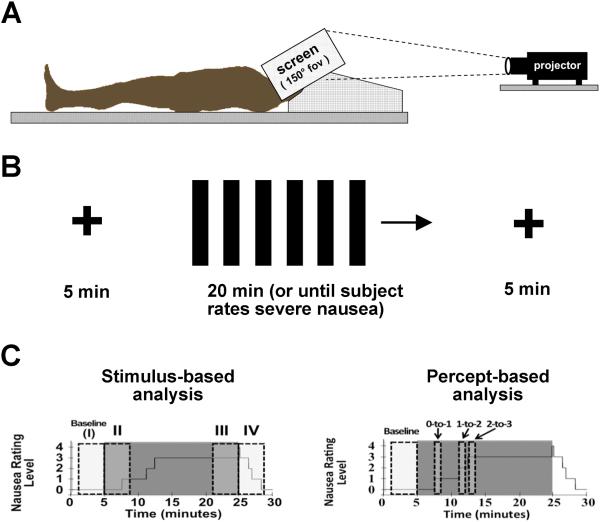
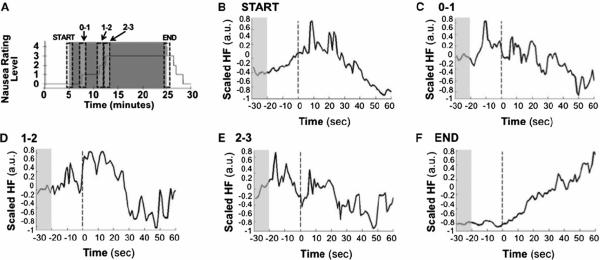
Our study employed a nauseogenic visual stimulus (horizontally translating stripes) while 17 female subjects freely rated transitions in nausea level and autonomic outflow was measured (heart rate, HR; heart rate variability, HRV; skin conductance response, SCR; respiratory rate). We also adopted a recent approach to continuous high-frequency (HF) HRV estimation to evaluate dynamic cardiovagal modulation.
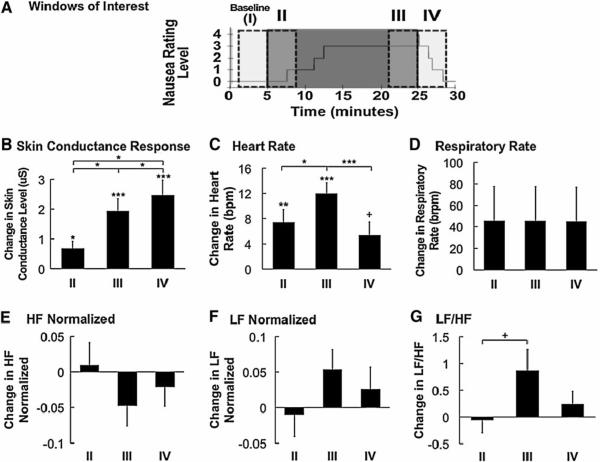
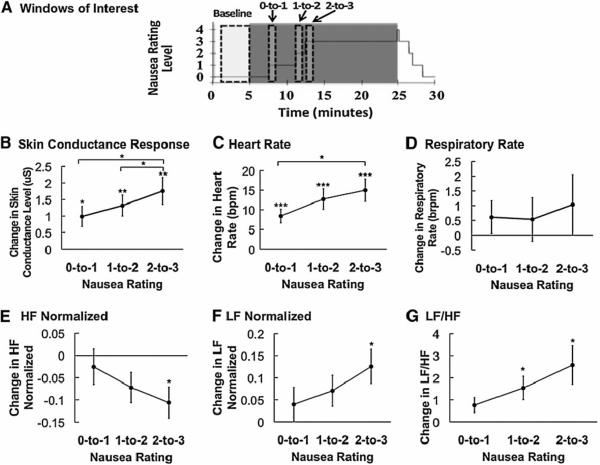
HR increased from baseline for all increasing nausea transitions, especially transition to strong nausea (15.0 +/- 11.4 bpm), but decreased (-6.6 +/- 4.6 bpm) once the visual stimulus ceased. SCR also increased for all increasing nausea transitions, especially transition to strong nausea (1.76 +/- 1.68 microS), but continued to increase (0.52 +/- 0.65 microS) once visual stimulation ceased. LF/HF HRV increased following transition to moderate (1.54 +/- 2.11 a.u.) and strong (2.57 +/- 3.49 a.u.) nausea, suggesting a sympathetic shift in sympathovagal balance. However, dynamic HF HRV suggested that bursts of cardiovagal modulation precede transitions to higher nausea, perhaps influencing subjects to rate higher levels of nausea. No significant change in respiration rate was found.
Our results suggest that increasing nausea perception is associated with both increased sympathetic and decreased parasympathetic ANS modulation. These findings corroborate past ANS studies of nausea, applying perception-linked analyses and dynamic estimation of cardiovagal modulation in response to nausea.
恶心是一种常见症状,表现为上腹部不适并伴有呕吐冲动。自主神经系统(ANS)输出与恶心感知增加之间的关系尚未完全明确。
我们的研究采用了一种致恶心的视觉刺激(水平移动条纹),17名女性受试者可自由对恶心程度的变化进行评分,并测量自主神经系统输出(心率、HR;心率变异性、HRV;皮肤电导反应、SCR;呼吸频率)。我们还采用了一种最新的连续高频(HF)HRV估计方法来评估动态心脏迷走神经调制。
在所有恶心程度增加的过程中,心率均从基线水平上升,尤其是在转变为强烈恶心时(15.0±11.4次/分钟),但在视觉刺激停止后心率下降(-6.6±4.6次/分钟)。在所有恶心程度增加的过程中,皮肤电导反应也增加,尤其是在转变为强烈恶心时(1.76±1.68微西门子),但在视觉刺激停止后仍继续增加(0.52±0.65微西门子)。在转变为中度(1.54±2.11任意单位)和强烈(2.57±3.49任意单位)恶心后,低频/高频HRV增加,表明交感迷走神经平衡向交感神经方向转变。然而,动态HF HRV表明,心脏迷走神经调制的爆发先于恶心程度升高,这可能影响受试者对更高恶心程度的评分。未发现呼吸频率有显著变化。
我们的结果表明,恶心感知增加与交感神经系统调制增强和副交感神经系统调制减弱均相关。这些发现证实了过去关于恶心的自主神经系统研究,应用了与感知相关的分析以及对恶心反应的心脏迷走神经调制的动态估计。