School of Biological Sciences, University of Hong Kong, Hong Kong SAR, China.
Virol J. 2011 Apr 12;8:164. doi: 10.1186/1743-422X-8-164.
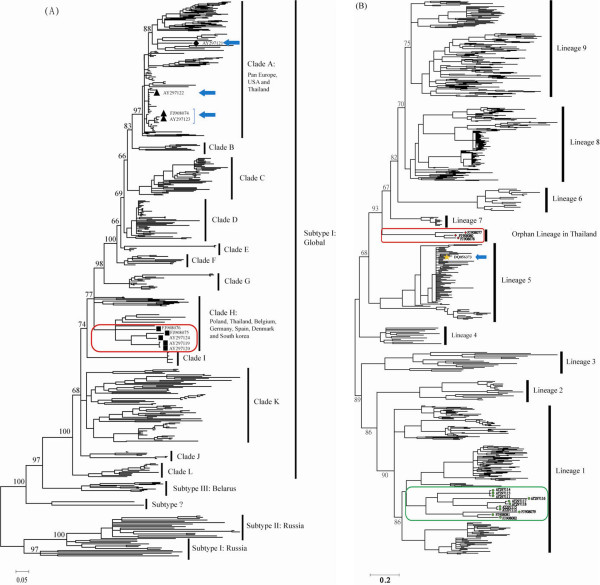
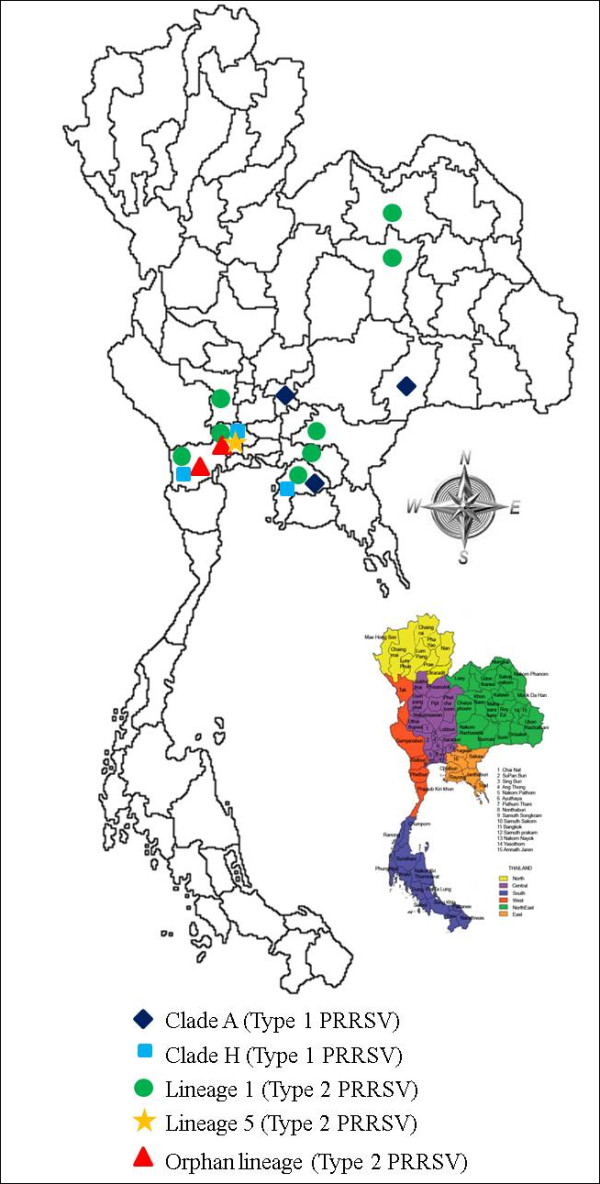
Porcine reproductive and respiratory syndrome virus (PRRSV) is prevalent in Thailand, causing a huge impact on the country's swine industry. Yet the diversity and origin of these Thai PRRSVs remained vague. In this context, we collected all the Thai PRRSV sequences described earlier and incorporated them into the global diversity. The results indicated that PRRSVs in Thailand were originated from multiple introductions involving both Type 1 and Type 2 PRRSVs. Many of the introductions were followed by extensive geographic expansion, causing regional co-circulation of diverse PRRSV variants in three major pig-producing provinces. Based on these results, we suggest (1) to avoid blind vaccination and to apply vaccines tailor-made for target diversity, (2) to monitor pig importation and transportation, and (3) to implement a better biosecurity to reduce horizontal transmissions as three potentially effective strategies of controlling PRRS in Thailand.
猪繁殖与呼吸综合征病毒(PRRSV)在泰国普遍存在,对该国的养猪业造成了巨大影响。然而,这些泰国 PRRSV 的多样性和起源仍不清楚。在这种情况下,我们收集了之前描述的所有泰国 PRRSV 序列,并将其纳入全球多样性中。结果表明,泰国的 PRRSV 是由多种传入引起的,涉及 1 型和 2 型 PRRSV。许多传入事件之后是广泛的地理扩张,导致三个主要养猪省份的不同 PRRSV 变体的区域性共同循环。基于这些结果,我们建议(1)避免盲目接种疫苗,并针对目标多样性应用定制疫苗,(2)监测猪的进口和运输,以及(3)实施更好的生物安全措施以减少水平传播,这是控制泰国 PRRS 的三种潜在有效策略。