Brunet Rachelle, How Maxine, Trigatti Bernardo L
Atherothrombosis Research Group, Department of Biochemistry and Biomedical Sciences, Thrombosis and Atherosclerosis Research Institute, Hamilton Health Sciences, McMaster University, 1200 Main St. W. Hamilton, ON, Canada L8N 3Z5.
Cholesterol. 2011;2011:687939. doi: 10.1155/2011/687939. Epub 2011 Jan 5.
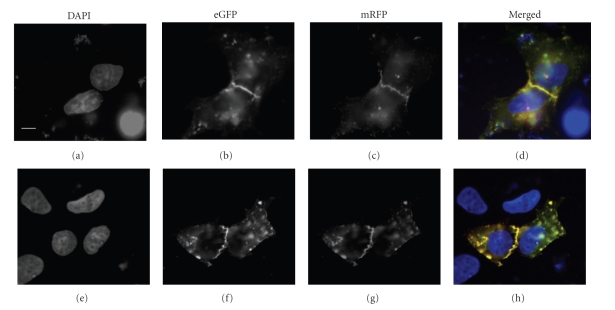
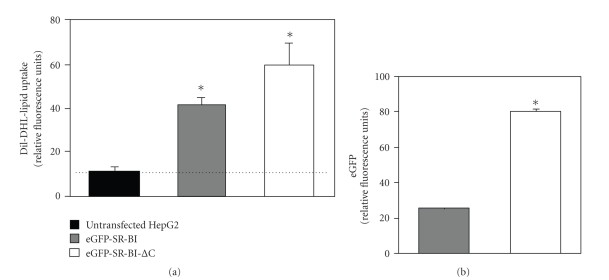
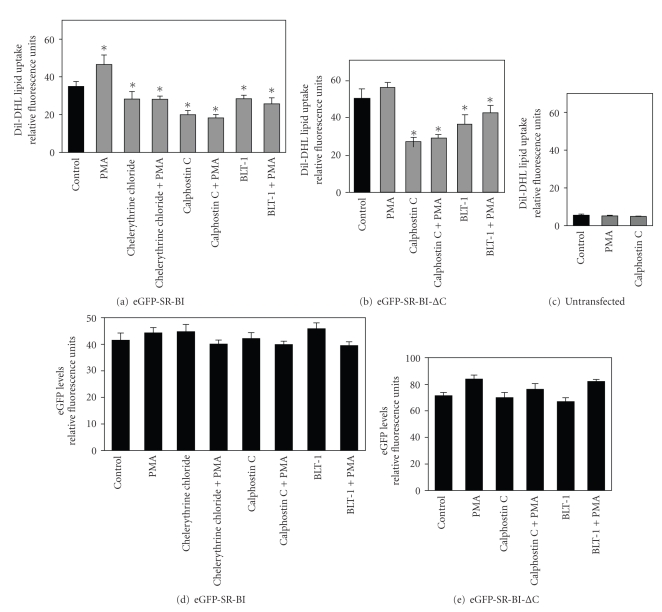
SR-BI is a cell surface HDL receptor that mediates selective uptake of the lipid cargo of HDL, an important process in hepatocytes, driving reverse cholesterol transport from cells in the artery wall. To facilitate examination of factors that modulate SR-BI activity in hepatocytes, we have generated fluorescent protein-tagged versions of SR-BI that allow for facile monitoring of SR-BI protein levels and distribution in transfected cells. We show that deletion of the C-terminal cytosolic tail does not affect the distribution of SR-BI in HepG2 cells, nor is the C-terminal cytosolic tail required for SR-BI-mediated uptake of HDL lipids. We also demonstrate that the phorbol ester, PMA, increased, while protein kinase C inhibitors reduced SR-BI-mediated HDL lipid uptake in HepG2 cells. These data suggest that protein kinase C may modulate selective uptake of HDL lipids including cholesterol in hepatocytes, thereby influencing hepatic HDL cholesterol clearance and reverse cholesterol transport.
SR-BI是一种细胞表面高密度脂蛋白(HDL)受体,它介导HDL脂质成分的选择性摄取,这是肝细胞中的一个重要过程,推动动脉壁细胞内的胆固醇逆向转运。为便于研究调节肝细胞中SR-BI活性的因素,我们构建了荧光蛋白标记的SR-BI变体,可轻松监测转染细胞中SR-BI蛋白的水平和分布。我们发现,删除C末端胞质尾巴不影响SR-BI在HepG2细胞中的分布,且SR-BI介导的HDL脂质摄取也不需要C末端胞质尾巴。我们还证明,佛波酯PMA可增加HepG2细胞中SR-BI介导的HDL脂质摄取,而蛋白激酶C抑制剂则可降低该摄取。这些数据表明,蛋白激酶C可能调节肝细胞中包括胆固醇在内的HDL脂质的选择性摄取,从而影响肝脏HDL胆固醇清除和胆固醇逆向转运。