Wallis Carole L, Mellors John W, Venter Willem D F, Sanne Ian, Stevens Wendy
Department of Molecular Medicine & Hematology, University of the Witwatersrand, Wits Medical School, 3B22, 3rd Floor, 7 York Road, Parktown 2193, South Africa.
AIDS Res Treat. 2011;2011:769627. doi: 10.1155/2011/769627. Epub 2010 Dec 2.
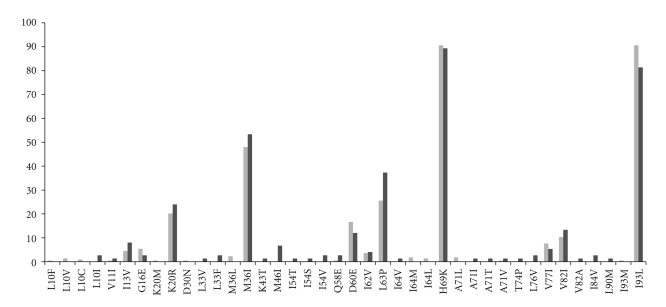
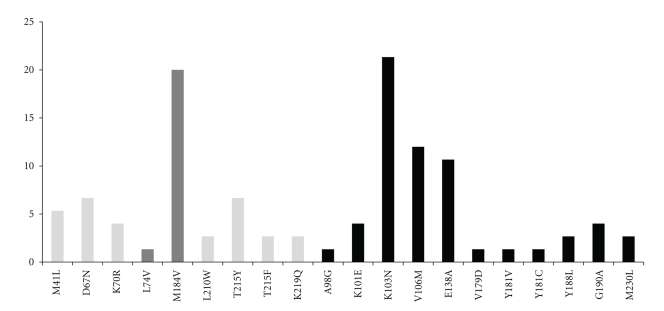
Limited data exist on HIV-1 drug resistance patterns in South Africa following second-line protease-inhibitor containing regimen failure. This study examined drug resistance patterns emerging in 75 HIV-1 infected adults experiencing virologic failure on a second-line regimen containing 2 NRTI and lopinavir/ritonavir. Ninety six percent of patients (n = 72) were infected with HIV-1 subtype C, two patients were infected with HIV-1 subtype D and one with HIV-1 subtype A1. Thirty nine percent (n = 29) of patients had no resistance mutations in protease or reverse transcriptase suggesting that medication non-adherence was a major factor contributing to failure. Major lopinavir resistance mutations were infrequent (5 of 75; 7%), indicating that drug resistance is not the main barrier to future viral suppression.
关于南非在含二线蛋白酶抑制剂的治疗方案失败后HIV-1耐药模式的数据有限。本研究调查了75名感染HIV-1的成年人在含两种核苷类逆转录酶抑制剂(NRTI)和洛匹那韦/利托那韦的二线治疗方案中出现病毒学失败时出现的耐药模式。96%(n = 72)的患者感染了HIV-1 C亚型,两名患者感染了HIV-1 D亚型,一名患者感染了HIV-1 A1亚型。39%(n = 29)的患者在蛋白酶或逆转录酶中没有耐药突变,这表明药物治疗依从性不佳是导致治疗失败的主要因素。主要的洛匹那韦耐药突变并不常见(75例中有5例;7%),这表明耐药性并非未来病毒抑制的主要障碍。