Department of Vascular Biology and Thrombosis Research, Center for Physiology and Pharmacology, Medical University Vienna, Vienna, Austria.
PLoS One. 2011 Apr 7;6(4):e18586. doi: 10.1371/journal.pone.0018586.
The use of spectrally distinct variants of green fluorescent protein (GFP) such as cyan or yellow mutants (CFP and YFP, respectively) is very common in all different fields of life sciences, e.g. for marking specific proteins or cells or to determine protein interactions. In the latter case, the quantum physical phenomenon of fluorescence resonance energy transfer (FRET) is exploited by specific microscopy techniques to visualize proximity of proteins.
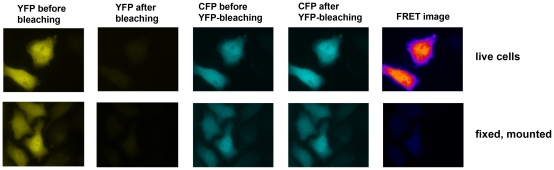
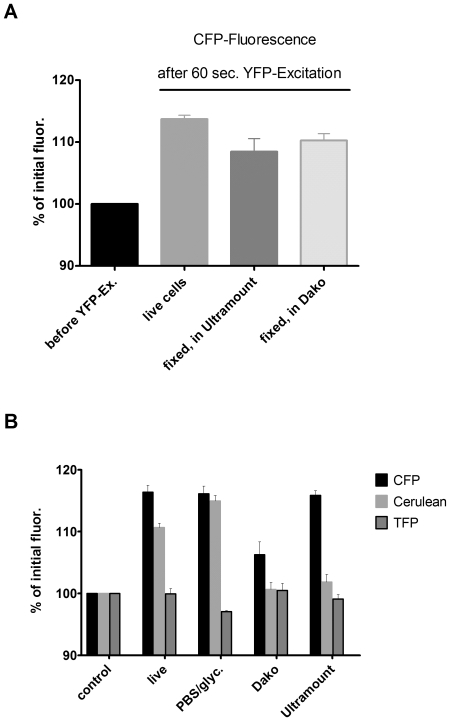
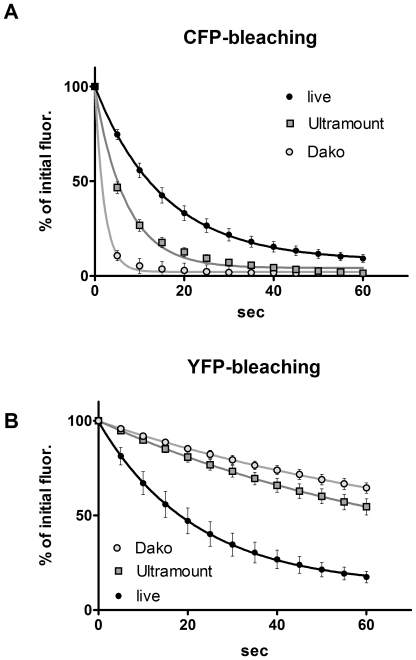
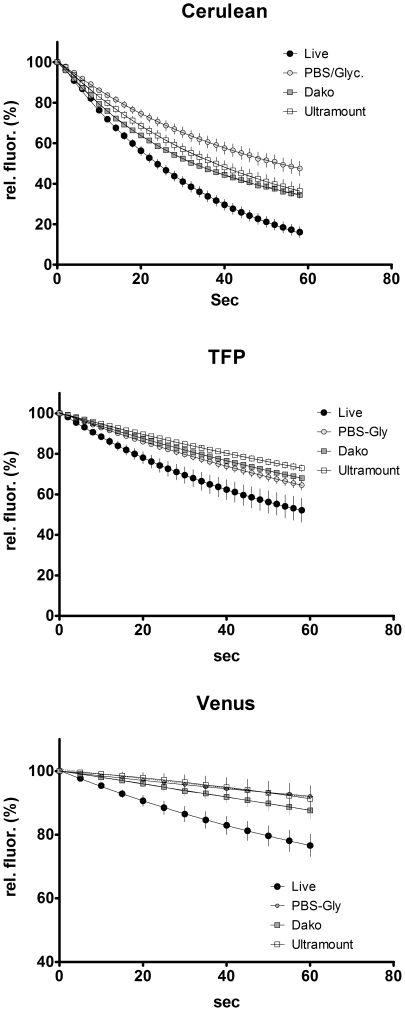
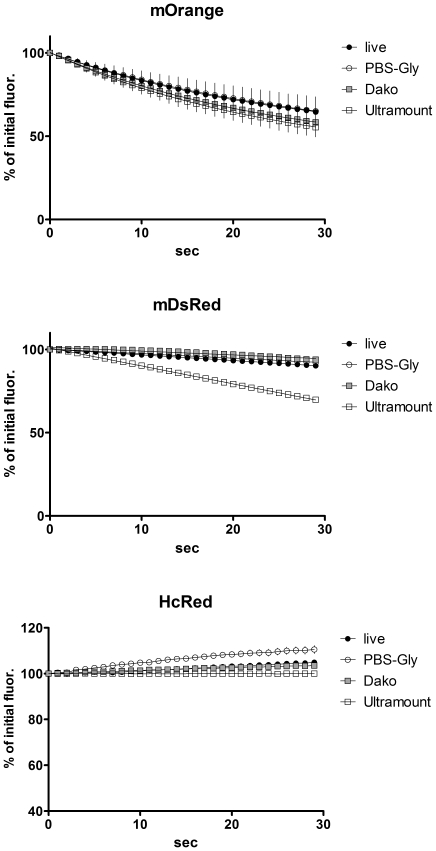
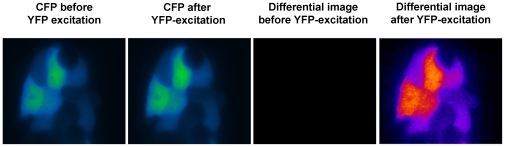
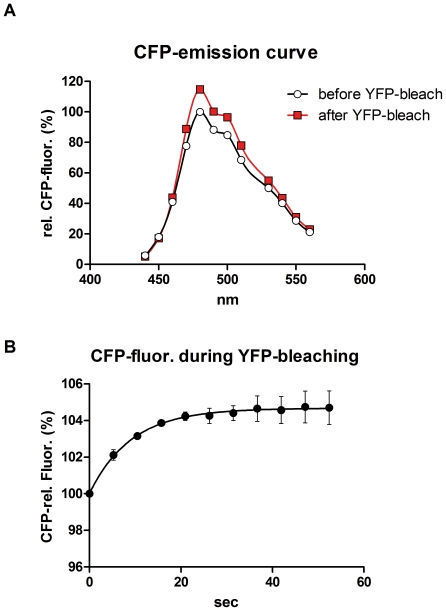
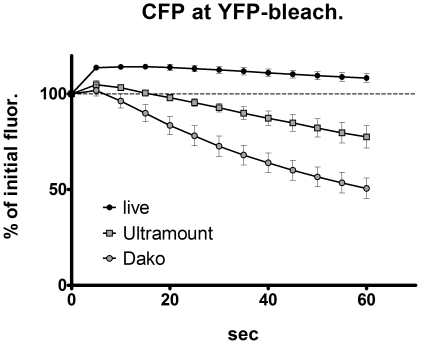
METHODOLOGY/PRINCIPAL FINDINGS: When we applied a commonly used FRET microscopy technique--the increase in donor (CFP)-fluorescence after bleaching of acceptor fluorophores (YFP), we obtained good signals in live cells, but very weak signals for the same samples after fixation and mounting in commercial microscopy mounting fluids. This observation could be traced back to much faster bleaching of CFP in these mounting media. Strikingly, the opposite effect of the mounting fluid was observed for YFP and also for other proteins such as Cerulean, TFP or Venus. The changes in photostability of CFP and YFP were not caused by the fixation but directly dependent on the mounting fluid. Furthermore we made the interesting observation that the CFP-fluorescence intensity increases by about 10-15% after illumination at the YFP-excitation wavelength--a phenomenon, which was also observed for Cerulean. This photoactivation of cyan fluorescent proteins at the YFP-excitation can cause false-positive signals in the FRET-microscopy technique that is based on bleaching of a yellow FRET acceptor.
CONCLUSIONS/SIGNIFICANCE: Our results show that photostability of fluorescent proteins differs significantly for various media and that CFP bleaches significantly faster in commercial mounting fluids, while the opposite is observed for YFP and some other proteins. Moreover, we show that the FRET microscopy technique that is based on bleaching of the YFP is prone to artifacts due to photoactivation of cyan fluorescent proteins under these conditions.
在生命科学的各个领域,例如标记特定蛋白质或细胞或确定蛋白质相互作用,使用光谱上明显不同的绿色荧光蛋白(GFP)变体(分别为青色或黄色突变体,CFP 和 YFP)非常普遍。在后一种情况下,荧光共振能量转移(FRET)的量子物理现象被特定的显微镜技术利用来可视化蛋白质的接近度。
方法/主要发现:当我们应用一种常用的 FRET 显微镜技术——在猝灭供体荧光团(YFP)的荧光后,CFP 的荧光增加,我们在活细胞中获得了良好的信号,但在固定和安装在商业显微镜安装液中的相同样本中,信号非常弱。这种观察可以追溯到这些安装介质中 CFP 更快的猝灭。引人注目的是,对于 YFP 以及其他蛋白质,如 Cerulean、TFP 或 Venus,安装液具有相反的效果。CFP 和 YFP 光稳定性的变化不是由固定引起的,而是直接取决于安装液。此外,我们还观察到一个有趣的现象,即在 YFP 激发波长下照明后,CFP 的荧光强度增加了约 10-15%——这一现象也在 Cerulean 中观察到。这种在 YFP 激发下的青色荧光蛋白的光激活会导致基于黄色 FRET 受体猝灭的 FRET 显微镜技术中产生假阳性信号。
结论/意义:我们的结果表明,荧光蛋白的光稳定性在各种介质中差异很大,并且 CFP 在商业安装液中猝灭得更快,而 YFP 和其他一些蛋白质则相反。此外,我们还表明,基于 YFP 猝灭的 FRET 显微镜技术由于在这些条件下青色荧光蛋白的光激活,容易产生假象。