Department of Biochemistry and Biophysics, Programs in Developmental and Stem Cell Biology, Genetics, and Human Genetics, Institute for Regeneration Medicine, Liver Center, and Diabetes Center, University of California, San Francisco, 1550 Fourth Street, San Francisco, CA 94158, USA.
Curr Biol. 2011 Apr 26;21(8):712-7. doi: 10.1016/j.cub.2011.03.041. Epub 2011 Apr 14.
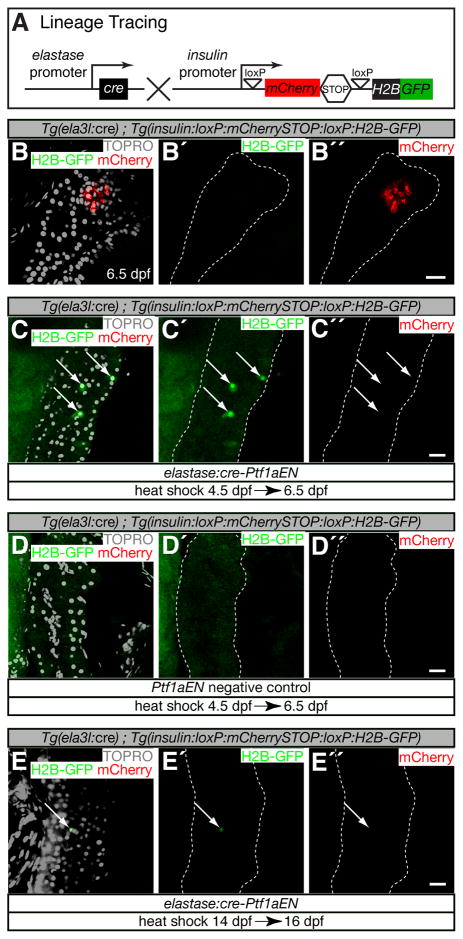
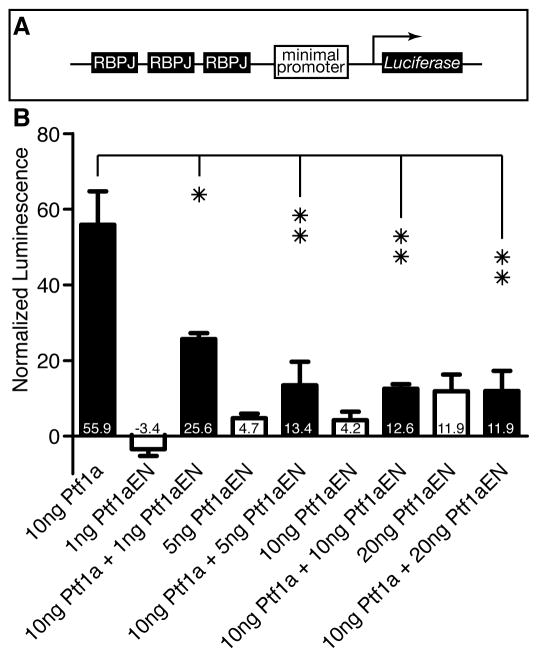
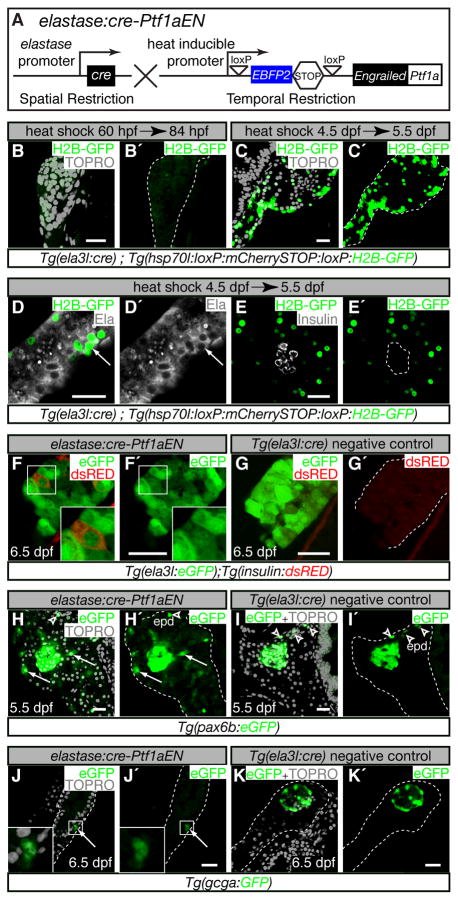
Pluripotent embryonic cells become progressively lineage restricted during development in a process that culminates in the differentiation of stable organ-specific cell types that perform specialized functions. Terminally differentiated pancreatic acinar cells do not have the innate capacity to contribute to the endocrine β cell lineage, which is destroyed in individuals with autoimmune diabetes. Some cell types can be reprogrammed using a single factor, whereas other cell types require continuous activity of transcriptional regulators to repress alternate cell fates. Thus, we hypothesized that a transcriptional network continuously maintains the pancreatic acinar cell fate. We found that postembryonic antagonism of Ptf1a, a master regulator of pancreatic development and acinar cell fate specification, induced the expression of endocrine genes including insulin in the exocrine compartment. Using a genetic lineage tracing approach, we show that the induced insulin+ cells are derived from acinar cells. Cellular reprogramming occurred under homeostatic conditions, suggesting that the pancreatic microenvironment is sufficient to promote endocrine differentiation. Thus, severe experimental manipulations may not be required to potentiate pancreatic transdifferentiation. These data indicate that targeted postembryonic disruption of the acinar cell fate can restore the developmental plasticity that is lost during development.
多能胚胎细胞在发育过程中逐渐受到谱系限制,这个过程最终导致稳定的器官特异性细胞类型的分化,这些细胞类型执行专门的功能。终末分化的胰腺腺泡细胞没有内在能力贡献于内分泌β细胞谱系,而内分泌β细胞谱系在自身免疫性糖尿病患者中被破坏。一些细胞类型可以使用单个因子重新编程,而其他细胞类型则需要转录调节剂的持续活性来抑制替代细胞命运。因此,我们假设一个转录网络持续维持胰腺腺泡细胞命运。我们发现,胚胎后拮抗 Ptf1a(胰腺发育和腺泡细胞命运特化的主调节因子)会诱导包括胰岛素在内的内分泌基因在外分泌区的表达。使用遗传谱系追踪方法,我们表明诱导的胰岛素+细胞来源于腺泡细胞。细胞重编程发生在稳态条件下,表明胰腺微环境足以促进内分泌分化。因此,可能不需要严重的实验操作来增强胰腺转分化。这些数据表明,靶向胚胎后破坏腺泡细胞命运可以恢复在发育过程中丢失的发育可塑性。