Headache Science Center, IRCCS 'C. Mondino Institute of Neurology Foundation, University of Pavia, Via Mondino 2, 27100 Pavia, Italy.
J Headache Pain. 2011 Aug;12(4):427-33. doi: 10.1007/s10194-011-0339-z. Epub 2011 Apr 16.
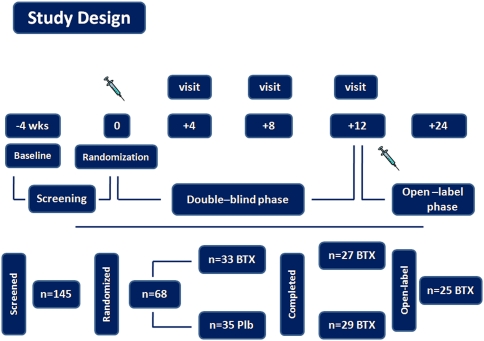
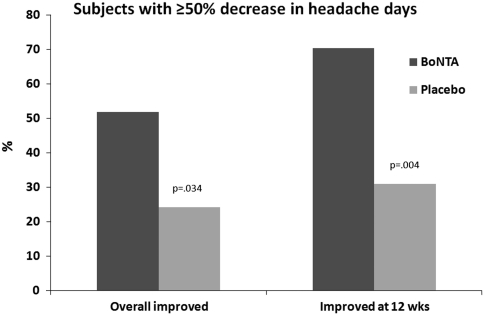
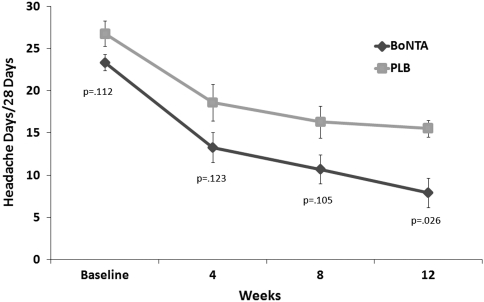
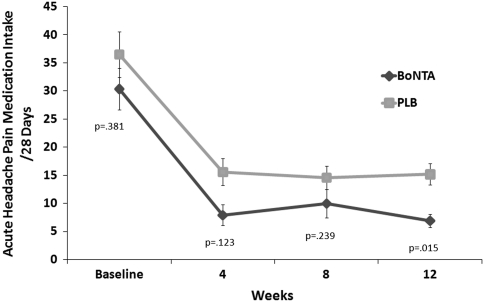
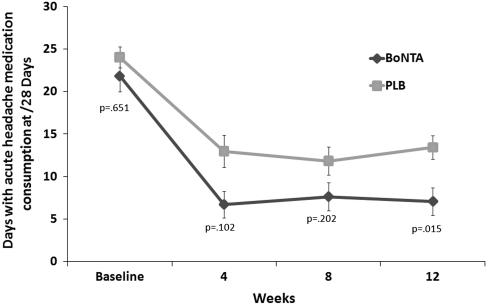
Medication-overuse headache (MOH) represents a severely disabling condition, with a low response to prophylactic treatments. Recently, consistent evidences have emerged in favor of botulinum toxin type-A (onabotulinum toxin A) as prophylactic treatment in chronic migraine. In a 12-week double-blind, parallel group, placebo-controlled study, we tested the efficacy and safety of onabotulinum toxin A as prophylactic treatment for MOH. A total of 68 patients were randomized (1:1) to onabotulinum toxin A (n = 33) or placebo (n = 35) treatment and received 16 intramuscular injections. The primary efficacy end point was mean change from baseline in the frequency of headache days for the 28-day period ending with week 12. No significant differences between onabotulinum toxin A and placebo treatment were detected in the primary (headache days) end point (12.0 vs. 15.9; p = 0.81). A significant reduction was recorded in the secondary end point, mean acute pain drug consumption at 12 weeks in onabotulinum toxin A-treated patients when compared with those with placebo (12.1 vs. 18.0; p = 0.03). When we considered the subgroup of patients with pericranial muscle tenderness, we recorded a significant improvement in those treated with onabotulinum toxin A compared to placebo treated in both primary (headache days) and secondary end points (acute pain drug consumption, days with drug consumption), as well as in pain intensity and disability measures (HIT-6 and MIDAS) at 12 weeks. Onabotulinum toxin A was safe and well tolerated, with few treatment-related adverse events. Few subjects discontinued due to adverse events. Our data identified the presence of pericranial muscle tenderness as predictor of response to onabotulinum toxin A in patients with complicated form of migraine such as MOH, the presence of pericranial muscle tenderness and support it as prophylactic treatment in these patients.
药物过度使用性头痛(MOH)是一种严重致残性疾病,预防性治疗的反应不佳。最近,越来越多的证据表明肉毒毒素 A 型(肉毒毒素 A)作为慢性偏头痛的预防性治疗有效。在一项为期 12 周的双盲、平行组、安慰剂对照研究中,我们测试了肉毒毒素 A 作为 MOH 预防性治疗的疗效和安全性。共有 68 名患者被随机分为(1:1)肉毒毒素 A(n=33)或安慰剂(n=35)治疗组,并接受 16 次肌肉注射。主要疗效终点是治疗 12 周结束时第 28 天头痛天数的平均变化。肉毒毒素 A 与安慰剂治疗在主要(头痛天数)终点(12.0 对 15.9;p=0.81)无显著差异。在次要终点中,肉毒毒素 A 治疗组患者在第 12 周时急性疼痛药物消耗的平均值显著降低,而安慰剂组患者则没有(12.1 对 18.0;p=0.03)。当我们考虑到颅周肌肉压痛的亚组患者时,我们记录到与安慰剂治疗相比,肉毒毒素 A 治疗的患者在主要(头痛天数)和次要终点(急性疼痛药物消耗,药物消耗天数)以及疼痛强度和残疾测量(HIT-6 和 MIDAS)方面均有显著改善在第 12 周。肉毒毒素 A 安全且耐受性良好,仅有少数与治疗相关的不良事件。少数患者因不良事件而停药。我们的数据确定了颅周肌肉压痛的存在是肉毒毒素 A 对 MOH 等复杂形式偏头痛患者有反应的预测因素,颅周肌肉压痛的存在并支持其作为这些患者的预防性治疗。