Clinical Research Division, Fred Hutchinson Cancer Research Center, Seattle, Washington 98109, USA.
Pediatr Blood Cancer. 2011 Aug;57(2):204-9. doi: 10.1002/pbc.23179. Epub 2011 Apr 18.
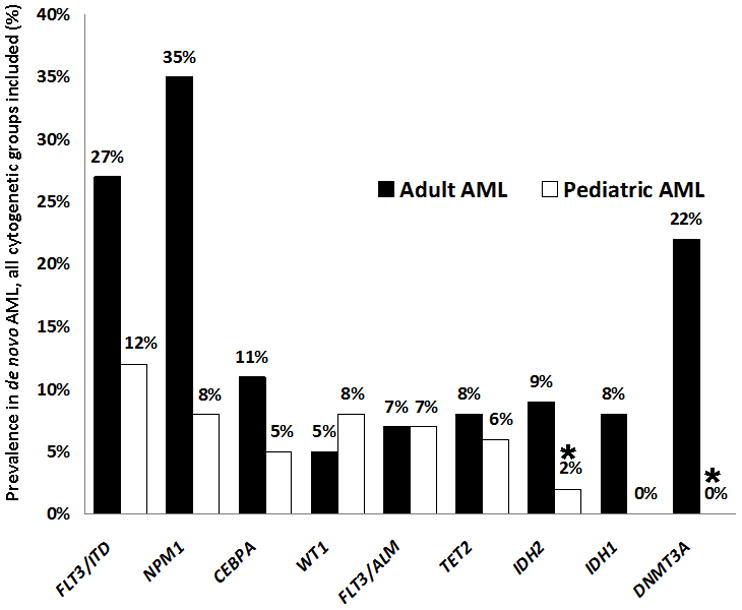
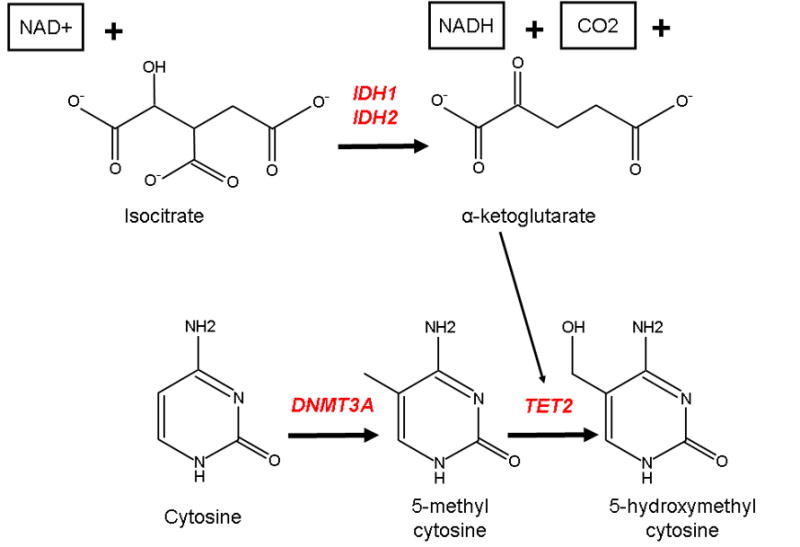
Mutations in the DNMT3A, TET2, IDH1, and IDH2 genes carry prognostic significance and occur frequently in adult acute myeloid leukemia (AML). Leukemic mutations in all four genes have recently been implicated in aberrant DNA methylation, a hallmark of neoplasia. We previously reported that IDH1 mutations were absent, whereas TET2 mutations were present in 6%, of pediatric AML patients; in the present study, we determined the prevalence of DNMT3A and IDH2 mutations in pediatric AML.
We screened for DNMT3A and IDH2 mutations by direct sequencing of diagnostic specimens from 180 children treated on the Children's Oncology Group clinical trial AAML03P1. Clinical characteristics, the presence of other leukemic mutations, and survival outcome was determined for mutation-positive patients.
No disease-associated DNMT3A mutations were detected. IDH2 mutations were detected in 4/180 patients (2.2%), affecting codons R140 (n = 3) and R172 (n = 1). Two patients with IDH2 mutations harbored t(8;21), one patient harbored an MLL translocation, and one patient had a concomitant NPM1 mutation. FLT3, CEBPA, and WT1 mutations did not occur together with IDH2 mutations in our study.
DNMT3A and IDH2 mutations are uncommon in pediatric AML. The low prevalence of methylation-associated mutations in our study highlights the differences in the pathogenesis of pediatric versus adult AML, at the genetic as well as potentially at the epigenetic level. The age-specific characteristics of AML underscore the importance of studying the molecular biology of both childhood and adult forms of this leukemia in parallel, as the development of novel therapeutics should account for these biologic differences.
DNMT3A、TET2、IDH1 和 IDH2 基因突变具有预后意义,并且在成人急性髓系白血病(AML)中经常发生。最近,所有这四个基因的白血病突变都与异常 DNA 甲基化有关,这是肿瘤的一个标志。我们之前报道过 IDH1 突变不存在,但在儿科 AML 患者中存在 6%的 TET2 突变;在本研究中,我们确定了儿科 AML 中 DNMT3A 和 IDH2 突变的流行率。
我们通过直接测序对接受儿童肿瘤学组临床试验 AAML03P1 治疗的 180 名儿童的诊断样本进行了 DNMT3A 和 IDH2 突变筛查。对突变阳性患者进行临床特征、其他白血病突变的存在和生存结果的确定。
未检测到与疾病相关的 DNMT3A 突变。在 180 名患者中发现了 4 例 IDH2 突变(2.2%),影响密码子 R140(n=3)和 R172(n=1)。两名 IDH2 突变患者均伴有 t(8;21),一名患者伴有 MLL 易位,一名患者同时伴有 NPM1 突变。在我们的研究中,FLT3、CEBPA 和 WT1 突变并未与 IDH2 突变同时发生。
DNMT3A 和 IDH2 突变在儿科 AML 中不常见。我们的研究中甲基化相关突变的低发生率突出了儿科 AML 与成人 AML 在发病机制上的差异,不仅在遗传水平上,而且在潜在的表观遗传水平上也是如此。AML 的年龄特异性特征强调了同时研究儿童和成人白血病这两种形式的分子生物学的重要性,因为开发新的治疗方法应该考虑到这些生物学差异。