Department of Psychiatry, Wayne State University School of Medicine, Detroit, MI 48201, USA.
Menopause. 2011 Aug;18(8):897-900. doi: 10.1097/gme.0b013e31820ac941.
The aim of this study was to determine if heart rate variability changes during hot flashes recorded during sleep.
This study was performed in a university medical center laboratory with 16 postmenopausal women demonstrating at least four hot flashes per night. Polysomnography, heart rate, and sternal skin conductance to indicate hot flashes were recorded in controlled, laboratory conditions.
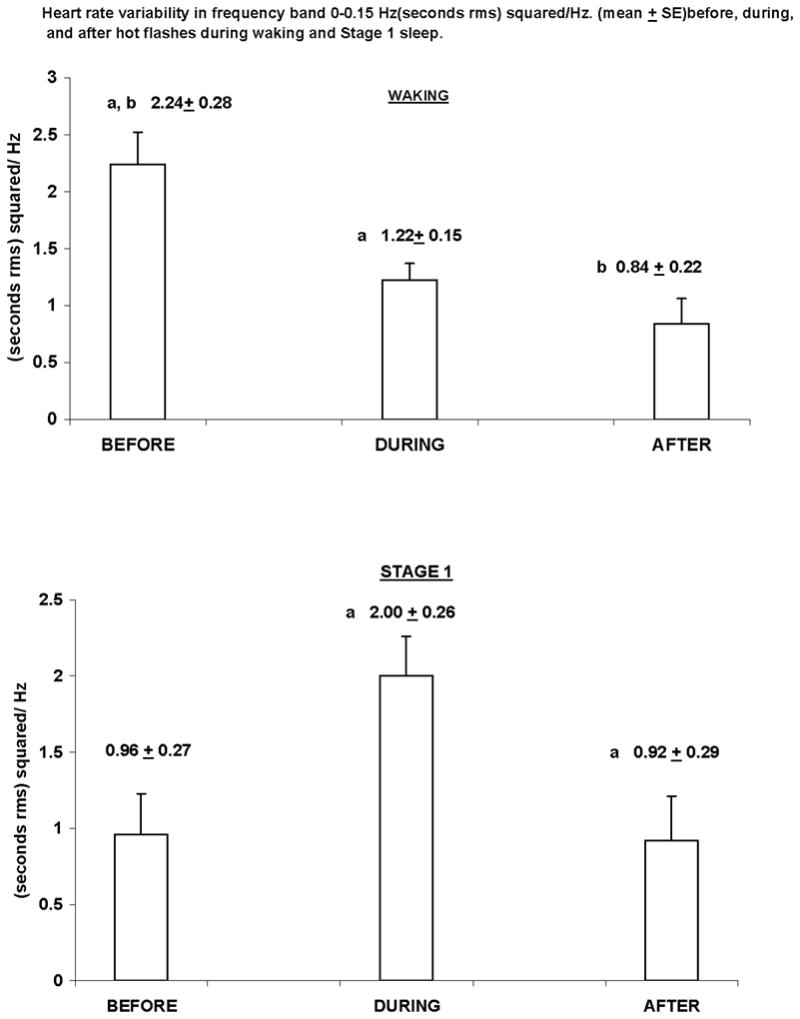
For the frequency bin of 0 to 0.15 Hz, spectral power was greater during waking compared with non-rapid eye movement sleep and less during stages 3 and 4 compared with stages 1 and 2. Power was greater during hot flashes compared with subsequent periods for all hot flashes. Power was greater during hot flashes compared with preceding and subsequent periods for those recorded during stage 1 sleep. For waking hot flashes, power in this band was higher before hot flashes than during or after them.
These data are consistent with our theory of elevated sympathetic activation as a trigger for menopausal hot flashes and with previous work on heart rate variability during the stages of sleep.
本研究旨在确定睡眠期间记录的潮热时心率变异性是否发生变化。
这项研究在大学医学中心实验室进行,纳入了 16 名绝经后妇女,这些妇女每晚至少有 4 次潮热。在受控的实验室条件下,同时记录了多导睡眠图、心率和胸骨皮肤电导率以指示潮热。
对于 0 到 0.15 Hz 的频带,与非快速眼动睡眠相比,在觉醒时的频谱功率更大,与 3 期和 4 期相比,在 1 期和 2 期时的频谱功率更小。与随后的时间段相比,所有的潮热时的频谱功率更大。与记录在 1 期睡眠时的相比,在该频段中,在潮热时的功率大于在其之前和之后的时间段的功率。对于觉醒时的潮热,在潮热之前的该频带中的功率高于在潮热期间或之后的功率。
这些数据与我们关于绝经后潮热时交感神经激活升高作为触发因素的理论以及关于睡眠阶段中心率变异性的先前工作一致。