Molecular Cell Biology, Taiwan International Graduate Program, Institute of Molecular Biology, Academia Sinica, and National Defense Medical Center, Taipei, Taiwan.
PLoS One. 2011 Apr 19;6(4):e18988. doi: 10.1371/journal.pone.0018988.
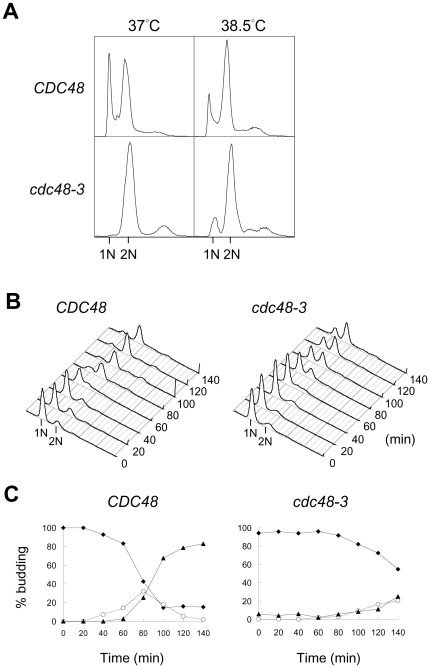
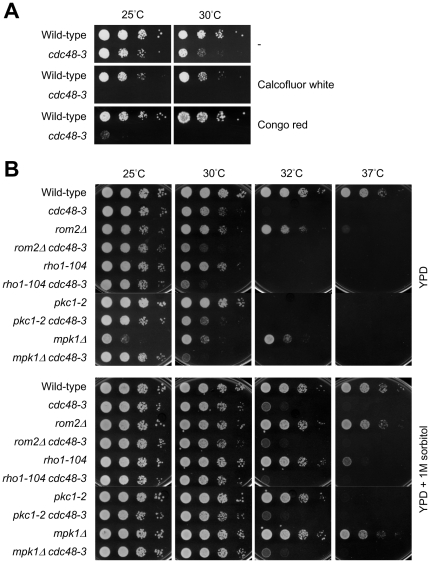
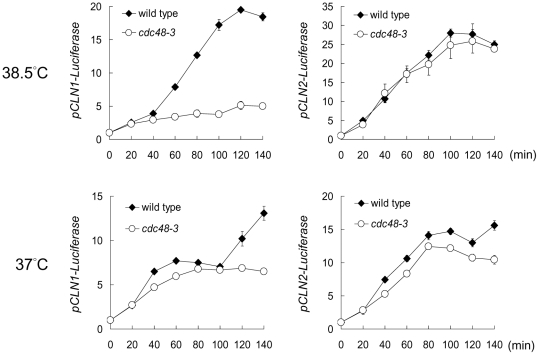
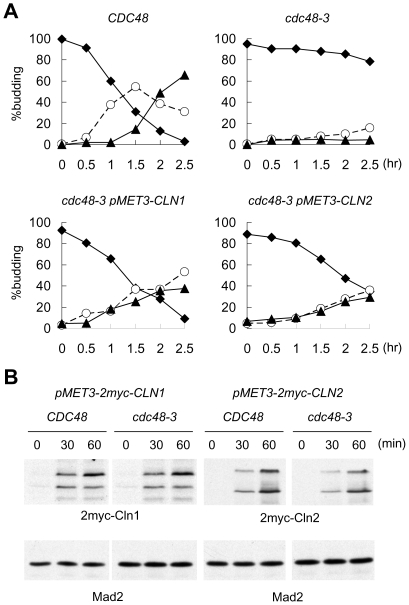
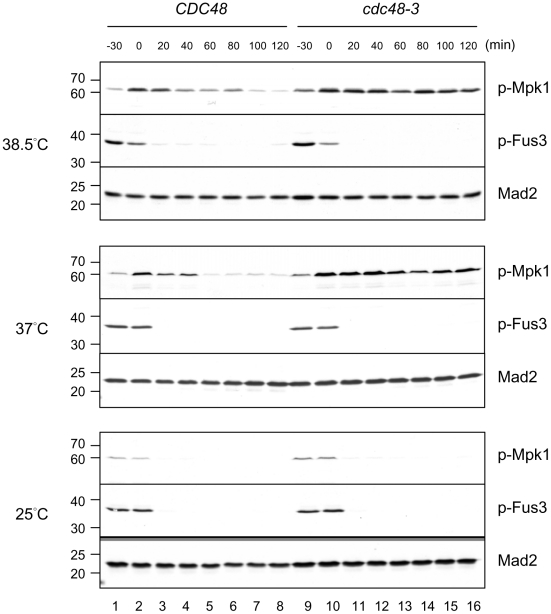
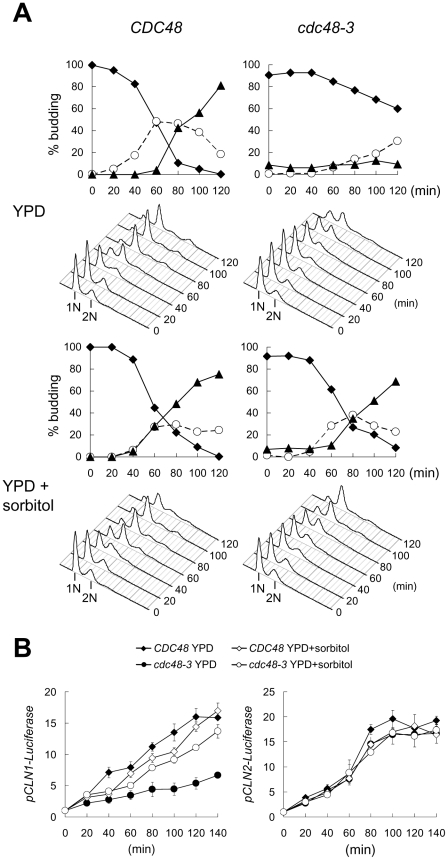
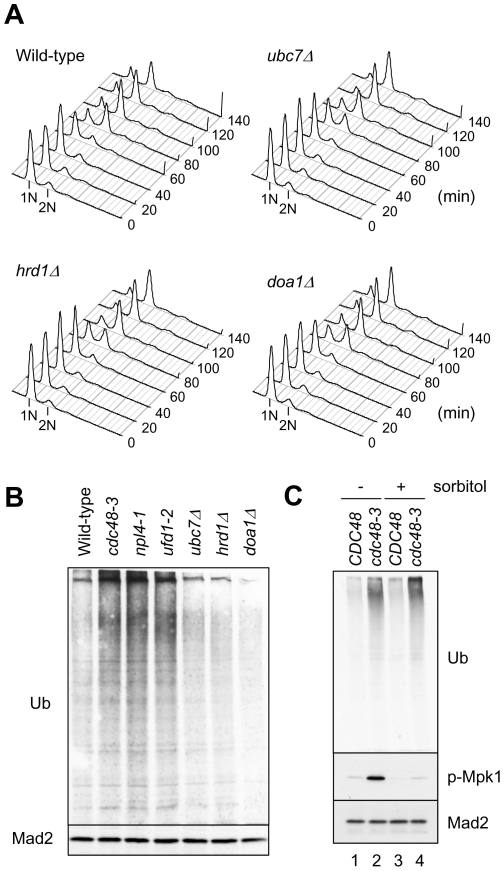
The ubiquitin-selective chaperone Cdc48, a member of the AAA (ATPase Associated with various cellular Activities) ATPase superfamily, is involved in many processes, including endoplasmic reticulum-associated degradation (ERAD), ubiquitin- and proteasome-mediated protein degradation, and mitosis. Although Cdc48 was originally isolated as a cell cycle mutant in the budding yeast Saccharomyces cerevisiae, its cell cycle functions have not been well appreciated. We found that temperature-sensitive cdc48-3 mutant is largely arrested at mitosis at 37°C, whereas the mutant is also delayed in G1 progression at 38.5°C. Reporter assays show that the promoter activity of G1 cyclin CLN1, but not CLN2, is reduced in cdc48-3 at 38.5°C. The cofactor npl4-1 and ufd1-2 mutants also exhibit G1 delay and reduced CLN1 promoter activity at 38.5°C, suggesting that Npl4-Ufd1 complex mediates the function of Cdc48 at G1. The G1 delay of cdc48-3 at 38.5°C is a consequence of cell wall defect that over-activates Mpk1, a MAPK family member important for cell wall integrity in response to stress conditions including heat shock. cdc48-3 is hypersensitive to cell wall perturbing agents and is synthetic-sick with mutations in the cell wall integrity signaling pathway. Our results suggest that the cell wall defect in cdc48-3 is exacerbated by heat shock, which sustains Mpk1 activity to block G1 progression. Thus, Cdc48-Npl4-Ufd1 is important for the maintenance of cell wall integrity in order for normal cell growth and division.
泛素选择性伴侣 Cdc48 是 AAA(与各种细胞活动相关的 ATP 酶)ATP 酶超家族的成员,参与许多过程,包括内质网相关降解(ERAD)、泛素和蛋白酶体介导的蛋白质降解以及有丝分裂。尽管 Cdc48 最初是作为芽殖酵母酿酒酵母中的细胞周期突变体分离出来的,但它的细胞周期功能尚未得到很好的理解。我们发现,温度敏感的 cdc48-3 突变体在 37°C 时主要在有丝分裂中被阻断,而在 38.5°C 时也在 G1 进展中被延迟。报告基因分析表明,在 38.5°C 时,cdc48-3 中的 G1 周期蛋白 CLN1 的启动子活性降低,但 CLN2 则没有。共因子 npl4-1 和 ufd1-2 突变体在 38.5°C 时也表现出 G1 延迟和 CLN1 启动子活性降低,表明 Npl4-Ufd1 复合物介导 Cdc48 在 G1 中的功能。cdc48-3 在 38.5°C 时的 G1 延迟是细胞壁缺陷的结果,该缺陷过度激活了 Mpk1,Mpk1 是 MAPK 家族的一个成员,对于细胞应对包括热休克在内的应激条件下的细胞壁完整性非常重要。cdc48-3 对细胞壁扰动剂敏感,并且与细胞壁完整性信号通路中的突变体表现出合成性疾病。我们的结果表明,cdc48-3 中的细胞壁缺陷在热休克下加剧,这维持了 Mpk1 的活性,从而阻止了 G1 的进展。因此,Cdc48-Npl4-Ufd1 对于维持细胞壁完整性以实现正常的细胞生长和分裂非常重要。