Department of Psychiatry, Behavioral Genetics Laboratory, Harvard Medical School, McLean Hospital, Belmont, Massachusetts, USA.
Biol Psychiatry. 2011 Sep 1;70(5):425-33. doi: 10.1016/j.biopsych.2011.03.017. Epub 2011 Apr 30.
The kappa opioid receptor (KOR) system contributes to the prodepressive and aversive consequences of stress and is implicated in the facilitation of conditioned fear and anxiety in rodents. Here, we sought to identify neural circuits that mediate KOR system effects on fear and anxiety in rats.
We assessed whether fear conditioning induces plasticity in KOR or dynorphin (the endogenous KOR ligand) messenger RNA (mRNA) expression in the basolateral (BLA) and central (CeA) nuclei of the amygdala, hippocampus, or striatum. We then assessed whether microinfusions of the KOR antagonist JDTic (0-10 μg/side) into the BLA or CeA affect the expression of conditioned fear or anxiety. Finally, we examined whether fear extinction induces plasticity in KOR mRNA expression that relates to the quality of fear extinction.
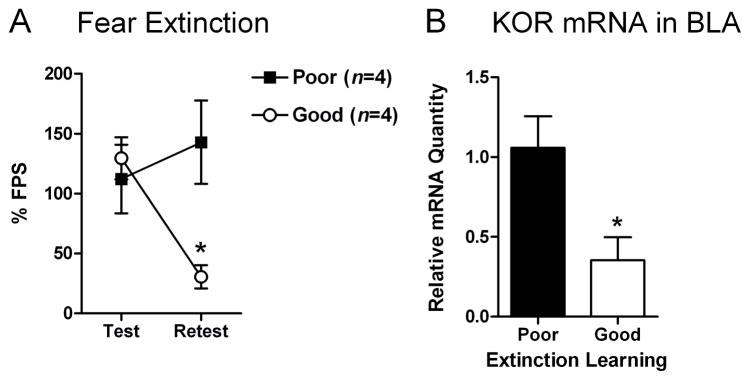
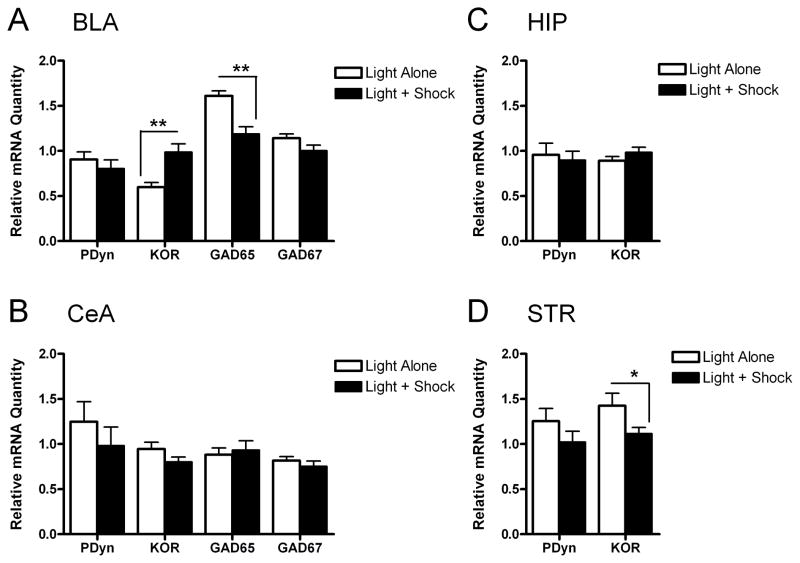
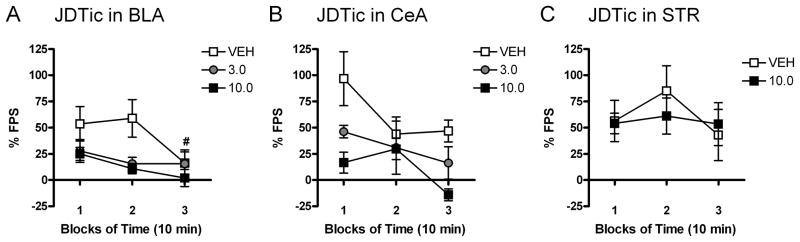
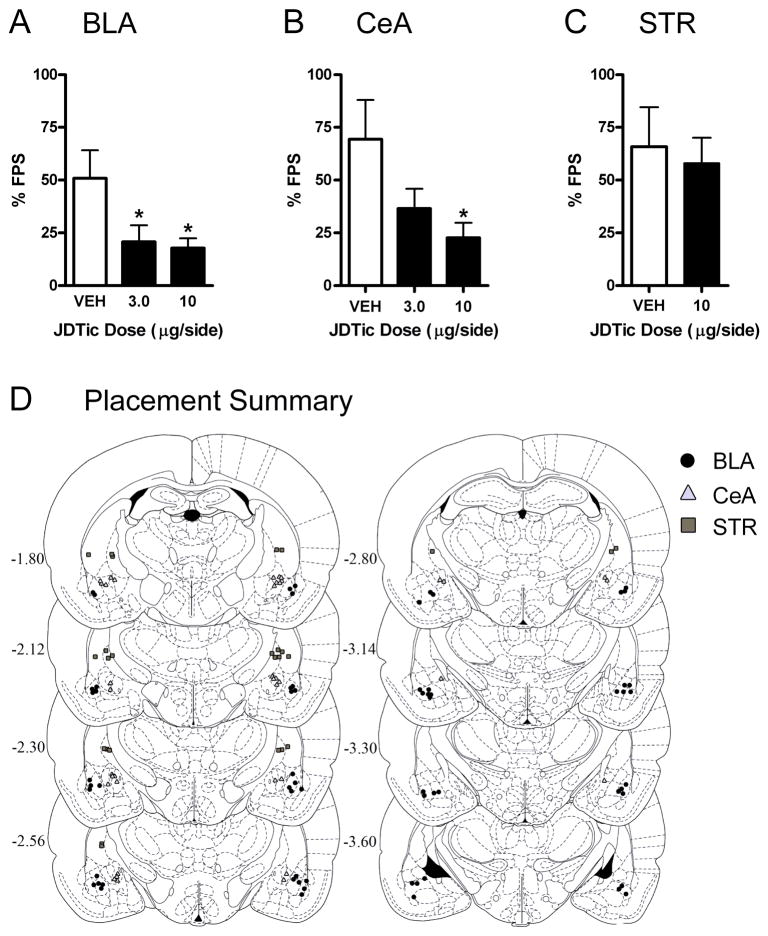
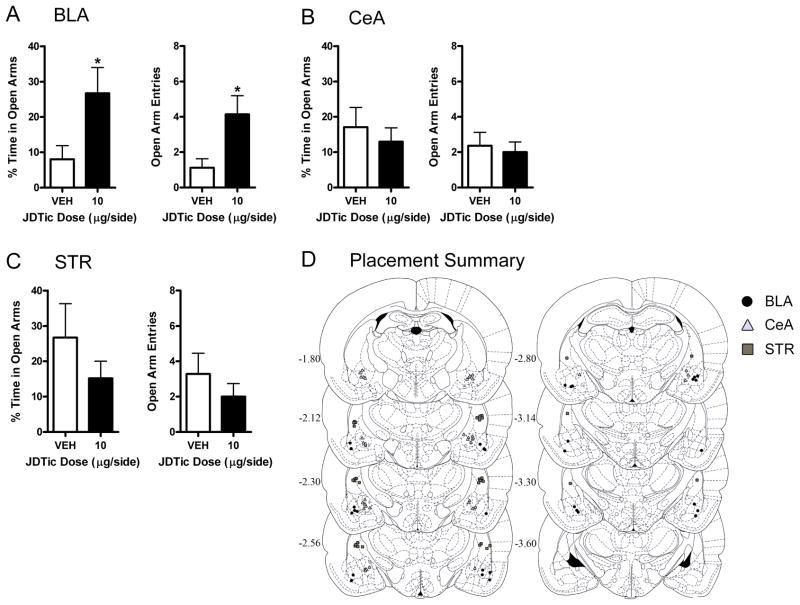
Fear conditioning upregulated KOR mRNA in the BLA by 65% and downregulated it in the striatum by 22%, without affecting KOR levels in the CeA or hippocampus, or dynorphin levels in any region. KOR antagonism in either the BLA or CeA decreased conditioned fear in the fear-potentiated startle paradigm, whereas KOR antagonism in the BLA, but not the CeA, produced anxiolytic-like effects in the elevated plus maze. Effective fear extinction was associated with a 67% reduction in KOR mRNA in the BLA.
These findings suggest that fear conditioning and extinction dynamically regulate KOR expression in the BLA and provide evidence that the BLA and CeA are important neural substrates mediating the anxiolytic-like effects of KOR antagonists in models of fear and anxiety.
κ 阿片受体(KOR)系统有助于应激产生抑郁和厌恶的后果,并与条件性恐惧和焦虑在啮齿动物中的促进有关。在这里,我们试图确定介导 KOR 系统对大鼠恐惧和焦虑影响的神经回路。
我们评估了恐惧条件反射是否会引起杏仁核的基底外侧(BLA)和中央(CeA)核、海马体或纹状体中 KOR 或内源性 KOR 配体强啡肽(dynorphin)mRNA 表达的可塑性。然后,我们评估了 BLA 或 CeA 中 KOR 拮抗剂 JDTic(0-10μg/侧)的微量输注是否会影响条件性恐惧或焦虑的表达。最后,我们检查了恐惧消退是否会引起与恐惧消退质量相关的 KOR mRNA 表达的可塑性。
恐惧条件反射使 BLA 中的 KOR mRNA 增加了 65%,而使纹状体中的 KOR mRNA 减少了 22%,而不影响 CeA 或海马体中的 KOR 水平,也不影响任何区域的强啡肽水平。BLA 或 CeA 中的 KOR 拮抗作用降低了恐惧增强的 startle 范式中的条件性恐惧,而 BLA 中的 KOR 拮抗作用而非 CeA 中的 KOR 拮抗作用产生了高架十字迷宫中的焦虑样效应。有效的恐惧消退与 BLA 中的 KOR mRNA 减少 67%有关。
这些发现表明,恐惧条件反射和消退动态调节 BLA 中的 KOR 表达,并提供证据表明 BLA 和 CeA 是介导 KOR 拮抗剂在恐惧和焦虑模型中产生焦虑样效应的重要神经基质。