Department of Medicine, University of California-San Diego (UCSD), San Diego, California, USA.
Nat Med. 2011 May;17(5):618-22. doi: 10.1038/nm.2332. Epub 2011 May 1.
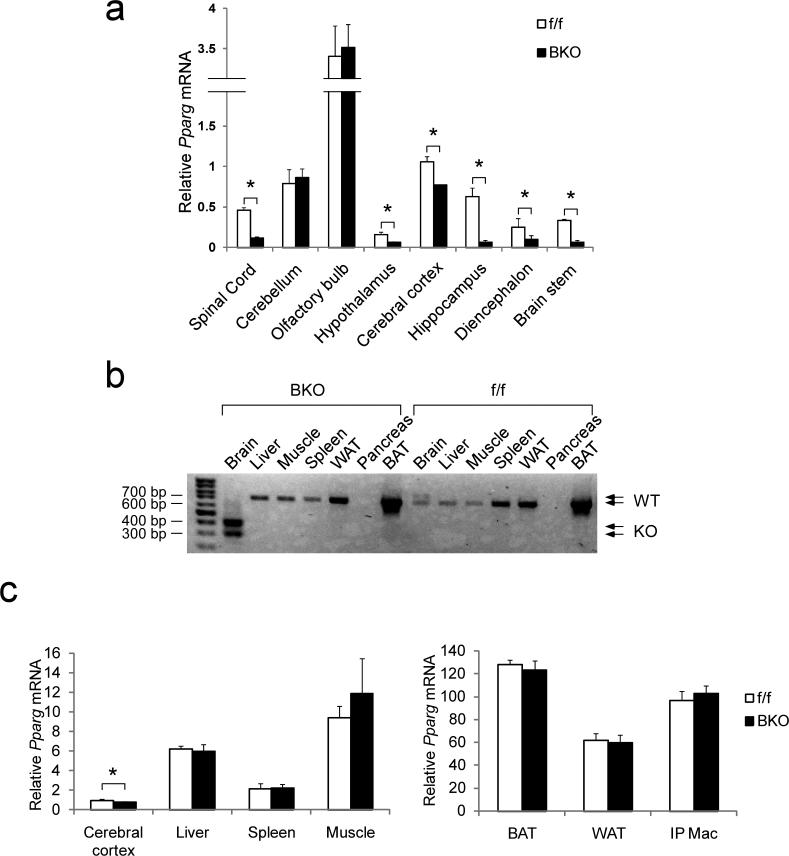
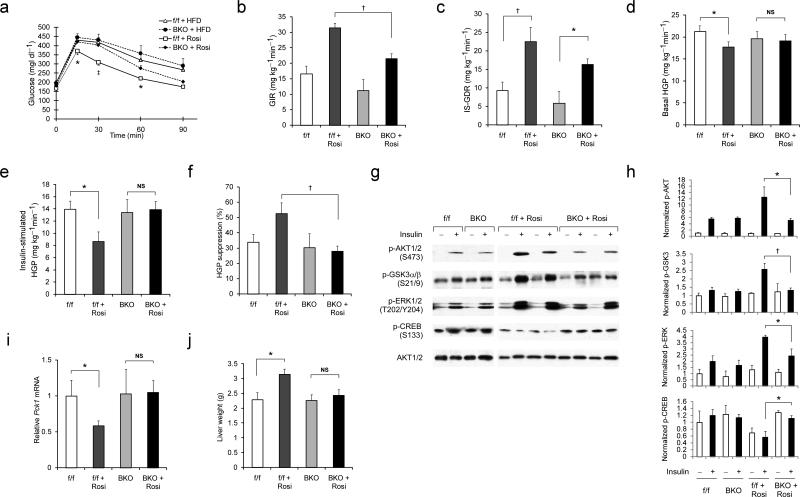
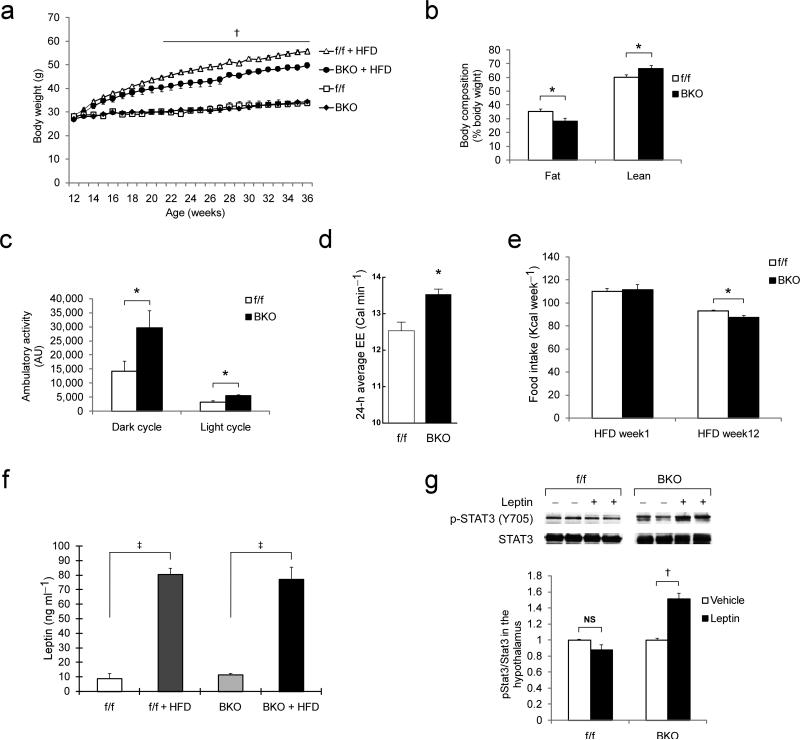
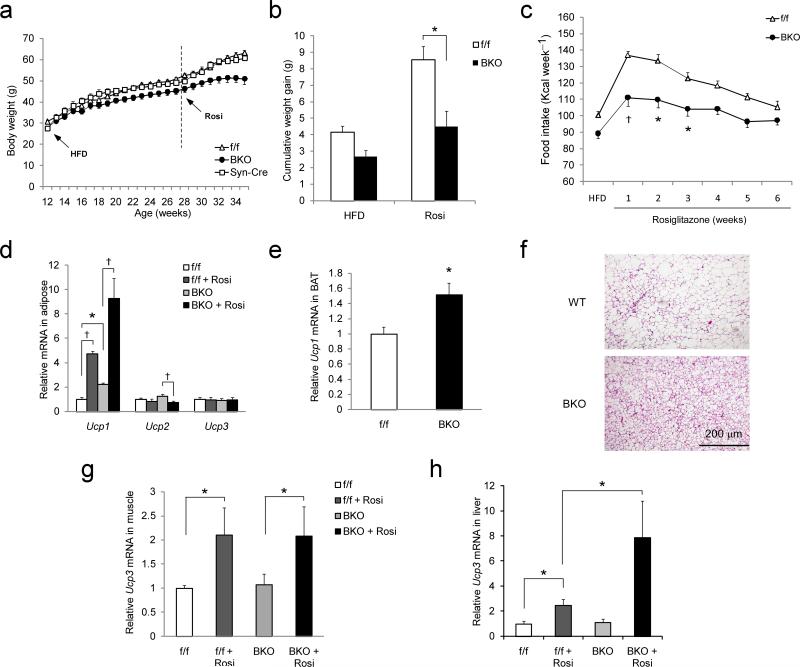
In adipose tissue, muscle, liver and macrophages, signaling by the nuclear receptor peroxisome proliferator-activated receptor-γ (PPAR-γ) is a determinant of insulin sensitivity and this receptor mediates the insulin-sensitizing effects of thiazolidinediones (TZDs). As PPAR-γ is also expressed in neurons, we generated mice with neuron-specific Pparg knockout (Pparg brain knockout (BKO)) to determine whether neuronal PPAR-γ signaling contributes to either weight gain or insulin sensitivity. During high-fat diet (HFD) feeding, food intake was reduced and energy expenditure increased in Pparg-BKO mice compared to Pparg(f/f) mice, resulting in reduced weight gain. Pparg-BKO mice also responded better to leptin administration than Pparg(f/f) mice. When treated with the TZD rosiglitazone, Pparg-BKO mice were resistant to rosiglitazone-induced hyperphagia and weight gain and, relative to rosiglitazone-treated Pparg(f/f) mice, experienced only a marginal improvement in glucose metabolism. Hyperinsulinemic euglycemic clamp studies showed that the increase in hepatic insulin sensitivity induced by rosiglitazone treatment during HFD feeding was completely abolished in Pparg-BKO mice, an effect associated with the failure of rosiglitazone to improve liver insulin receptor signal transduction. We conclude that excess weight gain induced by HFD feeding depends in part on the effect of neuronal PPAR-γ signaling to limit thermogenesis and increase food intake. Neuronal PPAR-γ signaling is also required for the hepatic insulin sensitizing effects of TZDs.
在脂肪组织、肌肉、肝脏和巨噬细胞中,核受体过氧化物酶体增殖物激活受体-γ (PPAR-γ) 的信号转导是胰岛素敏感性的决定因素,该受体介导噻唑烷二酮 (TZDs) 的胰岛素增敏作用。由于 PPAR-γ 也在神经元中表达,我们生成了神经元特异性 Pparg 敲除 (Pparg 脑敲除 (BKO)) 的小鼠,以确定神经元 PPAR-γ 信号是否有助于体重增加或胰岛素敏感性。在高脂肪饮食 (HFD) 喂养期间,与 Pparg(f/f) 小鼠相比,Pparg-BKO 小鼠的食物摄入量减少,能量消耗增加,导致体重增加减少。与 Pparg(f/f) 小鼠相比,Pparg-BKO 小鼠对瘦素的反应也更好。当用 TZD 罗格列酮治疗时,Pparg-BKO 小鼠对罗格列酮诱导的过度摄食和体重增加具有抗性,并且与用罗格列酮治疗的 Pparg(f/f) 小鼠相比,仅对葡萄糖代谢有轻微改善。高胰岛素正葡萄糖钳夹研究表明,在 HFD 喂养期间,罗格列酮治疗诱导的肝胰岛素敏感性增加在 Pparg-BKO 小鼠中完全被消除,这一效应与罗格列酮改善肝胰岛素受体信号转导失败有关。我们得出结论,HFD 喂养引起的体重过度增加部分依赖于神经元 PPAR-γ 信号的作用,以限制产热并增加食物摄入。神经元 PPAR-γ 信号对于 TZDs 的肝胰岛素增敏作用也是必需的。