Department of Human Genetics, University of Chicago, Chicago, Illinois, United States of America.
PLoS Genet. 2011 Apr;7(4):e1001375. doi: 10.1371/journal.pgen.1001375. Epub 2011 Apr 21.
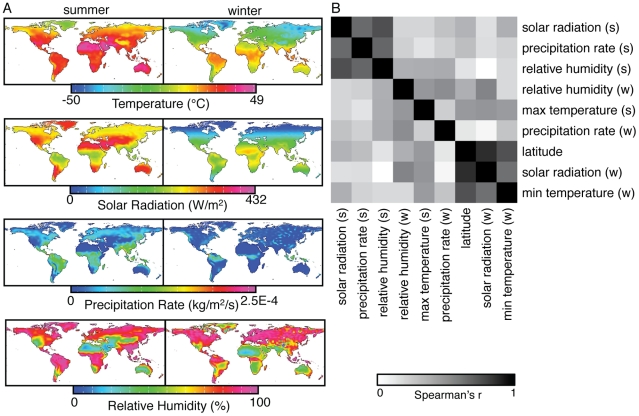
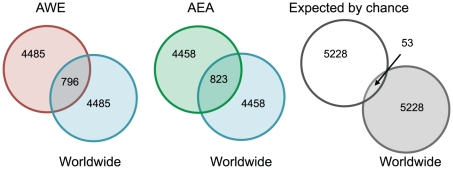
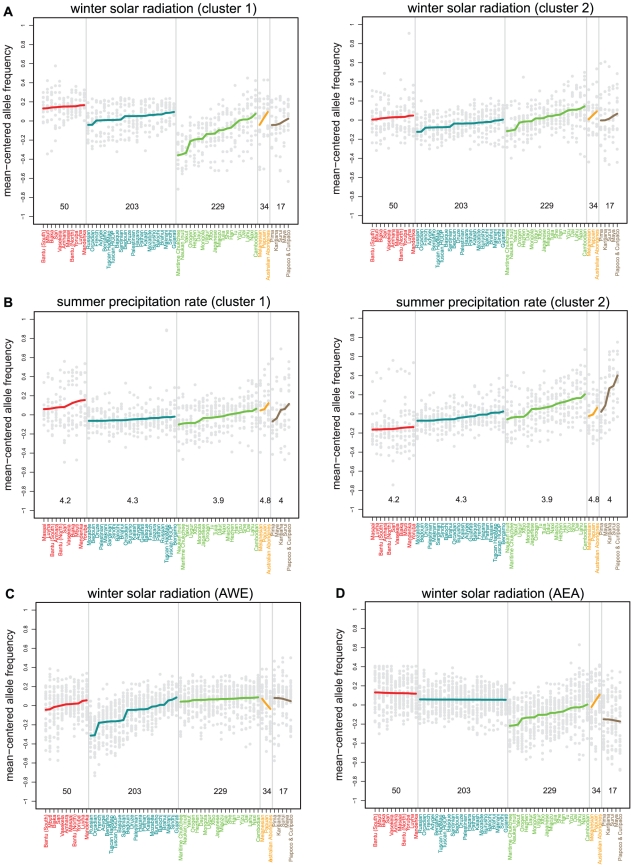
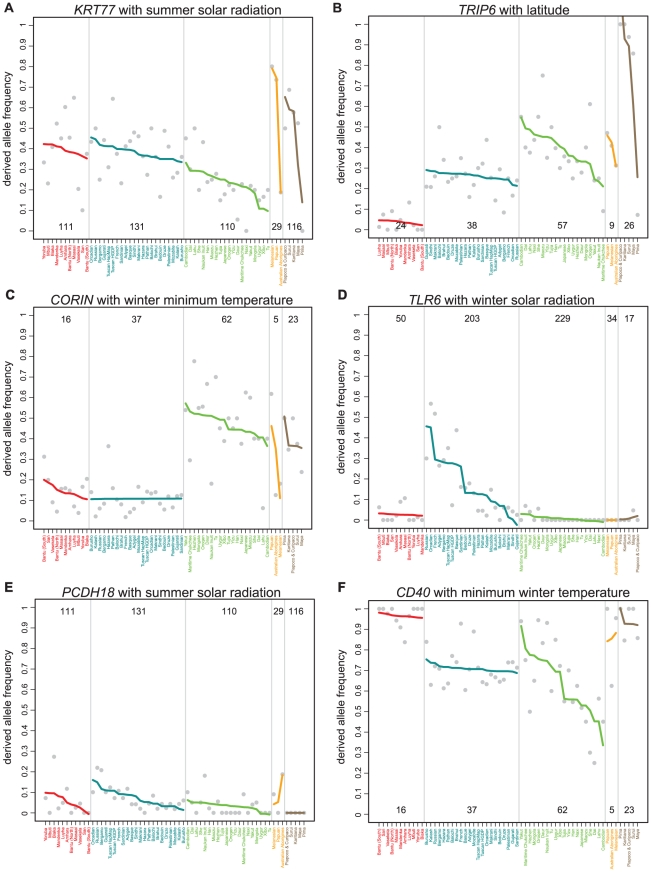
Humans inhabit a remarkably diverse range of environments, and adaptation through natural selection has likely played a central role in the capacity to survive and thrive in extreme climates. Unlike numerous studies that used only population genetic data to search for evidence of selection, here we scan the human genome for selection signals by identifying the SNPs with the strongest correlations between allele frequencies and climate across 61 worldwide populations. We find a striking enrichment of genic and nonsynonymous SNPs relative to non-genic SNPs among those that are strongly correlated with these climate variables. Among the most extreme signals, several overlap with those from GWAS, including SNPs associated with pigmentation and autoimmune diseases. Further, we find an enrichment of strong signals in gene sets related to UV radiation, infection and immunity, and cancer. Our results imply that adaptations to climate shaped the spatial distribution of variation in humans.
人类栖息于范围广泛的多样环境中,自然选择可能在人类适应和繁荣于极端气候的能力中扮演了核心角色。与许多仅使用群体遗传数据来寻找选择证据的研究不同,我们通过鉴定在 61 个人类群体中与气候间存在最强相关性的等位基因频率的 SNP,来在人类基因组中寻找选择信号。我们发现,在与这些气候变量强烈相关的 SNP 中,相对于非基因 SNP,基因 SNP 和非同义 SNP 显著富集。在最极端的信号中,有几个与 GWAS 相关的信号重叠,包括与色素沉着和自身免疫性疾病相关的 SNP。此外,我们还发现与紫外线辐射、感染和免疫以及癌症相关的基因集存在强烈信号的富集。我们的结果表明,对气候的适应塑造了人类变异的空间分布。