Brainard David H, Maloney Laurence T
Department of Psychology, University of Pennsylvania, Pennsylvania, PA, USA.
J Vis. 2011 May 2;11(5):10.1167/11.5.1 1. doi: 10.1167/11.5.1.
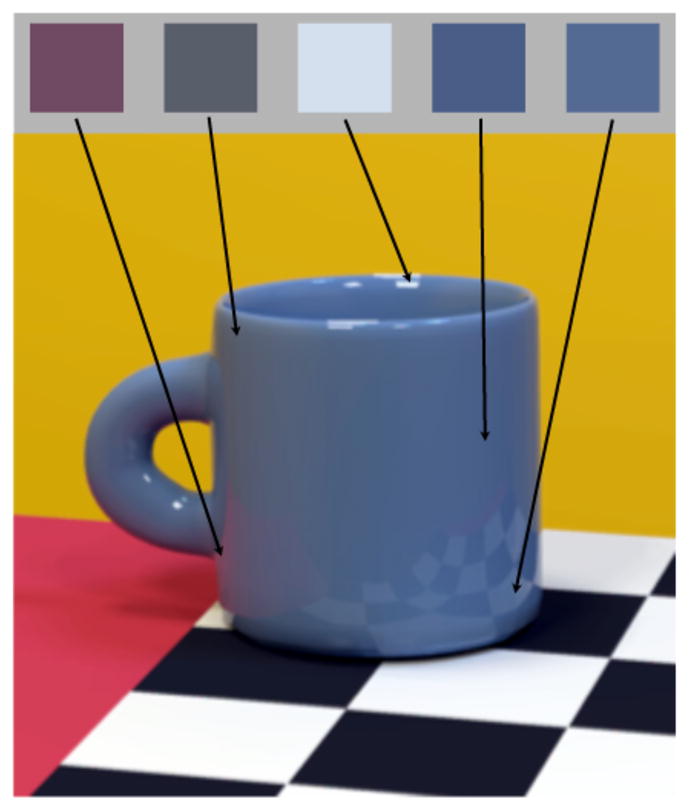
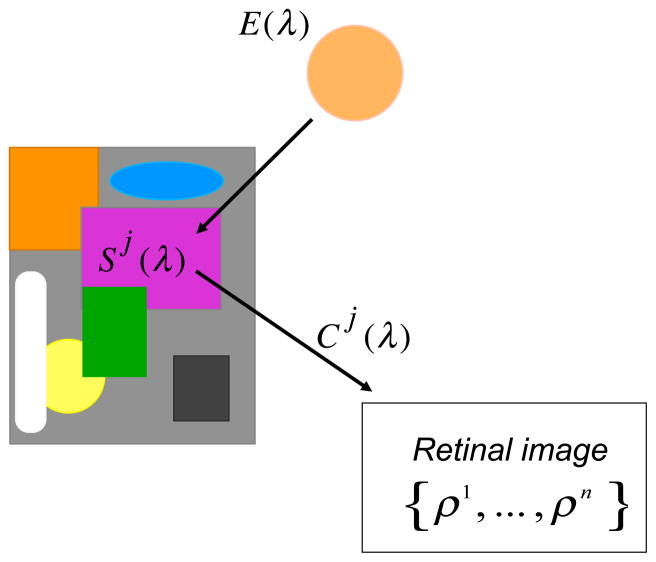
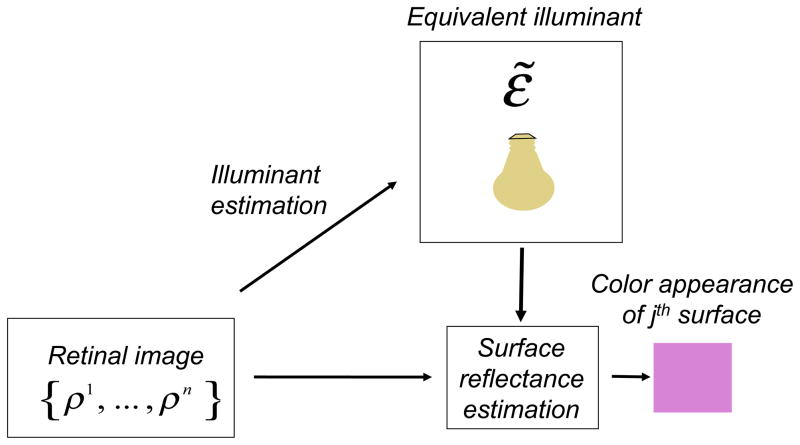
Vision provides information about the properties and identity of objects. The ease with which we perceive object properties belies the difficulty of the underlying information-processing task. In the case of object color, retinal information about object reflectance is confounded with information about the illumination as well as about the object's shape and pose. There is no obvious rule that allows transformation of the retinal image to a color representation that depends primarily on object surface reflectance. Under many circumstances, however, object color appearance is remarkably stable across scenes in which the object is viewed. Here, we review a line of experiments and theory that aim to understand how the visual system stabilizes object color appearance. Our emphasis is on models derived from explicit analysis of the computational problem of estimating the physical properties of illuminants and surfaces from the retinal image, and experiments that test these models. We argue that this approach has considerable promise for allowing generalization from simplified laboratory experiments to richer scenes that more closely approximate natural viewing. We discuss the relation between the work we review and other theoretical approaches available in the literature.
视觉提供有关物体属性和身份的信息。我们感知物体属性的轻松程度掩盖了底层信息处理任务的难度。就物体颜色而言,视网膜上有关物体反射率的信息与有关照明以及物体形状和姿态的信息相互混淆。没有明显的规则可以将视网膜图像转换为主要取决于物体表面反射率的颜色表示。然而,在许多情况下,物体的颜色外观在观看该物体的不同场景中都非常稳定。在这里,我们回顾一系列实验和理论,旨在了解视觉系统如何稳定物体的颜色外观。我们重点关注从对从视网膜图像估计光源和表面物理属性的计算问题进行明确分析得出的模型,以及测试这些模型的实验。我们认为,这种方法对于从简化的实验室实验推广到更接近自然观看的更丰富场景具有相当大的前景。我们讨论了我们所回顾的工作与文献中其他可用理论方法之间的关系。