Department of Engineering, Design and Mathematics, University of the West of England, Bristol, United Kingdom.
PLoS One. 2011 Apr 25;6(4):e18416. doi: 10.1371/journal.pone.0018416.
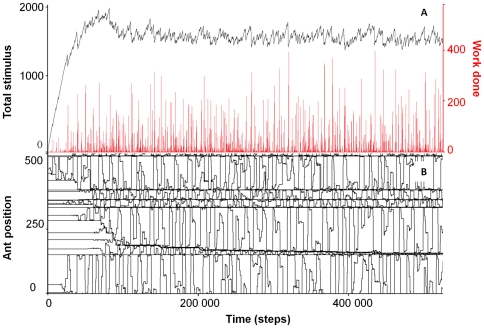
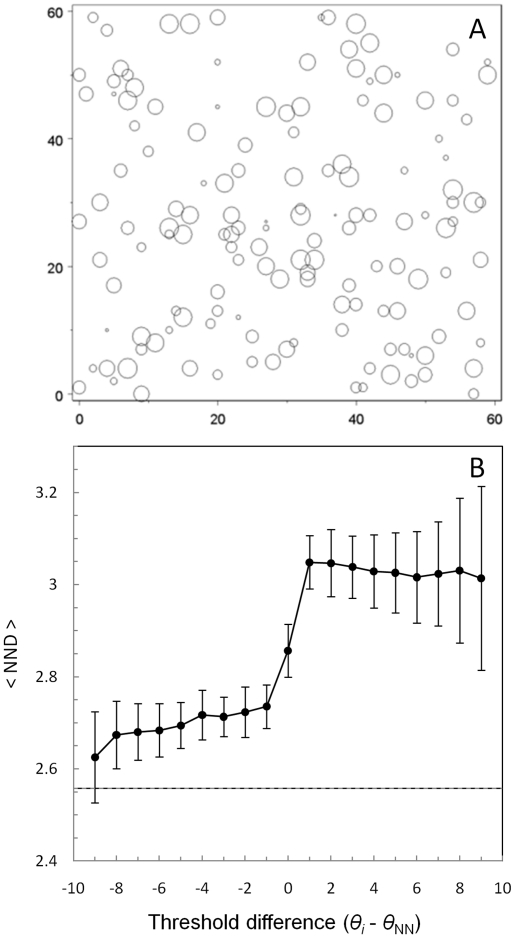
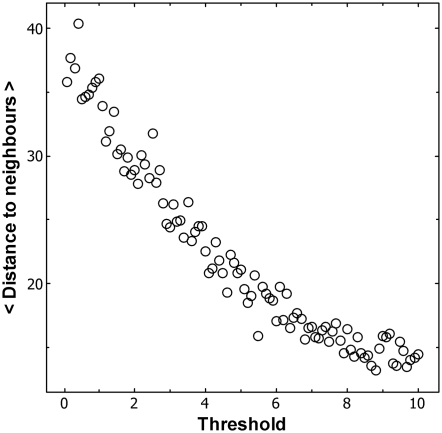
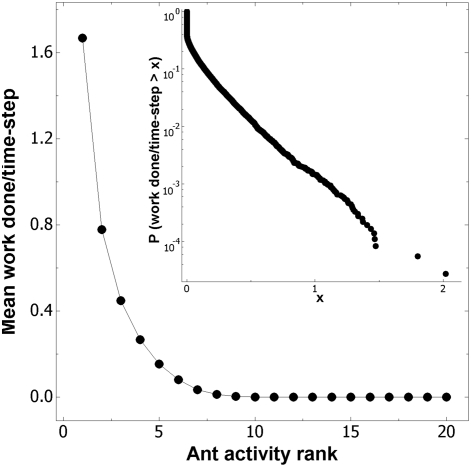
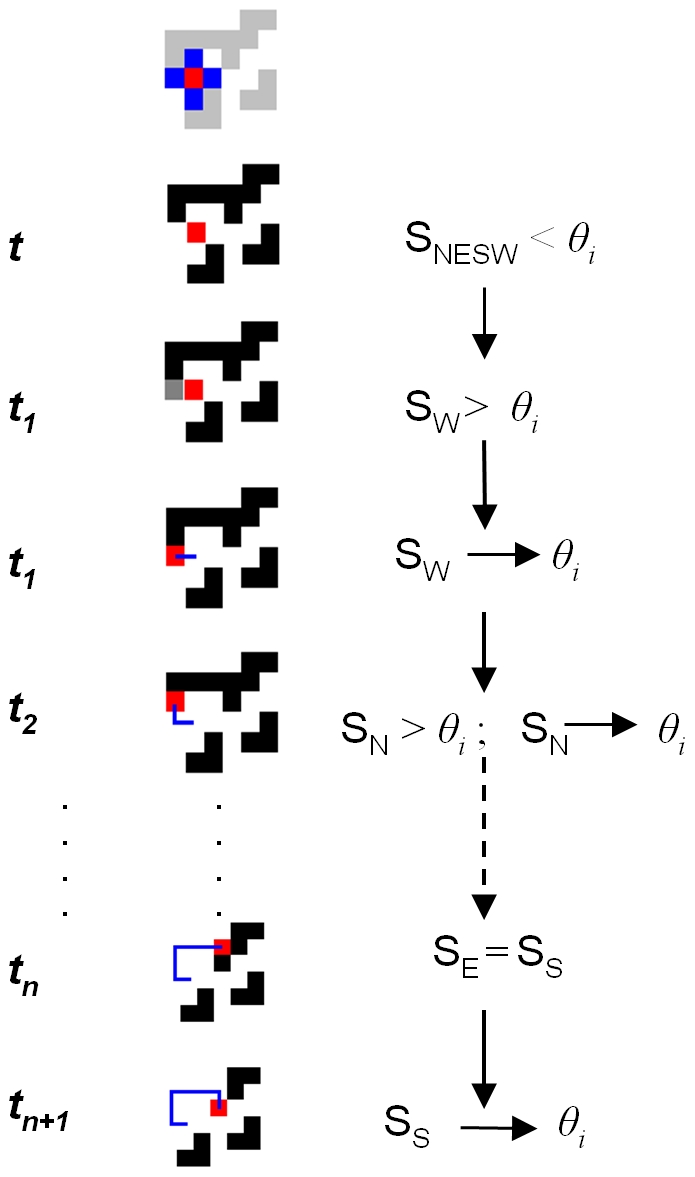
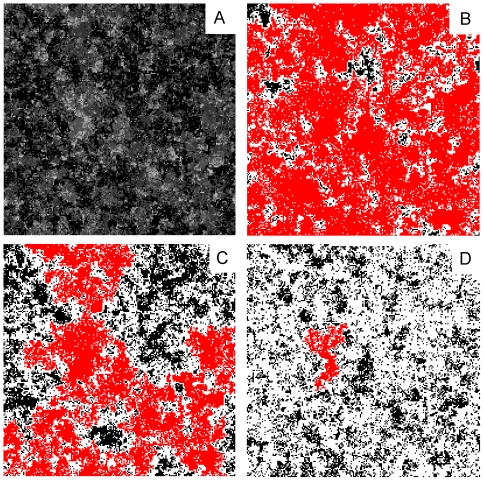
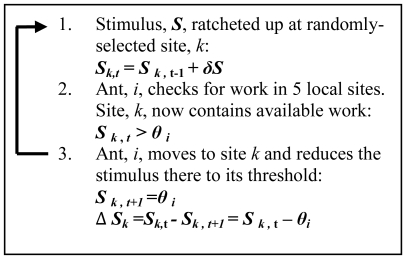
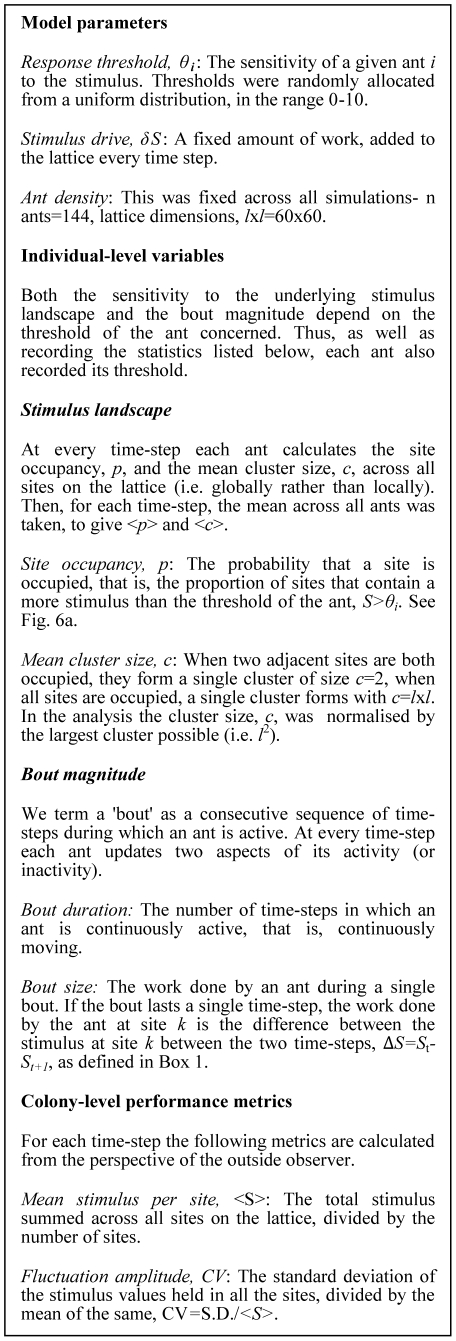
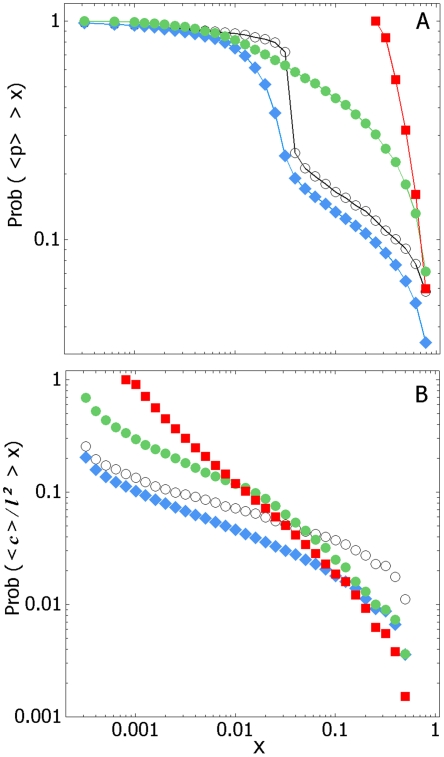
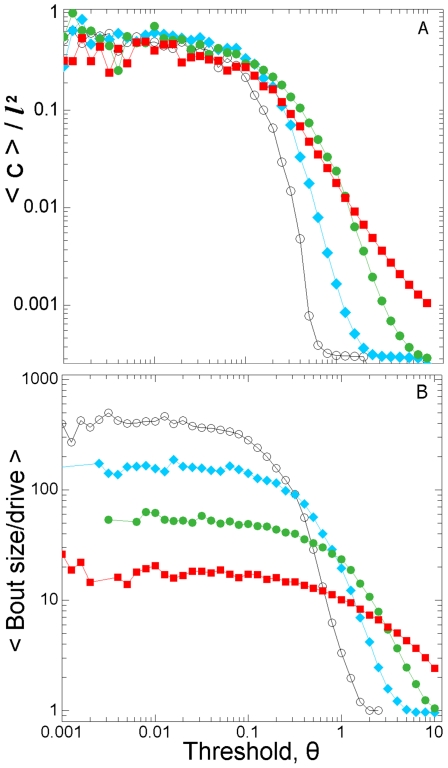
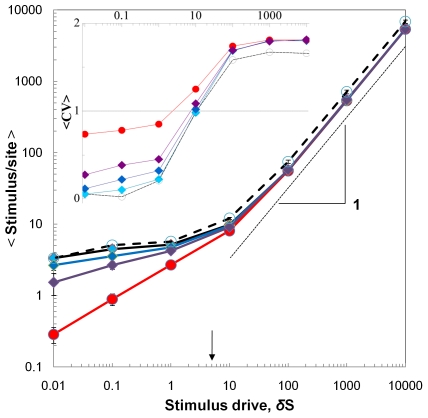
Division of labour (DoL) is a fundamental organisational principle in human societies, within virtual and robotic swarms and at all levels of biological organisation. DoL reaches a pinnacle in the insect societies where the most widely used model is based on variation in response thresholds among individuals, and the assumption that individuals and stimuli are well-mixed. Here, we present a spatially explicit model of DoL. Our model is inspired by Pierre de Gennes' 'Ant in a Labyrinth' which laid the foundations of an entire new field in statistical mechanics. We demonstrate the emergence, even in a simplified one-dimensional model, of a spatial patterning of individuals and a right-skewed activity distribution, both of which are characteristics of division of labour in animal societies. We then show using a two-dimensional model that the work done by an individual within an activity bout is a sigmoidal function of its response threshold. Furthermore, there is an inverse relationship between the overall stimulus level and the skewness of the activity distribution. Therefore, the difference in the amount of work done by two individuals with different thresholds increases as the overall stimulus level decreases. Indeed, spatial fluctuations of task stimuli are minimised at these low stimulus levels. Hence, the more unequally labour is divided amongst individuals, the greater the ability of the colony to maintain homeostasis. Finally, we show that the non-random spatial distribution of individuals within biological and social systems could be caused by indirect (stigmergic) interactions, rather than direct agent-to-agent interactions. Our model links the principle of DoL with principles in the statistical mechanics and provides testable hypotheses for future experiments.
分工(DoL)是人类社会、虚拟和机器人群体以及所有生物组织层次的基本组织原则。分工在昆虫社会中达到了顶峰,其中最广泛使用的模型基于个体之间反应阈值的变化,以及个体和刺激物充分混合的假设。在这里,我们提出了一个分工的空间显式模型。我们的模型受到 Pierre de Gennes 的“迷宫中的蚂蚁”的启发,这为统计力学的一个全新领域奠定了基础。我们展示了即使在简化的一维模型中,个体的空间模式和右偏态活动分布的出现,这两者都是动物社会分工的特征。然后,我们使用二维模型表明,个体在活动爆发期间所做的工作是其反应阈值的 sigmoid 函数。此外,活动分布的偏度与整体刺激水平呈反比关系。因此,两个具有不同阈值的个体所做的工作量之间的差异随着总刺激水平的降低而增加。事实上,在这些低刺激水平下,任务刺激的空间波动最小化。因此,劳动在个体之间分配得越不平等,群体维持体内平衡的能力就越强。最后,我们表明,生物和社会系统中个体的非随机空间分布可能是由间接(印迹)相互作用引起的,而不是直接的代理到代理相互作用。我们的模型将分工的原则与统计力学的原则联系起来,并为未来的实验提供了可测试的假设。